Bunn ICB Twin vs FETCO CBS-2141XTS: Commercial Batch Brewer Comparison
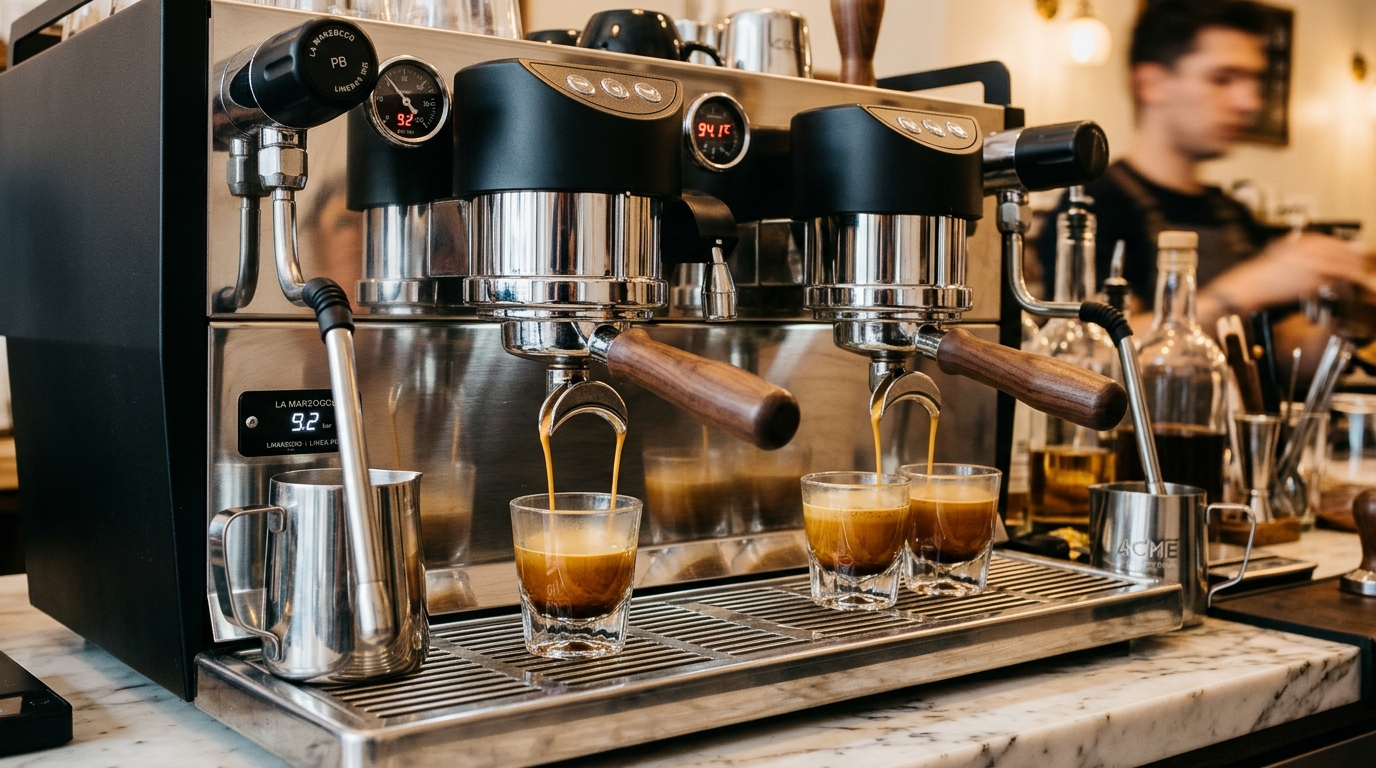
In the specialty coffee industry, shiny multi-boiler espresso machines capture all the social media glory. Yet, when you examine the Profit and Loss statement of an operating cafe, the true financial heavyweight of the business is revealed: batch-brewed drip coffee.
In North America, batch drip coffee accounts for 30% to 45% of total morning transactions. More importantly, while handcrafted espresso drinks carry a Cost of Goods Sold (COGS) of 20% to 35% and tie up barista labor for minutes, a 16oz batch brew carries a direct ingredient cost of under $0.40, sells for $3.75 to $4.50, and takes four seconds to pour from an insulated dispenser. It is an astronomical 90%+ gross profit margin engine.
However, brewing 1.5 gallons of specialty coffee that rivals the clarity and extraction yield of a manual pour-over requires complex thermodynamic engineering. It demands precise water temperature management ($\pm 1^\circ\text{F}$), customizable pulse-brewing algorithms, uniform showerhead hydrology, and laboratory-grade vacuum insulation.
When commercial operators build a high-volume batch brew program, two machines stand alone at the pinnacle of North American hospitality:
- The Bunn ICB Twin (Infusion Coffee Brewer): The Springfield, Illinois industrial benchmark, renowned for its legendary indestructible chassis, widespread parts distribution, and Peak Extraction sprayhead technology.
- The FETCO CBS-2141XTS Extractor Series: The Lake Zurich, Illinois technological innovator, celebrated by third-wave roasters for its patented Cascading Spray Dome (CSD), touchscreen recipe programming, and Luxus thermal dispensers.
In this comprehensive head-to-head engineering guide, we dissect the hydraulic dispersion mechanics, pulse algorithms, thermal decay profiles, and operational realities of the Bunn ICB Twin and FETCO CBS-2141XTS.
1. Technical Specifications Comparison Matrix
+-------------------------------------------------------------------------------+
|         BUNN ICB TWIN VS FETCO CBS-2141XTS TECHNICAL SPECIFICATION MATRIX      |
+-------------------------------------------------------------------------------+
| Feature Parameter               | Bunn ICB Twin (Infusion Series)    | FETCO CBS-2141XTS (Extractor Series)  |
|---------------------------------+------------------------------------+---------------------------------------|
| Brew Head Configuration         | Dual (Twin) 1.5-Gallon Brew Heads  | Dual (Twin) 1.0 - 1.5 Gallon Heads    |
| Internal Water Boiler Tank Size | **11.5 Gallons (43.5 Liters)**     | 9.8 Gallons (37.1 Liters)             |
| Electrical Power Rating         | 120/208V - 240V / 30A (6,000W)     | 120/208V - 240V / 30A (6,100W)        |
| Hot Water Dispensing Faucet     | Included (Standard on front)       | Included (Standard on front)          |
| Sprayhead Dispersion Design     | **Peak Extraction Multi-Stream**   | **Patented Cascading Spray Dome (CSD)**|
| Water Pulse Programming         | Up to 10 Pulses (Infusion Control) | Up to 12 Pulses (Touchscreen Algorithm)|
| Automatic Bypass Solenoid       | Digital Variable Bypass (0 - 40%)  | Digital Variable Bypass (0 - 40%)     |
| User Interface & Display        | Digital Multi-Button LCD Display   | **Full-Color Capacitive Touchscreen** |
| Recipe Cloning Method           | USB Port / SmartWAVE Interface     | **SD Card / Screen Transfer**         |
| Thermal Server Ecosystem        | Bunn ThermoFresh 1.5-Gal Servers   | **FETCO Luxus L4D-15 1.5-Gal Servers** |
| Physical Dimensions (W x D x H) | 20.2" x 22.3" x 32.9"              | 19.8" x 20.5" x 34.4"                 |
| Total Weight (Dry / Full)       | 77 lbs (Dry) / 173 lbs (Operating) | 71 lbs (Dry) / 152 lbs (Operating)    |
| Approx. Retail Price (USD)      | \$3,850 - \$4,350                  | \$4,100 - \$4,650                     |
+-------------------------------------------------------------------------------+
2. Sprayhead Hydrology: Cascading Spray Dome (CSD) vs Peak Extraction
The fundamental technical challenge of batch brewing is uniform wetting. You are pouring up to 1.5 gallons (5.7 liters) of water through a massive bed containing 250 to 350 grams of ground coffee in a 13-inch wide basket. If water streams down the center, the outer grounds remain completely dry and un-extracted while the center channels into astringent bitterness.
+-------------------------------------------------------------------------+
|                  SPRAYHEAD DISPERSION HYDROLOGY COMPARISON              |
+-------------------------------------------------------------------------+
|                                                                         |
|  [FETCO CASCADING SPRAY DOME (CSD)]    [BUNN PEAK EXTRACTION SPRAYHEAD] |
|                                                                         |
|             | Water Inlet                         | Water Inlet         |
|             v                                     v                     |
|     +---------------+                     +---------------+             |
|     | Dual Reservoir|                     | Directional   |             |
|     | Siphon Basin  |                     | Manifold Head |             |
|     +---------------+                     +---------------+             |
|      /  |   |   |  \                       \  |  |  |  /                |
|     v   v   v   v   v                       v  v  v  v  v               |
|                                                                         |
|  * Water overflows internal weir       * 17 Laser-cut micro-orifices    |
|  * Zero pressure nozzles; gravity drip * Multi-angle cross-flow pattern |
|  * Cannot clog with mineral scale!     * Silicone tips shed limescale   |
|  * 100% Edge-to-edge bed coverage      * Deep kinetic penetration       |
|                                                                         |
+-------------------------------------------------------------------------+
1. FETCO’s Patented Cascading Spray Dome (CSD)
Traditional sprayheads force water through tiny drilled holes. In hard-water environments, calcium carbonate crystals accumulate inside these holes within 30 days, clogging half the nozzles and deflecting water jets sideways.
FETCO eliminated tiny sprayhead holes entirely:
- Water pumps upward into an open, dual-chambered cascading dome.
- As the chamber fills, water overflows smoothly across a scalloped perimeter weir, creating a continuous, gentle, rain-like curtain across the entire diameter of the coffee bed.
- The Scale Immunity Advantage: Because the CSD operates on gravity overflow rather than pressurized micro-orifices, mineral scale cannot clog it. In high-volume cafes with challenging municipal water, the CSD delivers unmatched long-term extraction uniformity.
2. Bunn’s Peak Extraction Multi-Stream Sprayhead
Bunn spent four years redesigning its sprayhead technology to create the Peak Extraction Sprayhead:
- Features 17 laser-drilled orifices arranged in a concentric geometric pattern.
- Orifices are angled at varying trajectories (divergent angles) to ensure that incoming water penetrates deep into the center of the bed while simultaneously washing down the outer perimeter walls.
- Orifices feature flexible food-grade silicone tips that naturally flex under water pressure pulses, mechanically popping off microscopic limescale flakes before they can bond to the metal.
3. Extraction Programming: Pulse Algorithms, Pre-Infusion & Bypass
Both the Bunn ICB Twin and FETCO CBS-2141XTS are fully programmable commercial extraction computers. Mastering their pulse parameters allows you to dial in batch coffee with the mathematical precision of a barista competition routine.
+-------------------------------------------------------------------------+
|                  COMMERCIAL BATCH PULSE-BREWING TIMELINE                |
+-------------------------------------------------------------------------+
|                                                                         |
|  Water Flow                                                             |
|  Rate (ml/s)                                                            |
|                                                                         |
|  40 |    [BLOOM]       [PULSE 1]     [PULSE 2]     [PULSE 3]    [BYPASS]  |
|     |   +-------+      +-------+     +-------+     +-------+    +------+  |
|  20 |   | 15s ON|      | 10s ON|     | 10s ON|     | 10s ON|    |Direct|  |
|     |   |       |      |       |     |       |     |       |    |to Urn|  |
|   0 +---+-------+------+-------+-----+-------+-----+-------+----+------+  |
|        0s      35s    45s     60s   70s     85s   95s    110s  240s  300s|
|                 |              |             |              |             |
|              [PAUSE]        [PAUSE]       [PAUSE]        [PAUSE]          |
|              (20s Off)      (15s Off)     (15s Off)      (15s Off)        |
|                                                                         |
+-------------------------------------------------------------------------+
The Three Critical Extraction Variables
- Pre-Infusion / Bloom Phase: The initial pulse wets the dry coffee bed with approximately 10% to 15% of the total water recipe, then pauses for 20 to 45 seconds. This allows fresh roasted coffee to degas carbon dioxide ($CO_2$) without washing away fine solubles, preventing the coffee bed from floating and channeling.
- Pulse-On / Pulse-Off Duty Cycles: By breaking the brew cycle into 6 to 12 distinct pulses, the water level inside the brew basket rises to submerge the bed, then drains down slightly. This hydraulic pumping action creates gentle inter-particle turbulence, maximizing soluble extraction yield (19.5% to 21.0% EY) without astringency.
- Automated Percentage Water Bypass:
Both machines feature an independent solenoid valve that routes hot water directly into the dispenser without passing through the coffee grounds.
- Why use bypass? If you are brewing a delicate Ethiopian washed coffee, passing 1.5 gallons of water through the puck will over-extract bitter lignin compounds during the final 90 seconds. By setting a 15% bypass, you brew a super-concentrated, pristine bed with 1.27 gallons, and dilute it with 0.23 gallons of pure bypass water directly in the urn, achieving perfect 1.35% TDS with zero bitterness.
Programming Interface: Touchscreen (FETCO) vs Push-Button (Bunn)
- FETCO Touchscreen Extractor: The full-color capacitive touchscreen interface is a joy to use. Baristas visually adjust pre-infusion time, pulse count, and bypass percentage on a slider screen, saving up to 8 customizable recipes per brew head (e.g., “Full Batch Dark Roast”, “Half Batch Ethiopian”, “Cold Brew Drip”).
- Bunn ICB Infusion Series: Relies on a traditional multi-button digital LCD screen. While slightly more utilitarian to navigate during initial setup, it is completely impervious to wet barista hands and can be locked with a digital passcode to prevent staff from accidentally altering recipes.
4. Thermal Retention & Server Ergonomics: Luxus vs ThermoFresh
A batch brewer can brew an extraordinary pot of coffee, but if the thermal server fails to retain heat, that coffee is ruined within 45 minutes.
+-------------------------------------------------------------------------+
|                  4-HOUR THERMAL DISPENSER TEMPERATURE DECAY             |
+-------------------------------------------------------------------------+
|                                                                         |
|  Holding Temperature (°F)                                               |
|                                                                         |
|  200°F |                                                                |
|        | === (Fresh Brew Exits @ 195°F)                                 |
|  190°F |       \                                                        |
|        |        '--. FETCO Luxus L4D-15 (182°F @ 4 Hours)               |
|  180°F |            '-----------------------------------------.         |
|        |        .--. Bunn ThermoFresh TF (179°F @ 4 Hours)    |         |
|  170°F | ......'..............................................|.......  |
|        |  (175°F Minimum SCA Serving Standard Threshold)     |         |
|  160°F |                                                      '---.     |
|        |                                           Budget Glass Server  |
|  150°F |                                           (Drops to 145°F)     |
|        +---------------+---------------+---------------+-------------   |
|        Hour 0          Hour 1          Hour 2          Hour 4           |
|                                                                         |
+-------------------------------------------------------------------------+
1. FETCO Luxus L4D-15 Thermal Dispensers
The FETCO Luxus line is widely considered the gold standard in commercial thermal engineering:
- Vacuum Insulation: Dual-walled stainless steel chamber with high-vacuum evacuation. Holds coffee above 180°F for over four hours with less than 3.5°F thermal loss per hour.
- Digital Freshness Timer Display: The front face features an integrated digital freshness gauge that illuminates green for the first 60 minutes, yellow at 90 minutes, and flashes red when coffee reaches 120 minutes, informing staff when an urn has expired.
- Funnel-Action Base: The bottom interior is precision-sloped toward the center faucet, dispensing 99.5% of the brewed coffee with virtually zero stale dregs left behind.
2. Bunn ThermoFresh (TF) 1.5-Gallon Dispensers
The Bunn ThermoFresh is a rugged, nearly indestructible commercial dispenser:
- Mechanical Sight Gauge: Features a clear glass sight tube allowing baristas to visually see remaining coffee volume from across the cafe at a glance.
- Fast-Flow Faucet: Dispenses a 16oz cup in under 2.5 seconds, making it ideal for self-serve stations in high-volume breakfast cafes.
- The Tradeoff: The external mechanical sight glass tube acts as a small uninsulated thermal radiator; coffee inside the sight tube cools faster than the core tank, causing slightly higher overall heat loss over 4 hours compared to the fully sealed Luxus.
5. Maintenance, Scale Resistance & Total Cost of Ownership (TCO)
+-------------------------------------------------------------------------------+
|         MAINTENANCE & RELIABILITY COMPARISON MATRIX                           |
+-------------------------------------------------------------------------------+
| Maintenance Parameter           | Bunn ICB Twin                      | FETCO CBS-2141XTS                     |
|---------------------------------+------------------------------------+---------------------------------------|
| Susceptibility to Scale Clogging| Low (Silicone Peak Sprayhead tips) | **Virtually Zero (CSD Gravity Dome)** |
| Internal Boiler Access          | Top panel unbolts for tank clean   | Full-access top lid for descaling     |
| Heating Element Durability      | Heavy-duty Incoloy elements        | High-grade stainless alloy elements   |
| Spare Parts Availability        | **Ubiquitous (Any US supply house)**| Excellent (Major regional networks)   |
| Technician Familiarity          | **100% of US technicians know Bunn**| 95% of specialty technicians know FETCO|
| 5-Year Maintenance Cost Basis   | \$650 (Solenoids + gaskets)        | \$750 (Solenoids + touchscreens)      |
+-------------------------------------------------------------------------------+
6. The Final Buying Verdict: Which Batch Brewer Should You Choose?
+-------------------------------------------------------------------------------+
|                      FINAL SELECTION DECISION FRAMEWORK                       |
+-------------------------------------------------------------------------------+
| Cafe Operating Profile          | Recommended Batch Brewer | Core Decision Rationale                           |
|---------------------------------+--------------------------+---------------------------------------------------|
| The High-Volume Third-Wave      | **FETCO CBS-2141XTS**    | Patented Cascading Spray Dome provides unmatched  |
| Specialty Roaster               |                          | bed saturation; Luxus digital freshness timer     |
| The Bustling Multi-Unit Urban   | **Bunn ICB Twin**        | Massive 11.5-gal boiler tank recovers instantly;  |
| Commuter / Breakfast Cafe       |                          | indestructible hardware with nationwide parts     |
| The Challenging Water / High-   | **FETCO CBS-2141XTS**    | Gravity overflow CSD sprayhead will never clog    |
| Mineral Municipal Grid Location |                          | with scale; touchscreen simplifies recipe training|
| The Self-Serve Hotel / Corporate| **Bunn ICB Twin**        | Rapid-flow faucets, visible sight glass gauges,   |
| Dining Activation               |                          | simple multi-button operation                     |
+-------------------------------------------------------------------------------+
Both the Bunn ICB Twin and FETCO CBS-2141XTS represent world-class commercial engineering. By pairing FETCO’s Cascading Spray Dome with light-roast specialty origins, or utilizing Bunn’s massive 11.5-gallon water capacity for high-velocity commuter rushes, you guarantee that your highest-margin beverage is extracted with flawless consistency every single morning.
Frequently Asked Technical Questions
Which commercial batch brewer is better for specialty coffee: Bunn or FETCO?
Both machines dominate the North American commercial specialty coffee landscape. FETCO (specifically the CBS-2141XTS / 2151XTS series) is generally favored by progressive third-wave roasters for its patented Cascading Spray Dome (CSD), intuitive touchscreen recipe control, and superior thermal insulation in Luxus dispensers. Bunn ICB Twin (Infusion Series) is the legendary industry standard for commercial bulletproof durability, ubiquitous nationwide parts availability, and advanced Peak Extraction multi-stream sprayheads.
How does pulse brewing improve commercial batch coffee extraction?
Traditional commercial coffee makers dump water in a continuous stream, causing localized channeling through the center of the bed and overflowing the basket. Pulse brewing cycles the hot water delivery on and off in programmed pulses (e.g., 6 pulses of 12 seconds on, 15 seconds off). This allows the water level to rise and gently fall, maintaining ideal bed turbulence, ensuring uniform extraction across the entire 13x5 inch brew basket, and boosting extraction yields to 19% to 21% without bitterness.
What is an automated bypass valve on a commercial batch brewer?
A water bypass valve is a secondary electronic solenoid that routes a programmed percentage of hot water (typically 10% to 25%) directly into the thermal server, bypassing the coffee grounds entirely. This allows baristas to brew a concentrated coffee bed to maximize solubles, while automatically diluting the beverage to optimal TDS (1.25% to 1.40%) in the dispenser, shortening overall brew cycle times.
Why should commercial coffee shops never use heated burner plates for batch coffee?
Glass carafes on heated electric burner plates continuously cook coffee at high temperatures (exceeding 195°F), causing chlorogenic acids to degrade into harsh quinic acid within 15 minutes. This creates a bitter, burnt, acrid flavor. High-end specialty coffee shops exclusively use vacuum-insulated stainless steel thermal dispensers (such as FETCO Luxus or Bunn ThermoFresh), which hold coffee at perfect serving temperatures (175°F to 185°F) for up to 4 hours without external heat.
What electrical circuit is required for a commercial twin batch brewer?
A commercial twin (dual-head) batch brewer (brewing two 1.5-gallon batches simultaneously) requires a dedicated 120/208V or 120/240V single-phase, 30-Amp or 50-Amp electrical circuit. Peak power draw ranges between 6,000 and 7,500 Watts to maintain rapid recovery in 6-to-11-gallon stainless water tanks during morning rushes.