Commercial Coffee Water Filtration Guide: RO vs BWT (2026)
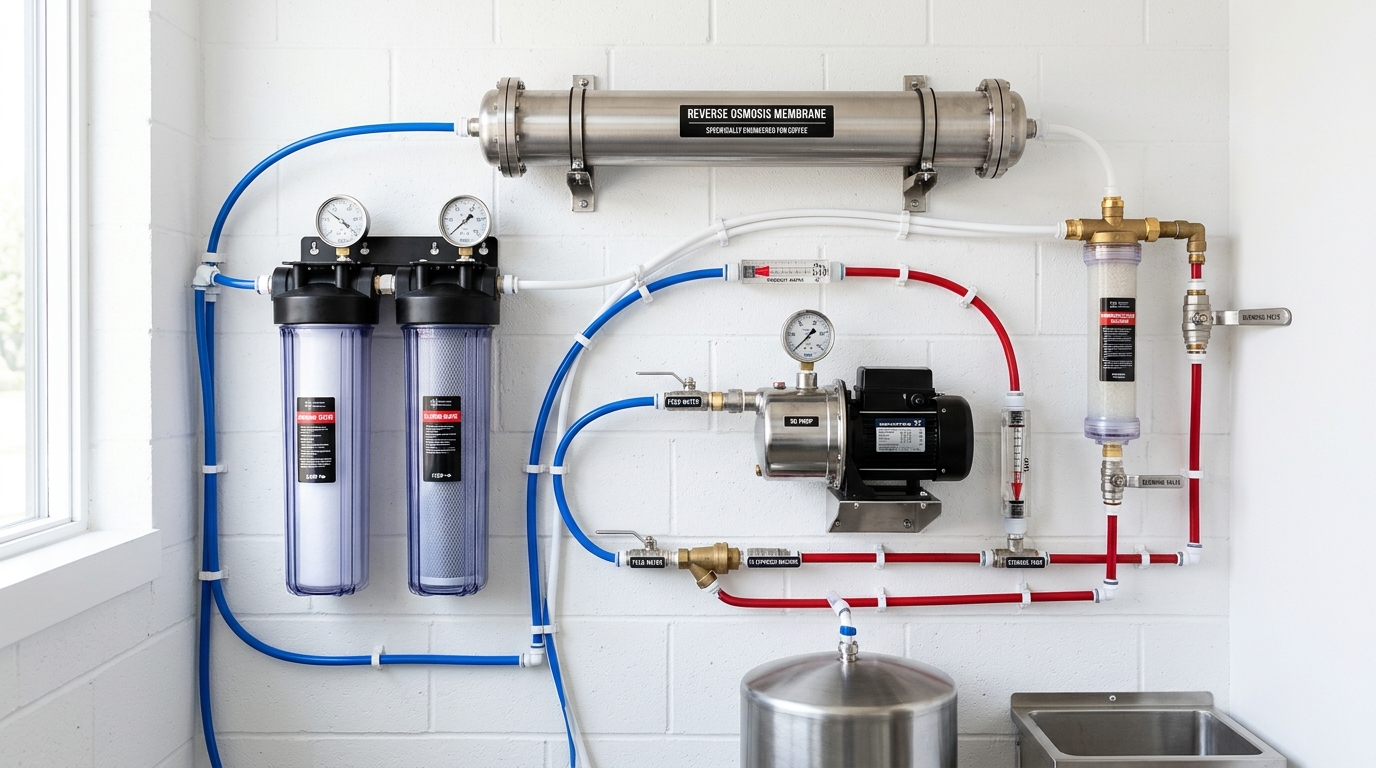
Ask any master commercial espresso technician what causes over 70% of machine breakdowns, and the answer is always the same: poor water quality.
Cafe owners will happily invest $18,000 in a hand-crafted Italian espresso machine and $3,500 in high-speed grinders, yet attempt to feed their equipment raw municipal tap water or an inexpensive under-sink carbon filter designed only for taste and odor.
Within six months, the consequences of this mistake become painfully evident:
- Limescale Incrustation: Heating elements become encrusted in thick calcium carbonate rock, forcing the elements to run 30% hotter to transfer heat, ultimately fracturing the sheath and shorting out the electrical mainboard.
- Flow Restrictor (Gicleur) Clogging: Modern commercial saturated groupheads rely on microscopic ruby or stainless steel restrictors measuring just 0.6mm to 0.8mm in diameter. A single flake of dislodged scale will plug the orifice, completely shutting down that grouphead during a Saturday morning rush.
- Chloride Pitting Corrosion: In coastal cities or regions using chloraminated municipal water, elevated chloride levels ($>30\text{ ppm}$) attack 304 and 316-grade stainless steel boilers from the inside out, causing microscopic pinhole leaks that cannot be welded or repaired.
This technical guide breaks down the chemical dynamics of water for specialty coffee, outlines the official Specialty Coffee Association (SCA) standards, and provides an engineering comparison between Reverse Osmosis (RO) with Precision Remineralization and Ion-Exchange Decarbonizing Filter Cartridges.
1. Coffee Water Chemistry: The Two Opposing Battles
Commercial water treatment for coffee requires managing a delicate thermodynamic tightrope between two catastrophic failure states: Scaling and Corrosion.
+-----------------------------------------------------------------------+
|                 THE WATER TREATMENT OPERATING WINDOW                  |
|                                                                       |
|  CORROSIVE REGION                 OPTIMAL SCA ZONE     SCALING REGION |
|  [TDS < 50 ppm]                   [TDS 75-175 ppm]     [TDS > 250 ppm]|
|  [Alkalinity < 30 ppm]            [Hardness 50-125]    [Hardness >175]|
|  [Chlorides > 30 ppm]                                                 |
|         <------------------------------+----------------------------> |
|         |                              |                            | |
|         v                              v                            v |
|  Eats copper pipes &              Ideal extraction,    Plugs 0.6mm    |
|  destroys stainless boilers       crisp acidity, zero  gicleurs, burns|
|  via acid pitting                 scale buildup        heating coils  |
+-----------------------------------------------------------------------+
1. Hardness (Calcium & Magnesium): The Scale Builders
Hardness refers to dissolved multivalent metallic cations, primarily calcium ($Ca^{2+}$) and magnesium ($Mg^{2+}$). While these minerals are essential for bonding with the volatile flavor compounds in roasted coffee during extraction, they have an unfortunate chemical characteristic known as retrograde solubility: Unlike sugar or salt, calcium carbonate becomes less soluble as water temperature rises. When cold water hits a 255°F commercial steam boiler, the calcium drops out of solution and crystallizes as solid calcium carbonate ($CaCO_3$) scale directly on the hottest surface in the boiler—the heating element.
2. Alkalinity (Carbonate & Bicarbonate): The Chemical Buffer
Alkalinity is the measure of water’s capacity to neutralize acids ($HCO_3^-$ and $CO_3^{2-}$). If alkalinity is too high ($>100\text{ ppm}$), it chemically neutralizes the bright, pleasant fruit acids in specialty coffees, rendering a floral washed Ethiopian coffee flat, chalky, and lifeless. If alkalinity is too low ($<30\text{ ppm}$), water lacks the buffer capacity to prevent rapid pH drops, allowing acidic coffee oils to corrode copper boiler plumbing.
2. SCA Water Quality Target Standards vs. Municipal Reality
The following matrix compares typical untreated municipal tap water across North American metropolitan areas against official Specialty Coffee Association (SCA) technical targets:
| Chemical Parameter | SCA Target Standard | Acceptable Operational Band | Typical Untreated City Water (e.g., Dallas, Chicago) | Impact on Coffee & Machinery |
|---|---|---|---|---|
| Total Dissolved Solids (TDS) | 150 ppm | 75 – 250 ppm | 280 – 550 ppm | High TDS mutes extraction; Low TDS yields sour, hollow cups |
| Total Calcium Hardness | 68 ppm CaCO3 | 50 – 175 ppm CaCO3 | 180 – 350 ppm CaCO3 | Causes rapid boiler scale; requires frequent acid descaling |
| Total Alkalinity | 40 ppm CaCO3 | 40 – 75 ppm CaCO3 | 120 – 220 ppm CaCO3 | High buffer mutes origin acidity and delicate fruity notes |
| pH Range | 7.0 | 6.5 – 8.0 | 7.8 – 8.8 | Alkaline water slows extraction rate; acidic water corrodes metals |
| Sodium ($Na^+$) | 10 ppm | < 30 ppm | 40 – 120 ppm | Excess sodium imparts salty, synthetic mouthfeel |
| Chlorine / Chloramine | 0.0 mg/L | 0.0 mg/L | 1.5 – 4.0 mg/L | Imparts pungent chemical bleach odor; destroys silicone seals |
| Chloride ($Cl^-$) | 0.0 mg/L | < 30 mg/L | 35 – 95 mg/L | EXTREME DANGER: Causes irreversible pitting in stainless boilers |
3. Technology Shootout: Reverse Osmosis (RO) vs. Ion-Exchange Cartridges
To achieve compliant water, commercial cafes utilize one of two primary filtration architectures.
+-----------------------------------------------------------------------+
|               COMMERCIAL WATER TREATMENT ARCHITECTURES                |
|                                                                       |
|  SYSTEM A: MULTI-STAGE REVERSE OSMOSIS (RO) WITH BLENDING VALVE       |
|  [City Water] ---> [Sediment/Carbon] ---> [RO High-Pressure Membrane] |
|                                                    |                  |
|        +-------------------------------------------+                  |
|        |                                                              |
|        v (99% Pure Permeate @ 10 ppm)                                 |
|  [Remineralization Mineral Cartridge] <--- [Adjustable Bypass Blend]   |
|        |                                                              |
|        v                                                              |
|  [Pressurized Storage Tank (15-30 Gal)] ===> 45-60 PSI to Cafe Bar   |
|                                                                       |
|  SYSTEM B: BWT BESTMAX PREMIUM (ION-EXCHANGE BLENDING HEAD)           |
|  [City Water] ---> [Carbon Pre-filter] ---> [Weak-Acid Cation Resin]  |
|                                                    |                  |
|  Replaces Ca2+ and Mg2+ with beneficial H+ and Mg2+ ions via calibrated|
|  bypass dial (Setting 1-3). Direct line without storage tank or drain. |
+-----------------------------------------------------------------------+
System A: Reverse Osmosis with Remineralization Blending (e.g., Pentair Conserv 75S, OptiPure BWS)
Reverse Osmosis forces municipal water across a microscopic semi-permeable membrane at high pressure (80 to 120 PSI), physically rejecting over 95% to 99% of all dissolved minerals, heavy metals, and chlorides into a waste discharge line (brine).
- How Remineralization Works: Because pure RO water (5–15 ppm TDS) is corrosive and produces sour espresso, commercial systems pass the permeate water through an active remineralization cartridge (adding controlled magnesium and calcium) or utilize an adjustable blending valve that mixes a micro-filtered stream of raw water back into the permeate until the desired target TDS (typically 120–150 ppm) is achieved.
- Advantages: Completely removes corrosive chloride ions ($Cl^-$); consistent output water quality regardless of seasonal municipal fluctuations; eliminates boiler scaling permanently.
- Disadvantages: Higher capital cost ($2,500–$4,500); generates wastewater (1 to 2 gallons of waste brine per gallon of pure permeate); requires a dedicated under-counter pressure tank (15 to 30 gallons) and floor drain.
System B: Ion-Exchange Decarbonizing Cartridges (e.g., BWT bestmax PREMIUM, Everpure Claris Ultra)
Ion-exchange cartridges utilize synthetic resin beads to chemically swap scale-forming ions. BWT’s patented bestmax PREMIUM technology utilizes a weak-acid cation exchange resin that absorbs calcium ions and releases beneficial magnesium ions ($Mg^{2+}$) in their place, creating optimal flavor solvency while preventing calcium carbonate from precipitating.
- How It Works: Water flows through a multi-stage head with an integrated bypass dial. Operators test their incoming local water hardness, look up the corresponding bypass setting on BWT’s titration chart (typically setting 2 or 3), and water is conditioned in a single pass without wastewater or electric booster pumps.
- Advantages: Compact vertical footprint (mounts cleanly on utility wall or under counter); zero wastewater generation; low initial capital investment ($450 to $850 for head and cartridge); effortless 5-minute cartridge spin-on replacement.
- Disadvantages: Does NOT remove chlorides. If your local municipal water contains $>30\text{ ppm}$ of dissolved chloride, ion-exchange cannot prevent stainless steel pitting. Cartridges have a fixed gallon exhaustion limit and require replacement every 4 to 6 months in busy shops.
4. Head-to-Head Architectural Comparison
| Feature / Criteria | Multi-Stage Reverse Osmosis (RO) System | BWT bestmax PREMIUM Ion-Exchange |
|---|---|---|
| Primary Mechanism | Physical membrane separation + mineral blend | Chemical ion-exchange resin (Ca swapped for Mg) |
| Chloride Removal | YES (>95% reduction) | NO (0% reduction) |
| Limescale Prevention | Absolute (100% control) | High (90–95% reduction within rated capacity) |
| Water Efficiency | Waste ratio: 1:1 to 1:2 (Permeate to Brine) | 100% efficient (Zero wastewater generated) |
| Physical Space Required | Large (Membrane assembly + 15–30 gal tank) | Ultra-compact (Single or dual cartridge wall mount) |
| Electrical Power Needed | Dedicated 120V outlet for booster pump | Zero electricity (Powered by incoming line pressure) |
| Drain Line Required | Mandatory (Needs indirect air-gap drain) | None required |
| Initial Purchase Cost | $2,400 – $4,200 | $450 – $850 |
| Annual Filter Operating Cost | $350 – $600 (Pre/Post filters every 6 mos) | $700 – $1,400 (Cartridge swap every 4–6 mos) |
| Ideal Cafe Application | High-volume cafes, coastal cities, high chlorides | Boutique cafes, low-chlorides, compact kiosk carts |
5. The Water Testing Reality: Why Digital TDS Meters Lie
One of the most frequent operational errors committed by baristas and cafe managers is relying exclusively on inexpensive digital handheld TDS pens.
+-----------------------------------------------------------------------+
|                      WHY DIGITAL TDS METERS LIE                       |
|                                                                       |
|  WHAT A TDS METER MEASURES:                                           |
|  - Measures electrical conductivity (microSiemens) and estimates TDS. |
|  - A TDS reading of 150 ppm CANNOT tell you if that mineral content is|
|    beneficial magnesium... or corrosive chloride and scale-forming    |
|    calcium carbonate!                                                 |
|                                                                       |
|  WHAT YOU ACTUALLY NEED:                                              |
|  - Liquid Chemical Drop Titration Kits (e.g., API GH & KH Test Kit)   |
|  - Measures Total Hardness (GH) and Carbonate Hardness (KH) drop-by-  |
|    drop in German degrees (°dGH) or ppm CaCO3.                        |
+-----------------------------------------------------------------------+
The Weekly Water Testing SOP:
- Total Hardness (GH): Test using a titrating drop reagent. Target: 3 to 7 drops (50 to 125 ppm CaCO3).
- Carbonate Hardness / Alkalinity (KH): Test using an alkalinity titrating kit. Target: 2 to 4 drops (35 to 70 ppm CaCO3).
- Chloride Verification: Submit a sample every 6 months to a certified water testing laboratory or use high-sensitivity chloride test strips ($0–100\text{ ppm}$ scale). If chlorides exceed 30 ppm, an RO system is mandatory to preserve machine warranty.
6. Sizing a Water System for Your Cafe: Calculation Guide
To prevent water pressure drops during morning peak hours (when the espresso machine is autofilling, the batch brewer is running, and the pitcher rinser is active), calculate your cafe’s Peak Gallon Per Hour (GPH) demand:
$$\text{Peak GPH Demand} = \text{Espresso Consumption} + \text{Batch Brewer Demand} + \text{Pitcher Rinser Usage}$$
+-----------------------------------------------------------------------+
|                    PEAK MORNING HOUR WATER DEMAND                     |
|                                                                       |
|  - 2-Group Espresso Machine: 120 drinks/hr @ 2oz = 2.0 Gallons        |
|  - Twin Batch Brewer (Fetco): Two 1.5 Gal cycles = 3.0 Gallons        |
|  - In-Counter Pitcher Rinser: 40 blasts @ 0.1 Gal = 4.0 Gallons       |
|                                                                       |
|  PEAK HOURLY FLOW DEMAND = 9.0 GALLONS PER HOUR                       |
|  => Requires RO system with minimum 200 GPD rated membrane and a      |
|     pressurized storage tank of at least 15 to 20 gallons.           |
+-----------------------------------------------------------------------+
If an RO system’s storage tank is too small (e.g., a standard residential 3-gallon tank), the reservoir will drain completely after brewing one batch of drip coffee and pulling 10 espressos. Once the tank is empty, water pressure at the espresso machine rotary pump collapses to near-zero, triggering emergency low-water cutoff warnings and bringing morning service to a complete standstill.
Summary Verdict & Selection Framework
+-----------------------------------------------------------------------+
|                     WATER PURIFICATION DECISION TREE                  |
|                                                                       |
|   Do city chloride levels exceed 30 ppm?                              |
|      |                                                                |
|      +--- YES ===> REVERSE OSMOSIS (RO) IS MANDATORY                  |
|      |             (OptiPure BWS or Pentair Conserv 75S)              |
|      |                                                                |
|      +--- NO  ===> Do you have space & drainage for a 20-gal tank?    |
|                      |                                                |
|                      +--- YES ===> Install RO for permanent stability |
|                      |                                                |
|                      +--- NO  ===> Install BWT bestmax PREMIUM        |
|                                    (Ion-Exchange with Mg2+ swap)      |
+-----------------------------------------------------------------------+- Install a Commercial Reverse Osmosis System with Remineralization if: Your store is located in an area with high chlorides (e.g., Southern California, coastal Florida, Texas) or very hard municipal water ($>250\text{ ppm}$ TDS), and you have adequate under-counter space for a 15–30 gallon accumulator tank and drain connection.
- Install a BWT bestmax PREMIUM Ion-Exchange System if: Your local municipal water has low chlorides ($<25\text{ ppm}$) and moderate hardness, your counter space is constrained, or you are outfitting a mobile coffee cart or kiosk where wastewater generation is strictly prohibited.
Water treatment works hand-in-hand with daily cafe maintenance. For step-by-step backflushing protocols and group gasket replacement intervals, review our Preventative Maintenance Guide.
Frequently Asked Technical Questions
Why is water filtration the number one factor in commercial espresso machine lifespan?
Water makes up 90% of an espresso and 98.5% of batch brewed coffee. When untreated water is heated inside commercial boilers above 140°F (60°C), dissolved calcium and magnesium carbonates precipitate out of solution as rock-hard limescale, insulating heating elements until they burn out and clogging delicate 0.6mm flow restrictors (gicleurs).
What is the difference between Reverse Osmosis (RO) and an ion-exchange water filter?
An ion-exchange filter (such as BWT bestmax) chemically swaps hardness ions (calcium and magnesium) for hydrogen or sodium ions, reducing mineral scale while allowing other dissolved solids to pass. A Reverse Osmosis (RO) system physically pushes water through a semi-permeable membrane at high pressure, stripping out 95% to 99% of ALL dissolved solids, bacteria, and corrosive chlorides, requiring a remineralization valve to reintroduce beneficial minerals for extraction.
Why shouldn't I use 100% pure distilled or zero-TDS RO water in an espresso machine?
Completely demineralized water (0 to 10 ppm TDS) is chemically aggressive and actively leaches copper, brass, and nickel out of internal boiler walls. Furthermore, water with zero mineral content cannot trigger electronic liquid-level autofill sensors (which rely on dissolved mineral conductivity), causing boilers to overfill or run dry.
What is the SCA recommended water standard for brewing specialty coffee?
The Specialty Coffee Association (SCA) standard calls for a Total Dissolved Solids (TDS) range between 75 and 250 ppm, total calcium hardness between 50 and 175 ppm CaCO3, total alkalinity between 40 and 75 ppm, a neutral pH between 6.5 and 8.0, and 0 mg/L chlorine and chloramines.