Commercial Espresso Machine Electrical & Plumbing Guide (2026)
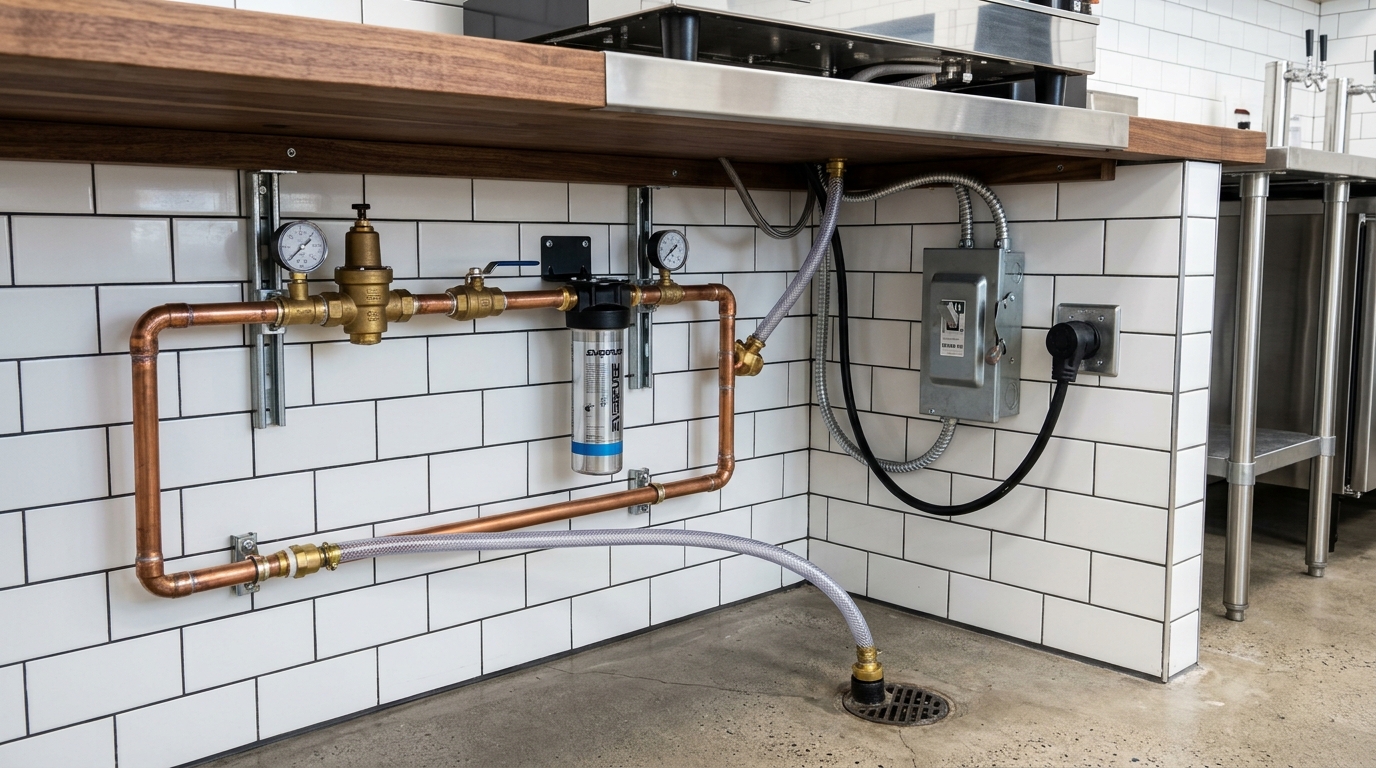
In the specialty coffee and restaurant industry, poor utility rough-in planning is the single most common cause of delayed store openings and blown construction budgets.
General contractors and commercial electricians frequently underestimate the unique utility demands of specialty espresso equipment. An espresso machine is not simply another kitchen appliance; it is an industrial thermodynamic boiler combining high electrical wattage (up to 7,800W) with precision hydraulic lines operating under 130 PSI of internal extraction pressure.
If your electrical subpanel delivers 208V when your heating elements are calibrated for 240V, your machine will suffer a 25% drop in heating recovery speed. If your plumber installs a sealed direct-connection drain instead of an indirect air-gap floor sink, your municipal health inspector will refuse to sign off on your Certificate of Occupancy.
This technical guide provides electricians, plumbing contractors, and coffee entrepreneurs with the exact National Electrical Code (NEC) rules, plumbing codes, breaker formulas, and counter rough-in dimensions required to install commercial coffee equipment seamlessly in 2026.
1. Electrical Engineering: Voltages, Amperage & The 80% NEC Rule
Commercial espresso machines operate on dedicated, single-phase alternating current (AC). In North American commercial buildings, supply voltage typically falls into one of two categories: 208V Three-Phase Delta/Wye or 240V Single-Phase Split.
+-----------------------------------------------------------------------+
|                    NORTH AMERICAN VOLTAGE DISCREPANCY                 |
|                                                                       |
|  240V Residential / Light Commercial     208V Heavy Commercial Grid   |
|  [Hot Leg A: 120V] + [Hot Leg B: 120V]   [Leg A: 120V] + [Leg B: 120V]
|  = Full 240V Nominal Potential           = 208V (Phase-to-Phase vector)|
|                                                                       |
|  IMPACT ON 4,600W HEATING ELEMENT:                                    |
|  - At true 240V: Yields 4,600 Watts of heating power.                 |
|  - At 208V: Yields only 3,450 Watts (P = V^2 / R) — 25% HEAT LOSS!    |
+-----------------------------------------------------------------------+
The Ohm’s Law Reality Check:
Heating elements are fixed-resistance resistors ($R = V^2 / P$). If an espresso machine manufactured in Italy is rated at 4,600W at 240V ($R = 12.52,\Omega$), and you plug it into a 208V supply, the actual power output drops precipitously:
$$P = \frac{V^2}{R} = \frac{208^2}{12.52} \approx 3,455\text{ Watts}$$
A 25% drop in wattage means your steam boiler recovery time stretches from 45 seconds to nearly 2 minutes during an aggressive morning rush. Always verify incoming line voltage with a digital multimeter and instruct your equipment distributor whether you require 208V or 240V heating elements.
The NEC Continuous Duty 80% Rule:
Under the National Electrical Code (NEC Article 210.20), commercial coffee machines are classified as continuous duty loads because they remain energized for three or more continuous hours. Consequently, the branch circuit and circuit breaker must be rated for at least 125% of the machine’s continuous current draw (or conversely, the machine must not exceed 80% of the breaker rating):
$$\text{Minimum Breaker Amperage} = \frac{\text{Machine Full Load Amps}}{0.80}$$
2. Electrical Specification & Receptacle Matrix
The following table provides verified electrical parameters, wire gauge recommendations, and NEMA receptacle designations for standard commercial configurations:
| Machine Class / Volume | Total Rated Wattage | Operating Voltage | Full Load Amperage | Minimum Breaker Size | Recommended Wire Gauge (THHN Copper) | Required NEMA Receptacle |
|---|---|---|---|---|---|---|
| Commercial 1-Group (e.g., Linea Mini) | 1,620W | 120V | 13.5A | 20A Dedicated | 12 AWG | NEMA 5-15P or NEMA 5-20R |
| Commercial 2-Group Compact (Appia Life) | 2,900W | 208–240V | 13.2A | 20A Dedicated | 12 AWG | NEMA L6-20R (Twist-Lock) |
| Commercial 2-Group Standard (Linea S / Wave) | 4,600W–5,400W | 208–240V | 21.0A–23.5A | 30A Dedicated | 10 AWG | NEMA L6-30R (Twist-Lock) |
| Commercial 2-Group Multi-Boiler (Synesso S200) | 7,800W | 220–240V | 35.5A | 40A / 50A Dedicated | 8 AWG | NEMA L6-50R or Hardwired |
| Commercial 3-Group Flagship (Linea PB / MVP) | 6,500W–8,500W | 208–240V | 31.0A–38.5A | 50A Dedicated | 6 AWG or 8 AWG | NEMA 6-50R or Direct Conduit |
| Bulk Batch Brewer (Fetco Twin 1.5 Gal) | 4,500W–6,000W | 208–240V | 21.6A–26.0A | 30A Dedicated | 10 AWG | NEMA L6-30R |
| Commercial On-Demand Grinders (Each) | 350W–650W | 120V | 3.5A–5.5A | 15A / 20A Shared | 12 AWG | NEMA 5-15R Duplex |
+-----------------------------------------------------------------------+
|                    COMMON NEMA PLUG GEOMETRIES                        |
|                                                                       |
|   NEMA 5-20R (120V / 20A)             NEMA L6-30R (240V / 30A)        |
|      +---------------+                   +---------------+            |
|      |   |       |   |                   |     (---)     |            |
|      |   |       --- |                   |  /-\     /-\  |            |
|      |       O       |                   |  \-/     \-/  |            |
|      +---------------+                   +---------------+            |
|      Standard Commercial 120V            Twist-Lock Locking 240V      |
|      (T-Slot Neutral)                    (Industry Espresso Standard) |
+-----------------------------------------------------------------------+
Note on Isolation: Never share an espresso machine’s branch circuit with refrigeration compressors, blenders, or microwave ovens. Compressor startup surges introduce voltage spikes that degrade sensitive solid-state PID microcontrollers.
3. Plumbing Engineering: Supply Lines, Flow Rate & Pressure Regulators
An espresso machine’s internal rotary vane pump requires a constant, laminar supply of potable, treated water. If incoming line pressure dips during service, the pump cavitates, causing premature bearing failure and inaccurate flow meter measurements.
+-----------------------------------------------------------------------+
|                   UNDER-COUNTER PLUMBING ROUGH-IN                     |
|                                                                       |
|  [Main Potable Water Line 3/4" Copper]                                |
|        |                                                              |
|        v                                                              |
|  +---------------------------------------------------------------+    |
|  | ASSE 1022 Certified Dual Check Valve Backflow Preventer        |    |
|  +---------------------------------------------------------------+    |
|        |                                                              |
|        v                                                              |
|  +---------------------------------------------------------------+    |
|  | Commercial Water Treatment System (RO / BWT Filter Train)     |    |
|  +---------------------------------------------------------------+    |
|        |                                                              |
|        v                                                              |
|  +---------------------------------------------------------------+    |
|  | Brass Pressure Reducing Valve (PRV) with Liquid-Filled Gauge   |    |
|  | Set to 45 – 55 PSI Dynamic Flow                               |    |
|  +---------------------------------------------------------------+    |
|        |                                                              |
|        +--- 3/8" OD Braided Stainless Line ===> Espresso Machine Inflow
|        +--- 3/8" OD Braided Stainless Line ===> Twin Batch Brewer Inflow
|        `--- 3/8" OD Braided Stainless Line ===> In-Counter Pitcher Rinser
+-----------------------------------------------------------------------+
Water Supply Code Checklist:
- Pipe Diameter & Velocity:
The primary cold water feed to the beverage area should be a dedicated 3/4-inch copper (Type L) or PEX line branching down to 1/2-inch at the filtration manifold. Final connections to individual machines use NSF-certified 3/8-inch outer diameter (OD) flexible braided stainless steel lines with 3/8-inch male BSP or flare fittings. - Backflow Prevention (ASSE 1022 Standard):
Local municipal plumbing codes mandate the installation of an ASSE 1022-listed dual check valve with an atmospheric vent immediately upstream of any carbonator or commercial coffee machine to prevent boiler water from back-siphoning into city drinking mains. - Pressure Regulation:
Municipal water grids fluctuate wildly between 40 PSI and 110 PSI throughout the day. Install a commercial-grade brass Pressure Reducing Valve (PRV) with an integrated dial gauge set between 45 and 55 PSI (3.1 to 3.8 bar). - Dedicated Shut-Off Valves:
Every connected machine must have its own 1/4-turn brass ball valve installed under the counter within arm’s reach of the barista station for emergency isolation.
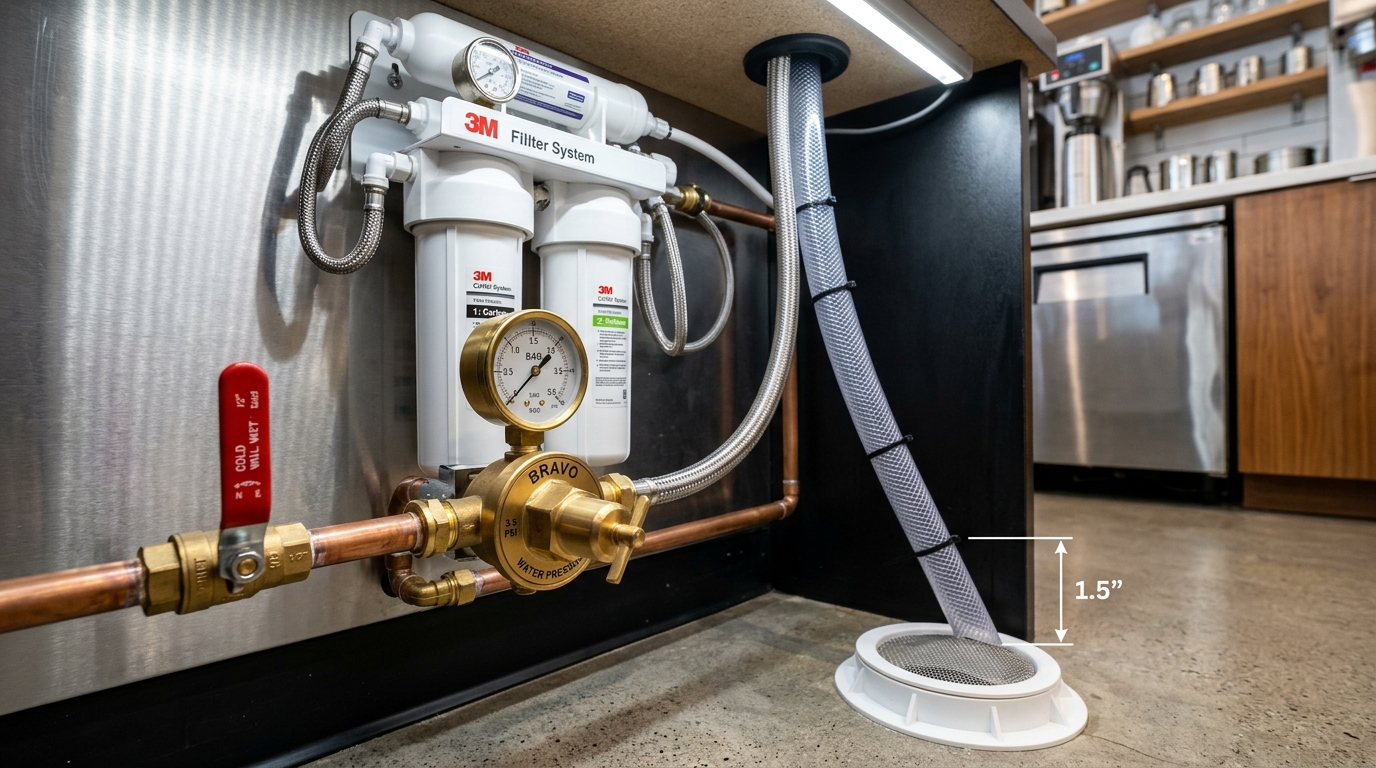
4. Drainage Architecture: The Mandatory Air Gap Floor Sink
No single issue triggers more failed health inspections than improper drainage plumbing beneath the coffee bar.
Commercial espresso machines discharge high-temperature water (over 190°F) laden with coffee grounds, milk fats, and chemical backflush residues. If connected directly to a sealed waste pipe, sewer gas will enter the machine, and any main line clog will push black wastewater directly up into the barista’s drip tray.
+-----------------------------------------------------------------------+
|                    INDIRECT WASTE AIR GAP SCHEMATIC                   |
|                                                                       |
|  [Espresso Machine Drip Tray Basin]                                   |
|        |                                                              |
|        | (Reinforced Braided Drain Hose, Min. 3/4" ID)                |
|        | Continuous downward pitch (Min 1" drop per linear foot)      |
|        |                                                              |
|        v                                                              |
|      +---+                                                            |
|      |   |  Flexible Drain Tube End                                   |
|      +---+                                                            |
|        |                                                              |
|        |   <--- MINIMUM 1.0 INCH VERTICAL PHYSICAL AIR GAP --->       |
|        |        (Air space prevents siphoning of contaminated waste)  |
|        v                                                              |
|   +---------------------------------------------------------------+   |
|   | \                                                           / |   |
|   |  \          Open-Hub Cast Iron or Stainless Steel          /  |   |
|   |   \               Floor Sink / Drain Receptor             /   |   |
|   |    +-----------------------------------------------------+    |   |
|   +------------------------------+--------------------------------+   |
|                                  |                                    |
|                                  v (To 2" P-Trap & Grease Waste Main) |
+-----------------------------------------------------------------------+
Drainage Engineering Rules:
- The Indirect Waste Rule:
Under Uniform Plumbing Code (UPC Section 801.2) and International Plumbing Code (IPC Section 802.1), coffee machines and beverage dispensers must discharge into an indirect waste receptor (floor sink or funnel hub drain) through a physical air gap measuring at least twice the diameter of the drain pipe (minimum 1.0 inch). - Continuous Downward Pitch:
The corrugated or reinforced clear vinyl drain hose (typically 3/4-inch to 1-inch inner diameter) must maintain a continuous downward slope of at least 1 inch of drop for every 12 inches of horizontal run. Never allow the drain hose to sag or form a “U-trap” beneath the counter; trapped coffee grinds will ferment and create a rock-hard biological blockage within weeks. - High-Temperature Pipe Rating:
Drainage pipes receiving espresso machine boiler dump flushes must be rated for intermittent temperatures of at least 200°F (93°C). Use Schedule 40 CPVC, cast iron, or high-temperature polypropylene rather than standard thin-walled PVC, which warps and deforms under boiling water discharge.
5. Countertop Rough-In Dimensions & Penetration Holes
Running supply lines and heavy cables over the back edge of a finished quartz or granite counter looks unprofessional and risks pinching vital water lines. All utilities should enter directly through precision countertop core-drill holes hidden beneath the machine’s footprint.
+-----------------------------------------------------------------------+
|                 COUNTER PENETRATION HOLE DRILL PATTERN                |
|                                                                       |
|     +-----------------------------------------------------------+     |
|     |                                                           |     |
|     |              COMMERCIAL 2-GROUP FOOTPRINT                 |     |
|     |                   (Approx. 28" x 23")                     |     |
|     |                                                           |     |
|     |                     (Grommet Hole)                        |     |
|     |                        +-----+                            |     |
|     |                        | 3"  |  <--- 2.5" to 3.0" Hole    |     |
|     |                        +-----+       Drilled 4" from back |     |
|     |                                      and 6" off-center    |     |
|     +-----------------------------------------------------------+     |
|                     FRONT OF SERVICE COUNTER                          |
+-----------------------------------------------------------------------+
Counter Penetration Instructions:
- Hole Diameter: Cut one 2.5-inch to 3.0-inch (65mm to 76mm) hole using a diamond core bit for stone counters, or a bi-metal hole saw for stainless steel.
- Hole Location: Position the hole 4 to 5 inches forward from the back edge of the machine and offset 6 inches toward the side where the machine’s internal manifold enters (consult your specific model’s template).
- Edge Protection: Line the drilled hole with a heavy-duty plastic desk grommet or rubber edge protector to prevent sharp stone or metal edges from slicing into water lines or electrical cable insulation.
6. Pre-Inspection Contractor Checklist (Sign-Off Sheet)
Before scheduling your municipal building, electrical, and health department inspections, print this verification checklist for your general contractor:
| Trade | System Item | Code / Inspection Requirement | Verified |
|---|---|---|---|
| Electrical | Dedicated Circuit Breaker | Sized at 125% of full machine load (e.g., 30A breaker for 22A continuous machine) | [ ] |
| Electrical | Disconnect / Receptacle | NEMA L6-30R twist-lock receptacle located within 3 feet of machine, fully grounded | [ ] |
| Electrical | Conductor Sizing | Dedicated 10 AWG copper THHN wiring run from subpanel to outlet without splices | [ ] |
| Plumbing | Backflow Preventer | ASSE 1022-listed dual check valve with atmospheric vent installed upstream of RO | [ ] |
| Plumbing | Supply Pressure | Brass PRV with gauge dialed to 45–55 PSI static pressure under flow | [ ] |
| Plumbing | Isolation Ball Valves | 1/4-turn brass ball valve installed under counter for each individual machine | [ ] |
| Plumbing | Indirect Waste Air Gap | Floor sink located beneath bar with verified 1-inch physical vertical air separation | [ ] |
| Plumbing | Drain Hose Pitch | Minimum 1” fall per linear foot of hose without sag, dip, or makeshift traps | [ ] |
| Sanitation | Water Hardness Test | Pre-tested water showing 50–125 ppm CaCO3 and 0 ppm chlorine prior to boiler fill | [ ] |
Proper utility rough-in guarantees that your equipment runs reliably for years without voiding manufacturer warranties. For ongoing maintenance intervals and chemical cleaning protocols, consult our Preventative Maintenance Guide.
Frequently Asked Technical Questions
Can a commercial 2-group espresso machine run on a standard 120V household outlet?
No. A commercial 2-group espresso machine requires between 4,300 and 5,400 Watts of heating power. A standard 120V 15A or 20A circuit can only supply up to 1,800 to 2,400 Watts. Attempting to power a multi-group commercial machine on 120V will immediately trip breakers or fail to recover boiler steam pressure.
What is an indirect waste drain air gap, and why is it mandatory for coffee machines?
An indirect waste air gap is a physical vertical air separation (minimum 1 inch) between the espresso machine's flexible drain line and the floor sink or standpipe. It guarantees that if the city sewer or building drain backs up, contaminated wastewater cannot physically siphon into the espresso machine drip tray.
What water pressure is required for direct-plumbed commercial espresso machines?
Most commercial rotary vane pump espresso machines require static water pressure between 45 and 60 PSI (3.0 to 4.0 bar). Water pressure below 35 PSI causes pump cavitation and dry-fire element damage, while pressure exceeding 75 PSI causes internal expansion valve leaks and blown solenoids.
What NEMA plug is standard on commercial 2-group espresso machines in the US?
The industry-standard plug for 2-group machines (drawing between 20A and 30A at 208-240V) is the NEMA L6-30P twist-lock plug, mating with a dedicated NEMA L6-30R wall or floor receptacle.