Mobile Coffee Cart Electrical & Plumbing: Generators, Inverters & Water
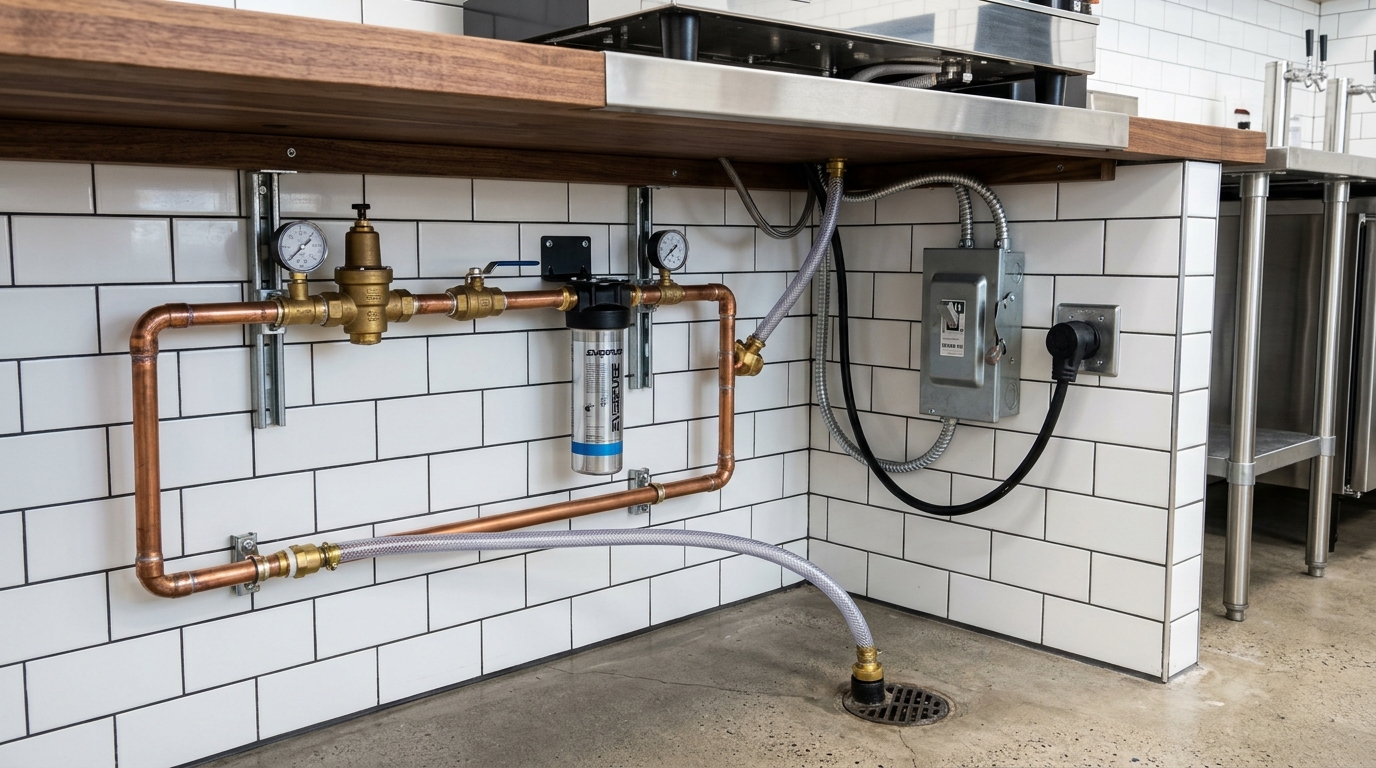
Operating a mobile coffee cart, catering trailer, or pop-up espresso bar is one of the most lucrative and capital-efficient entry points into the specialty coffee industry. With overhead expenses stripped to a fraction of a brick-and-mortar cafe, mobile operators regularly net 40% to 55% profit margins on weekend weddings, corporate activations, farmers markets, and festival events.
However, behind the polished butcher-block countertops and sparkling chrome espresso groupheads lies an unforgiving engineering challenge: you are building a self-contained, off-grid industrial manufacturing plant within a mobile 6-foot by 3-foot chassis.
Unlike a static coffee shop with infinite municipal water pressure and a 200-Amp wall panel, a mobile cart must generate its own electrical grid, regulate its own hydraulic water pressure, heat sanitation water to FDA standards, and safely contain hazardous wastewater—all while operating under the watchful eye of local health inspectors and fire marshals.
A single undersized electrical breaker, a pulsing water pump that starves a rotary vane pump, or a missing air-gap drain fitting will shut down an event before you pull your first shot of espresso.
This comprehensive technical guide provides mobile entrepreneurs and fabricators with the exact electrical formulas, plumbing schematics, equipment selections, and health code compliance blueprints needed to build an elite, bulletproof mobile coffee cart.
1. Electrical Power Engineering: Calculating True Running & Surge Watts
Electrical failure is the number one cause of mobile coffee cart breakdowns. To size your power system accurately, you must differentiate between Running Watts (Continuous Load) and Surge Watts (Starting Inrush Current).
+-------------------------------------------------------------------------+
|                  MOBILE COFFEE CART ELECTRICAL LOAD AUDIT               |
+-------------------------------------------------------------------------+
|                                                                         |
|  EQUIPMENT               VOLTAGE    RUNNING WATTS    PEAK SURGE WATTS   |
|  ---------------------------------------------------------------------  |
|  2-Group Espresso        220V 1-Ph      4,200 W          4,500 W        |
|  (La Marzocco Linea PB)                                                 |
|  On-Demand Grinder       120V 1-Ph        650 W          1,800 W (Motor)|
|  (Mahlkönig E65S GBW)                                                   |
|  Handwash Water Heater   120V 1-Ph      1,440 W          1,440 W (Elem.)|
|  (Bosch 2.5 Gal Mini)                                                   |
|  12V Water Booster Pump  12V DC (Conv.)    60 W            120 W        |
|  (Flojet Triplex Demand)                                                |
|  Pitcher Rinser Supply   N/A (Hydraulic)    0 W              0 W        |
|  POS Tablet / Terminal   5V USB            15 W             15 W        |
|  LED Bar Lighting        12V DC            30 W             30 W        |
|  ---------------------------------------------------------------------  |
|  TOTAL CUMULATIVE LOAD:                 6,395 W          7,905 W        |
|                                                                         |
+-------------------------------------------------------------------------+
The 80% Continuous Load Engineering Rule
Under the National Electrical Code (NEC Article 210), electrical circuits and generators should never be operated at greater than 80% of their continuous rated capacity for extended periods (defined as loads running continuously for 3 hours or more).
- If your mobile cart has a total continuous running draw of 6,395 Watts, dividing by 0.80 yields a minimum required generator or inverter continuous rating of: $$\text{Minimum Power Capacity} = \frac{6,395,\text{W}}{0.80} = 7,993,\text{Watts}$$
- Attempting to run this 2-group setup on a standard 6,000-watt generator will cause internal thermal breakers to trip the exact second the espresso boiler elements engage while the water heater is actively reheating.
Managing High-Wattage Simultaneous Inrush
In mobile setups, you must manage concurrent heating elements. The espresso boiler (4,200W) and the handwash sink water heater (1,440W) represent 5,640W of pure resistive heating.
- Smart Staging Strategy: Use a 120V mechanical timer or load-shedding relay that cuts power to the 2.5-gallon handwash water heater while the espresso machine is actively pulling shots, or pre-heat the sink water during initial morning cart setup and switch the heater to “Low / Eco” (750W) during service rushes.
2. Power Sources: Inverter Generators vs 48V Off-Grid Lithium Systems
Mobile coffee operators have two distinct avenues for power generation: internal combustion inverter generators or modular lithium-ion battery banks.
+-------------------------------------------------------------------------------+
|             GENERATOR VS LITHIUM BATTERY POWER TRADEOFF MATRIX                |
+-------------------------------------------------------------------------------+
| System Parameter                | Commercial Inverter Generator (Gas) | 48V LiFePO4 Inverter System (Battery) |
|---------------------------------+-------------------------------------+---------------------------------------|
| Representative Models           | Honda EU7000is / Predator 9500      | Victron MultiPlus-II 48/5000 + 10kWh |
| Continuous Output Power         | 5,500W - 7,600W Continuous          | 4,000W - 8,000W Continuous Pure Sine  |
| Capital Hardware Cost           | \$2,400 - \$4,800                   | \$5,500 - \$9,200                     |
| Acoustic Operating Noise        | 52 - 60 dBA @ 23 feet               | 0 dBA (Completely silent)             |
| Exhaust Emissions & Fumes       | Carbon monoxide / Hydrocarbons      | ZERO (Safe for indoor office catering)|
| Operating Runtime               | 6 to 18 hours (Unlimited refuel)    | 4 to 6 hours continuous (Requires grid|
|                                 |                                     | recharge or solar replenishment)      |
| Physical Weight & Footprint     | 260 lbs (Wheeled cart)              | 220 lbs (Integrated into cart base)   |
| Venue Permissibility            | Outdoor events only (Banned inside) | 100% Permitted indoor & outdoor       |
+-------------------------------------------------------------------------------+
The Inverter Generator Standard: Honda EU7000is
For outdoor festivals, street fairs, and farmers markets, the Honda EU7000is is the gold standard across the North American mobile industry:
- Electronic Fuel Injection (EFI): Eliminates carburetor clogging from stale ethanol gasoline and provides flawless cold starts down to 20°F (-7°C).
- Ultra-Quiet Inverter Architecture: Operates at 52 to 58 dBA, allowing pleasant conversation directly adjacent to the cart without deafening customers.
- Pure Sine Wave Output: Total Harmonic Distortion (THD) under 2.5%, safeguarding delicate digital PID controllers, solid-state relays, and microprocessors inside commercial espresso machines.
The Indoor Game-Changer: 48-Volt Lithium Power (Victron Energy)
If your business model focuses on high-ticket indoor corporate catering, wedding venues, and convention centers, a gas generator is completely prohibited by fire codes. You must build an off-grid lithium battery system.
+-------------------------------------------------------------------------+
|                  48V LITHIUM INVERTER SYSTEM SCHEMATIC                  |
+-------------------------------------------------------------------------+
|                                                                         |
|  [SHORE POWER / 120V GRID RECHARGE] (Optional Wall Plug)                |
|                    |                                                    |
|                    v                                                    |
|  +-------------------------------------------------------------------+  |
|  | VICTRON ENERGY MULTIPLUS-II (48V / 5000VA / 70A Inverter-Charger)  |  |
|  +-------------------------------------------------------------------+  |
|         ^                                                 |             |
|         | 48V DC Bus (00 AWG Cable)                       | 120V/240V AC|
|         v                                                 v             |
|  +---------------------------+              +------------------------+  |
|  | 2x 48V 100Ah LiFePO4      |              | AC DISTRIBUTION PANEL  |  |
|  | LITHIUM BATTERY PACKS     |              | (Square D QO Panel)    |  |
|  | (10.24 kWh Energy Reserve)|              | - 30A 240V: Espresso   |  |
|  | Rated for 4,000+ Cycles   |              | - 15A 120V: Grinder    |  |
|  +---------------------------+              | - 15A 120V: Water Heat |  |
|                                             | - 15A 120V: DC Conv.   |  |
|                                             +------------------------+  |
|                                                                         |
+-------------------------------------------------------------------------+
Calculating Lithium Battery Sizing
A 2-group espresso machine pulling 150 drinks over a 4-hour event consumes approximately 5.5 to 7.0 kWh of energy (due to boiler thermostatic cycling—elements are only energized ~40% of the time once at temperature).
- Two 48V 100Ah Lithium Iron Phosphate (LiFePO4) batteries provide: $$\text{Total Energy} = 48,\text{V} \times 200,\text{Ah} = 9,600,\text{Watt-hours} ,(9.6,\text{kWh})$$
- Factoring in an 88% inverter efficiency factor: $$\text{Usable Energy} = 9.6,\text{kWh} \times 0.88 = 8.45,\text{kWh}$$
- This setup powers a 2-group machine, grinder, and water pump through a full 5-hour high-volume catering event on a single charge with zero noise and zero emissions!
3. Mobile Plumbing Architecture: Schematics & Component Engineering
Operating off-grid means you have no municipal water supply line and no city sewer drain. Your plumbing system must extract water from a food-grade tank, deliver it at a rock-solid 40 PSI to the espresso machine, and safely collect drain water without leaks or odor.
+-------------------------------------------------------------------------+
|                  MOBILE COFFEE CART PLUMBING SCHEMATIC                  |
+-------------------------------------------------------------------------+
|                                                                         |
|  +-------------------------------------------------------------------+  |
|  | POTABLE FRESH WATER TANK (10 to 15 Gallons Food-Grade Poly)       |  |
|  +-------------------------------------------------------------------+  |
|       |                                                                 |
|       v (1/2" ID Reinforced Food-Grade Hose)                            |
|  +-------------------------------------------------------------------+  |
|  | 50-MESH IN-LINE SEDIMENT STRAINER (Stainless Screen)              |  |
|  +-------------------------------------------------------------------+  |
|       |                                                                 |
|       v                                                                 |
|  +-------------------------------------------------------------------+  |
|  | FLOJET TRIPLEX / BW5000 DEMAND PUMP (12V DC or 115V AC / 45 PSI)  |  |
|  +-------------------------------------------------------------------+  |
|       |                                                                 |
|       v (Check Valve)                                                   |
|  +-------------------------------------------------------------------+  |
|  | ACCUMULATOR TANK (1.0 - 2.0 Liter Pressurized Bladder @ 25 PSI)   |  |
|  +-------------------------------------------------------------------+  |
|       |                                                                 |
|       +------------------------------------+                            |
|       |                                    |                            |
|       v (3/8" Push-Fit Line)               v (3/8" Push-Fit Line)       |
|  +---------------------------+        +------------------------------+  |
|  | COMMERCIAL ESPRESSO       |        | POINT-OF-USE WATER HEATER    |  |
|  | MACHINE INLET             |        | (Bosch 2.5 Gallon / 120V)    |  |
|  +---------------------------+        +------------------------------+  |
|       |                                    | (120°F Hot Water)          |
|       |                                    v                            |
|       |                               +------------------------------+  |
|       |                               | 3-COMPARTMENT & HAND SINK    |  |
|       |                               +------------------------------+  |
|       |                                    |                            |
|       v                                    v                            |
|  +-------------------------------------------------------------------+  |
|  | GRAVITY WASTEWATER DRAIN MANIFOLD (1" ID Reinforced Smooth-Bore)  |  |
|  +-------------------------------------------------------------------+  |
|       |                                                                 |
|       v                                                                 |
|  +-------------------------------------------------------------------+  |
|  | GRAY WATER WASTE TANK (15 to 20 Gallons / 15%+ Larger Than Fresh)  |  |
|  | - Features quick-disconnect camlock fitting & mechanical vent valve  |
|  +-------------------------------------------------------------------+  |
|                                                                         |
+-------------------------------------------------------------------------+
1. Potable Fresh Water Storage Tanks
- Use only rotationally molded, seamless high-density polyethylene (HDPE) tanks certified under NSF Standard 61. Never use cheap translucent storage totes or re-purposed chemical containers.
- Tank capacity: 10 to 15 gallons is the optimal sweet spot between operational runtime and weight (water weighs 8.34 lbs per gallon; a 15-gallon tank adds 125 lbs of ballast to your cart).
2. The On-Demand Diaphragm Delivery Pump
- Flojet Bottled Water System (BW5000) or Shurflo 4008 / 2088 Industrial Diaphragm Pump:
- Delivers 1.0 to 3.0 Gallons Per Minute (GPM) on demand.
- Features an internal pressure switch that engages automatically when water line pressure drops below 30 PSI and shuts off when line pressure reaches 45–50 PSI.
- Engineering Warning: Commercial espresso machine rotary vane pumps require a positive supply pressure of at least 25 to 40 PSI. If fed from a passive gravity siphon, the rotary pump cavitates, scorches its brass vanes, and ruins extraction pressure within weeks.
3. The Accumulator Tank: Eliminating Water Hammer
The accumulator tank is an enclosed metal or heavy composite cylinder containing an internal rubber bladder surrounded by compressed air:
- Pre-charge the Schrader valve on the accumulator to 25 PSI (approx. 3 PSI below the pump cut-in pressure).
- When the pump runs, it fills the bladder, compressing the air cushion.
- When the espresso machine opens its boiler fill solenoid or initiates a shot, pressurized water flows smoothly from the accumulator reservoir. The delivery pump turns on smoothly once every few minutes rather than violently chattering on and off every second.
4. Gray Water Drainage & Health Department Rules
- The 15% Capacity Mandate: Health departments strictly require that the wastewater tank capacity exceed fresh water storage by a minimum of 15% to 50%. A cart with a 12-gallon fresh tank must have a minimum 14- to 18-gallon gray tank.
- Air Gaps on Drains: Health codes prohibit direct, sealed mechanical plumbing connections between sink basins/espresso drain trays and the waste tank. An approved 1-inch physical air gap must exist above the tank inlet or drain standpipe to prevent contaminated sewage from backing up into coffee-making areas in the event of an overflow.
- Dumping Valve: Mount a 1.5-inch or 2.0-inch RV-style slide valve or camlock quick-disconnect at the bottom perimeter of the cart to allow rapid emptying into approved sanitary utility sinks.
4. Health Department & NSF Sanitation Compliance Checklist
Securing a mobile food vendor permit requires satisfying rigid municipal health regulations. Fabricate your cart with these non-negotiable health criteria from Day One:
+-------------------------------------------------------------------------------+
|              MOBILE COFFEE CART HEALTH INSPECTION SCORECARD                   |
+-------------------------------------------------------------------------------+
| Health Code Requirement         | Technical Specification Criteria                   | Pass / Fail Inspection Target |
|---------------------------------+----------------------------------------------------+-------------------------------|
| Dedicated Handwashing Sink      | Minimum 9" x 9" x 5" stainless bowl;               | MANDATORY (Non-negotiable)    |
|                                 | hot & cold running water; hands-free lever/paddle  |                               |
| Warewashing Basin               | 3-Compartment stainless sink (Wash, Rinse,         | Required if washing pitchers  |
|                                 | Sanitize) sized to submerge largest pitcher        | on-site without commissaries  |
| Water Temperature Capability    | Hand sink: 100°F (38°C) within 30 seconds          | Verified with probe thermo    |
|                                 | 3-Compartment: 110°F - 120°F (43°C - 49°C)         | by field inspector            |
| Countertop Materials            | Non-porous, smooth, easily cleanable surface:      | Porous, unsealed raw wood     |
|                                 | NSF Stainless steel or food-grade sealed quartz    | is instantly failed           |
| Splash Guards & Sneeze Shields  | Minimum 8-inch stainless or acrylic barrier        | Required if hand sink is      |
|                                 | between hand sink and food/cup prep surfaces       | within 18 inches of espresso  |
| Wastewater Tank Venting         | Tank must be vented to atmosphere outside cart     | Banned from venting inside    |
|                                 | with a fine mesh insect-proof screen               | enclosed service cabinetry    |
+-------------------------------------------------------------------------------+
5. Mobile Cart Equipment Footprint & Space Planning
Every square inch of a mobile cart must be planned with three-dimensional CAD precision. Below is an optimized spatial layout for a standard 6-foot by 30-inch commercial mobile cart chassis.
+-------------------------------------------------------------------------+
|                  6-FOOT MOBILE CART TOP-DOWN CAD LAYOUT                 |
+-------------------------------------------------------------------------+
|                                                                         |
|  |<------------- 36 INCHES ------------->|<--- 18 IN --->|<-- 18 IN -->|
|  +---------------------------------------+---------------+-------------+
|  |                                       | PITCHER       | HANDWASH &  |
|  |   COMMERCIAL 2-GROUP ESPRESSO         | RINSER & DROP | 3-COMPART.  |
|  |   MACHINE                             | KNOCKBOX      | SINK BASIN  |
|  |   (La Marzocco Linea Mini / PB)       |               |             |
|  |                                       | (In-Counter)  | (Acrylic    |
|  +---------------------------------------+               |  Splash     |
|  | ON-DEMAND GRINDER  | PUQPRESS AUTO    | [Syrup Wells] |  Shield)    |
|  | (Mahlkönig E65S)   | TAMPER           |               |             |
|  +--------------------+------------------+---------------+-------------+
|                                                                         |
|  ========================= CART INTERIOR (LOWER) ===================== |
|                                                                         |
|  +--------------------+------------------+---------------+-------------+
|  | 48V LITHIUM SYSTEM | 12-GAL FRESH H2O | FLOJET PUMP & | 16-GAL GRAY |
|  | & 5000W INVERTER   | TANK (Food-Grade)| ACCUMULATOR & | WATER TANK  |
|  | (OR 220V PLUG-IN)  |                  | MINI HEATER   | (DUMP VALVE)|
|  +--------------------+------------------+---------------+-------------+
|                                                                         |
+-------------------------------------------------------------------------+
6. Daily Field Setup & Winterization SOP
Morning Setup SOP (Event Arrival - 45 Minutes to Service)
- Level the Chassis: Drop corner stabilizing jacks. Verify cart countertop is level using a bubble level (essential for espresso extraction uniformity and sink drainage).
- Sanitize Water Line: Fill fresh water tank with potable water. Purge 1 gallon through sinks and espresso line.
- Power-On Sequence:
- Engage generator or switch lithium inverter to ON.
- Power on water delivery pump; check accumulator pressure gauge (should read 40–45 PSI).
- Once water system is pressurized, power on the espresso machine. (Never power on an espresso machine before pressurizing the water line; dry heating elements will burn out in 15 seconds).
- Heat Verification: Monitor boiler gauges until steam reaches 1.5 bar and grouphead hits 200°F. Verify hand sink delivers 100°F water. Pull 2 seasoning espresso shots to dial in grind.
Winterization Protocol (Freezing Climate Protection)
If your mobile cart is stored in an unheated garage or trailer during freezing winter months, trapped water inside boilers, pumps, and heat exchanger pipes will freeze and expand, bursting copper lines and cracking expensive grouphead castings.
- Drain the fresh water tank completely.
- Disconnect inlet hose from pump; attach a short bypass hose submerged in 1 gallon of food-grade non-toxic RV propylene glycol antifreeze (pink fluid, NSF certified—never use automotive ethylene glycol!).
- Pump antifreeze through the water pump, accumulator, sink faucets, and pitcher rinsers until pink fluid emerges.
- Drain espresso boilers completely using the bottom boiler drain petcocks.
- In spring: Flush the system with 20 gallons of fresh water and 100ppm chlorine sanitizing solution until water tests completely clear and odor-free.
7. The Mobile Coffee Cart Pre-Event Readiness Checklist
+-------------------------------------------------------------------------+
|                  MOBILE OPERATOR PRE-FLIGHT CHECKLIST                   |
+-------------------------------------------------------------------------+
| [ ] 1. Fuel / Battery Level: Generator fuel tank 100% full (plus 5-gal  |
|        carb-compliant backup can) OR Lithium battery bank at 100% SoC.  |
| [ ] 2. Water Tanks: Fresh water tank filled with conditioned RO water;  |
|        gray water tank drained, valve closed, and sanitized with bleach.|
| [ ] 3. Pump Priming: Flojet pump cycles smoothly, holds 45 PSI, and     |
|        shuts off automatically with zero continuous chattering.         |
| [ ] 4. Accumulator Pre-Charge: Air bladder checked with tire gauge to   |
|        verify 25 PSI internal pneumatic pre-charge.                     |
| [ ] 5. Sink Sanitation Kit: Food-grade liquid soap, disposable paper     |
|        towels, quaternary ammonium sanitizer test strips, and bucket.   |
| [ ] 6. Splash Barriers: Acrylic sneeze shield and hand sink splash      |
|        guards mounted and secured with thumbscrews.                     |
| [ ] 7. Emergency Tool & Spares Box: 12V spare pump, John Guest push-fit |
|        connectors, Teflon tape, multimeter, and spare fuses on board.   |
+-------------------------------------------------------------------------+
By engineering your mobile coffee cart to rigorous commercial electrical standards and strict municipal plumbing health codes, you eliminate the operational chaos that plagues amateur mobile vendors. Your mobile business operates with absolute mechanical reliability, securing pristine health inspection scores and delivering high-volume specialty coffee anywhere your wheels can roll.
Frequently Asked Technical Questions
What size generator is required to power a commercial mobile espresso cart?
A mobile coffee cart running a standard 2-group commercial espresso machine (3,800W to 4,600W), an on-demand grinder (650W), a point-of-use water heater (1,440W), and a water pump (60W) requires an inverter generator with a minimum continuous output of 6,500 running watts and 7,000+ surge watts (such as the Honda EU7000is or Predator 9500 Inverter). For 1-group compact carts (under 2,400W total load), a 3,000W to 3,500W inverter generator (Honda EU3000is) is sufficient.
Can you run a commercial espresso machine off a lithium battery inverter system?
Yes, modern 48-Volt LiFePO4 (Lithium Iron Phosphate) battery banks paired with 5,000W to 8,000W pure sine wave inverters (such as Victron Energy MultiPlus-II or dual EcoFlow Delta Pro units) can fully power a mobile coffee cart for 4 to 8 hours of off-grid operation. Lithium setups operate with zero engine noise, zero exhaust emissions, and zero vibration, allowing mobile caterers to operate inside corporate office lobbies, luxury wedding venues, and convention centers where gas generators are strictly banned.
Why is an accumulator tank mandatory for mobile espresso cart plumbing?
An accumulator tank (a pressurized bladder tank such as a Shurflo or Seaflo 21-oz to 2-gallon tank) stores a pressurized reservoir of water between the on-demand pump and the espresso machine. Without an accumulator, the rapid opening of the machine's inlet solenoid causes the diaphragm pump to violently pulse on and off several times per second ('water hammer'), causing severe cavitation, fluctuating brew pressures (spiking from 2 to 9 bars), and premature pump motor burnout.
What is the health department ratio rule for fresh vs gray water tanks on mobile carts?
Across nearly all North American municipal health departments (following FDA Food Code guidelines), the mobile wastewater (gray water) holding tank must have a liquid storage capacity that is at least 15% to 50% larger than the potable fresh water supply tank. For example, if your fresh water tank holds 10 gallons, your gray water tank must hold a minimum of 11.5 to 15.0 gallons to prevent raw wastewater overflow onto public sidewalks or event floors.
What water temperature is required for a mobile coffee cart handwashing sink?
Municipal health inspectors strictly mandate that handwashing sinks on mobile food units deliver warm running water at a minimum temperature of 100°F (38°C) within 20 to 30 seconds of actuation. Warewashing (3-compartment sink) basins must reach a minimum of 110°F to 120°F (43°C to 49°C) for detergent wash steps, necessitating a dedicated point-of-use mini-tank water heater (such as a Bosch Tronic 3000T 2.5-gallon electric heater).