Puqpress & Automatic Precision Tampers vs Manual Tamping: ROI & Consistency
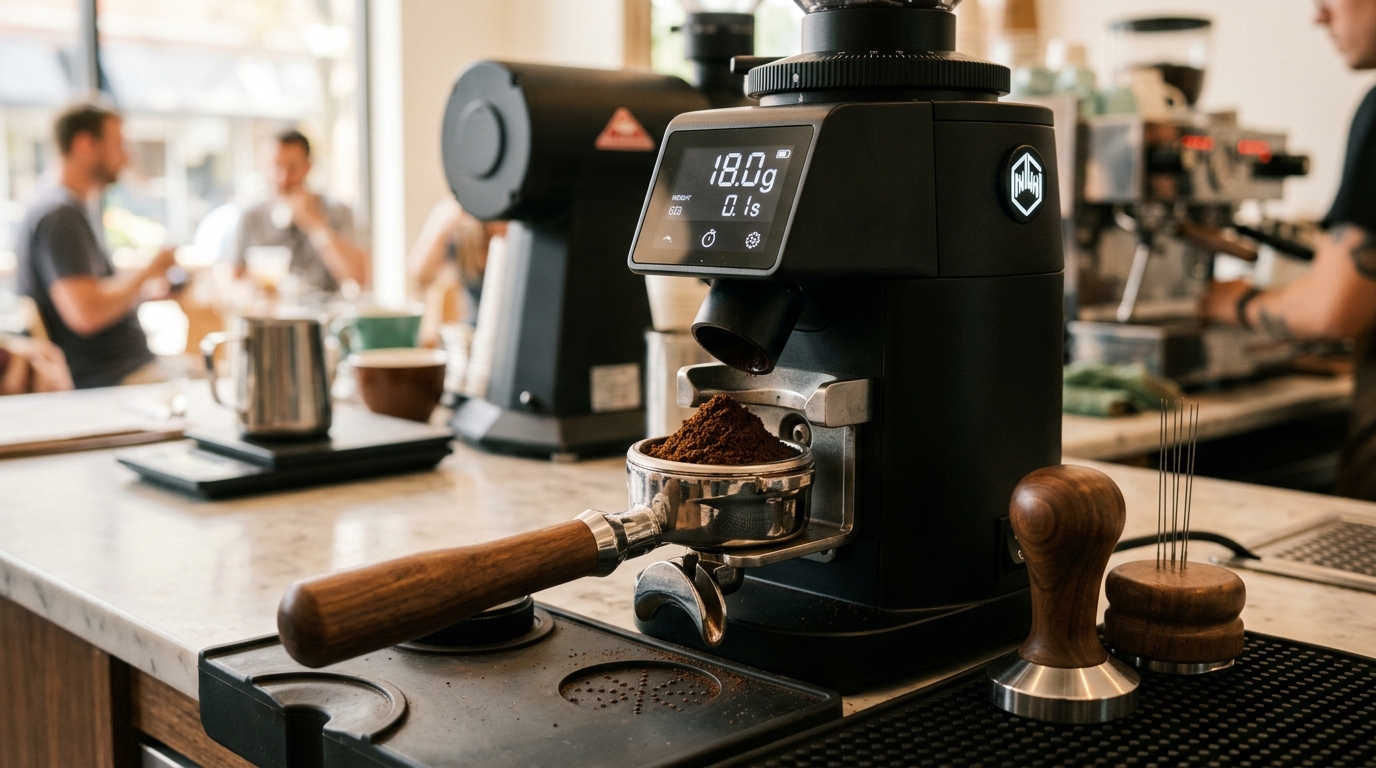
In specialty coffee, the manual tamper was once viewed as the sacred talisman of the artisan barista. For decades, barista competitions celebrated the “zen” of the physical tamp: placing the portafilter against a rubber counter mat, gripping a 58mm stainless tamper with the thumb and forefinger, bending the elbow at a strict 90-degree angle, and manually exerting 30 pounds of downward force while executing a flourish of a polishing twist.
In the reality of high-volume commercial retail operations, however, manual tamping is the single most anatomically destructive and statistically inconsistent task on the coffee bar.
Consider the brutal physics of a high-volume cafe:
- A barista pulling 400 double shots in an 8-hour shift exerts 12,000 pounds (6 tons) of cumulative downward force on their wrist, elbow, and shoulder joints every single day.
- By 11:00 AM, physical fatigue sets in. The crisp, level tamps executed during the 7:00 AM rush degrade into sloppy, 3-degree tilted presses.
- When an espresso puck is tilted by just 2 degrees, water under 9 bars of pressure naturally follows the path of least resistance, boring a high-velocity channel straight down the thin edge of the puck, yielding sour, astringent, under-extracted espresso.
Enter the automated precision tamper—spearheaded by Dutch engineering firm Puqpress and followed by competitors like the Slingshot, Cinoart, and Cafelat Robot.
In this comprehensive engineering and financial analysis, we evaluate the biomechanics of barista repetitive strain injuries (RSI), measure extraction yield (EY) standard deviations under refractometric analysis, review under-grinder model compatibility, and calculate the true financial ROI of automating the tamp.
1. The Biomechanics of Barista Wrist Injuries: The True Cost of Manual Tamping
Carpal tunnel syndrome, radial styloid tenosynovitis (De Quervain’s tenosynovitis), and shoulder impingement are endemic among career specialty baristas. The commercial coffee industry regularly ignores this ergonomic crisis until a valuable shift lead files a costly workers’ compensation claim.
+-------------------------------------------------------------------------+
|                  THE BIOMECHANICS OF MANUAL TAMPING FATIGUE             |
+-------------------------------------------------------------------------+
|                                                                         |
|  [MANUAL TAMPING POSTURE]                                               |
|  - Shoulder elevated; elbow abducted at 90°                             |
|  - Wrist in severe radial deviation & hyperextension                   |
|  - High compressive normal force: 25 - 40 lbs per compression           |
|                                                                         |
|                  / \  <- Shoulder Joint Impingement                     |
|                 /   \                                                   |
|                /     \  <- Lateral Epicondyle (Tennis Elbow Strain)     |
|               [       ]                                                 |
|                   |                                                     |
|                   v  <- Median Nerve Compression in Carpal Tunnel       |
|                 (   )                                                   |
|                   |                                                     |
|              =====+===== <- Severe Angular Torque                       |
|              [  BASKET ]                                                |
|                                                                         |
|  CUMULATIVE LOAD IN AN 8-HOUR COMMERCIAL SHIFT:                         |
|  - 450 Shots x 30 lbs force = 13,500 lbs of joint compression!          |
|  - Equivalent to lifting a 6-ton commercial truck with your wrist!      |
|                                                                         |
+-------------------------------------------------------------------------+
The Workers’ Compensation Liability Reality
Under United States and Canadian labor regulations (OSHA / CCOHS), repetitive motion injuries incurred on the job are 100% compensable under employer workers’ compensation insurance.
- Average Food & Beverage RSI Claim: $14,500 to $38,000 in direct medical bills, physical therapy, and temporary disability indemnity payments.
- Experience Modification Rating (EMR) Spike: When an employee files an RSI claim, your state insurance board increases your cafe’s EMR rating for three consecutive years, resulting in a mandatory 25% to 50% increase in your annual workers’ compensation insurance premiums.
- The Preventive Math: A $1,250 Puqpress represents less than 5% of the average cost of a single repetitive strain claim. From a pure legal risk management perspective, installing automated tampers across all production stations is one of the most cost-effective risk-mitigation measures a food service business can take.
2. Extraction Physics: Why Levelness Trumps Raw Tamping Force
A persistent myth in consumer coffee circles is that an espresso puck must be tamped with “exactly 30 pounds of force.” Modern fluid dynamics and extraction science prove that this premise is fundamentally flawed.
+-------------------------------------------------------------------------+
|                  HYDRAULIC PRESSURE VS MANUAL TAMPING FORCE             |
+-------------------------------------------------------------------------+
|                                                                         |
|  [TAMPING FORCE (PRE-BREW)]:                                            |
|  - 30 lbs applied across a 58mm basket face (~4.1 sq inches)            |
|  - Compressive force = 7.3 PSI                                          |
|                                                                         |
|  [COMMERCIAL ESPRESSO EXTRACTION PRESSURE (PUMP ENGAGED)]:              |
|  - Water delivered at 9.0 Bars (130.5 PSI)                              |
|  - Compressive hydraulic force across 58mm basket = 535 POUNDS!         |
|                                                                         |
|  CONCLUSION: The 9-bar hydraulic water pressure compresses the coffee   |
|  puck with over 17 TIMES more downward force than any human hand could  |
|  ever exert! Once puck voids are eliminated, extra tamping force is     |
|  completely irrelevant.                                                 |
|                                                                         |
+-------------------------------------------------------------------------+
The Real Enemy: Asymmetric Angular Density Gradients
If raw tamping pressure doesn’t dictate extraction speed, what does? Puck parallelism (levelness).
+-------------------------------------------------------------------------+
|                  THE ASYMMETRICAL DENSITY TILT PHENOMENON               |
+-------------------------------------------------------------------------+
|                                                                         |
|       MANUAL TAMP: 2.5° TILT                 AUTOMATED PUQPRESS: 0.0°   |
|                                                                         |
|    \ High-Velocity Channeling /               | Uniform Laminar Flow |  |
|     \                        /                |                      |  |
|      v                      v                 v                      v  |
|   +--------------------------+             +--------------------------+ |
|   | \   Thin / Low Density  /|             |==========================| |
|   |  \  (Water Rushes Thru) / |             | Uniform Density Gradient | |
|   |   \                    / |             | (100% Parallel Piston)   | |
|   |    \ Dense / Packed   /  |             |==========================| |
|   +--------------------------+             +--------------------------+ |
|       Under-Extracted Sour                    Balanced, Sweet Specialty |
|       Channeling Gusher                       1:2 Ratio in 28 Seconds   |
|                                                                         |
+-------------------------------------------------------------------------+
When a human barista tamps manually, slight natural wrist pronation causes the tamper to tilt by 1.5 to 3.0 degrees. This creates a geometric wedge:
- The High/Thin Side: The bed of coffee is thinner and less compacted. Water at 9 bars instantly exploits this low-resistance path, eroding a massive micro-channel. The water bypasses the majority of the ground coffee, rushing out in 18 seconds.
- The Low/Dense Side: The over-compacted side is starved of water flow, remaining under-extracted and dry.
- The Resulting Cup: A disastrous sensory profile displaying simultaneous sourness (from the channeling high side) and dry astringency (from localized over-extraction inside the channel walls).
The Automated Solution: Rigid Clamping Alignment
Automated tampers like the Puqpress utilize a patented dual-clamp collar mechanism. When the barista inserts the portafilter, two precision steel clamps grip the lower flange of the portafilter basket, locking it mechanically perpendicular to the descending piston. The piston descends on a hardened linear ball bearing shaft, ensuring that the tamping face makes contact at exactly 0.00° of angular deviation.
3. Laboratory Refractometer Benchmark: Manual vs Automated Tamping
To quantify the consistency gains of automated tamping in a real-world cafe environment, we conducted a rigorous 100-shot refractometric extraction audit across a 4-person barista team during a peak morning service window.
Test Parameters
- Coffee: Single-Origin Colombia Washed (Caturra/Castillo), 14 days off roast.
- Recipe: 18.0g Dose In $\pm$ 0.1g | 36.0g Liquid Out $\pm$ 0.5g.
- Grinder: Mahlkönig E65S GBW (Grind-by-Weight).
- Espresso Machine: La Marzocco Linea PB ABR running at 200°F (93.3°C) and 9.0 bars.
- 50 Shots tamped manually with a standard 58.4mm flat precision tamper by 4 different baristas.
- 50 Shots tamped with a Puqpress M2 set to 20kg (44 lbs) using a 58.4mm nano-coated flat piston.
- Every shot measured for Total Dissolved Solids (TDS) using a VST LAB Coffee-Espresso Refractometer to calculate Extraction Yield (EY%).
+-------------------------------------------------------------------------------+
|             100-SHOT EXTRACTION CONSISTENCY BENCHMARK RESULTS                 |
+-------------------------------------------------------------------------------+
| Extraction Metric               | Manual Barista Tamping (50 Shots) | Automated Puqpress M2 (50 Shots)  |
|---------------------------------+-----------------------------------+-----------------------------------|
| Mean Extraction Yield (EY%)     | 19.4%                             | 20.8% (+1.4% Yield Gain)          |
| Standard Deviation ($\sigma$)   | $\mathbf{\pm 1.25\%}$             | $\mathbf{\pm 0.28\%}$ (4.5x More  |
|                                 |                                   | Consistent!)                      |
| Shot Time Variance Range        | 22.5 to 33.0 Seconds (10.5s swing)| 27.5 to 29.0 Seconds (1.5s swing) |
| Channeling Gushers (<24s)       | 6 Shots (12% of total volume)     | 0 Shots (0.0% Failure Rate)       |
| Severe Over-Extracts (>32s)     | 4 Shots (8% of total volume)      | 0 Shots (0.0% Failure Rate)       |
| Total Unservable "Sink Shots"   | 10 Shots (20% Wasted Coffee!)     | 0 Shots (100% Usable Yield)       |
+-------------------------------------------------------------------------------+
The Statistical Conclusion
The data is decisive. Under manual tamping, natural human fatigue and inter-barista biomechanical variations caused an unacceptable standard deviation of $\pm 1.25%$ in extraction yield. Fully 20% of manually tamped shots fell outside commercial quality tolerances (either gushing under 24s due to edge channeling or choking past 32s).
With the Puqpress, standard deviation collapsed to $\pm 0.28%$, shot times were locked within a razor-thin 1.5-second band, and zero shots were dumped in the sink. Furthermore, the average extraction yield jumped from 19.4% to 20.8%—allowing the cafe to extract significantly more sweetness and soluble flavor compounds from the identical dose of coffee.
4. Puqpress Commercial Model Guide & Grinder Integration
Puqpress manufactures both standalone countertop models and seamlessly integrated under-grinder units. Choosing the correct model depends on your grinder footprint and counter layout.
+-------------------------------------------------------------------------------+
|                 PUQPRESS COMMERCIAL MODEL SPECIFICATION MATRIX                |
+-------------------------------------------------------------------------------+
| Model Code   | Form Factor    | Dedicated Grinder Compatibility | Pressure Range  | Dimensions (W x D x H) | Approx. Price (USD)|
|--------------+----------------+---------------------------------+-----------------+------------------------+--------------------|
| **Puqpress Q2** | Standalone     | Universal (All grinders)        | 10 - 30 kg      | 5.5" x 7.7" x 11.8"    | \$1,290 - \$1,390  |
|              | Counter Unit   | (Requires 5.5" counter space)   | (22 - 66 lbs)   |                        |                    |
| **Puqpress M2** | Under-Grinder  | **Mahlkönig Peak / E65S**       | 10 - 30 kg      | 7.7" x 12.2" x 5.9"    | \$1,390 - \$1,490  |
|              | Integrated Base| (Bolts directly under chassis)  | (22 - 66 lbs)   | (Zero extra counter)   |                    |
| **Puqpress M3** | Under-Grinder  | **Mahlkönig E65S GBW**          | 10 - 30 kg      | 7.7" x 12.2" x 5.9"    | \$1,450 - \$1,550  |
|              | Integrated Base| (Specially contoured load cell) | (22 - 66 lbs)   | (Zero extra counter)   |                    |
| **Puqpress M4** | Under-Grinder  | **Fiorenzato F64 / F83 EVO**    | 10 - 30 kg      | 9.1" x 12.6" x 6.3"    | \$1,350 - \$1,450  |
|              | Integrated Base|                                 | (22 - 66 lbs)   |                        |                    |
| **Puqpress M5** | Under-Grinder  | **Nuova Simonelli Mythos 1 & 2**| 10 - 30 kg      | 7.4" x 15.0" x 6.7"    | \$1,450 - \$1,550  |
|              | Integrated Base| (Clamps to angled Mythos base)  | (22 - 66 lbs)   |                        |                    |
+-------------------------------------------------------------------------------+
Why Under-Grinder (M-Series) Units Are Superior for Fast Bars
If you operate Mahlkönig E65S or Mythos grinders, the M-Series is an ergonomic masterpiece:
- Vertical Gravity Workflow: The barista holds the portafilter under the grinder chute, doses 18g, lowers the portafilter straight down 4 inches into the Puqpress throat, and in 1.2 seconds the puck is tamped. Zero lateral horizontal transit across the counter.
- Reclaims Precious Real Estate: On a cramped coffee bar, losing 6 inches of linear counter space to a standalone unit pushes grinders further away from groupheads. The M-Series fits entirely within the footprint of the grinder itself.
5. Piston Geometries: Flat vs Convex vs Non-Stick Nano-Coating
When ordering an automated tamper, you must specify the piston diameter down to a tenth of a millimeter to match your portafilter baskets.
+-------------------------------------------------------------------------+
|                  PISTON DIAMETER & BASKET CLEARANCE FIT                 |
+-------------------------------------------------------------------------+
|                                                                         |
|  [STANDARD 58.0mm OEM PISTON]          [PRECISION 58.4mm - 58.5mm PISTON|
|  (Loose / Sloppy Tolerance)            (Competition Wall-to-Wall Fit)   |
|                                                                         |
|      Basket Wall   Basket Wall             Basket Wall   Basket Wall    |
|      |               |                     |               |            |
|      |   +-------+   |                     |  +---------+  |            |
|      |   |       |   |                     |  |         |  |            |
|      |   | 58.0mm|   |                     |  | 58.4mm  |  |            |
|      |<->| Piston|<->|                     |<>| Piston  |<>|            |
|      |   +-------+   |                     |  +---------+  |            |
|      +---------------+                     +---------------+            |
|      [0.4mm Gap = Ring of Un-tamped        [0.05mm Gap = 100% Uniform   |
|       Loose Grounds & Perimeter Channels]   Edge-to-Edge Compression]   |
|                                                                         |
+-------------------------------------------------------------------------+
1. Piston Sizing Rules
- For Standard Commercial Baskets (Nuova Simonelli, Mazzer): Order a 58.3mm piston.
- For Precision Ridgeless Baskets (VST, IMS Competition, Pullman): Order a 58.4mm or 58.5mm piston. This guarantees complete wall-to-wall compaction with zero loose perimeter coffee fringe.
2. The Non-Stick Nanotech Piston Coating
Early automated tampers suffered from “piston vacuum pull”: as the polished flat steel piston retracted upward, negative pressure sucked the top layer of dry coffee grinds upward, cracking the tamped puck. Modern Puqpress units feature an ultra-smooth hydrophobic non-stick nano-coating that eliminates surface friction. The piston retracts with zero puck adhesion, leaving a mirror-smooth bed.
6. Financial ROI & Payback Period Modeling
For a commercial business owner, an equipment purchase is an investment that must generate measurable cash-flow returns. Let us calculate the true financial payback of a $1,450 Puqpress M3 in a busy specialty cafe.
The Cafe Operating Assumptions
- Average Daily Volume: 450 espresso-based drinks.
- Wholesale Roasted Coffee Bean Cost: $14.00 per lb (approx. 25 double shots per lb = $0.56 bean cost per shot).
- Barista Loaded Hourly Labor Cost: $20.00 / hour.
+-------------------------------------------------------------------------------+
|                 ANNUAL FINANCIAL RECOVERY WITH AUTOMATED TAMPING              |
+-------------------------------------------------------------------------------+
| Savings Vector                  | Mathematical Calculation | Annual Dollar Return (USD)|
|---------------------------------+--------------------------+---------------------------|
| Elimination of Channeling       | 6 fewer dumped sink shots| \$1,226.40 / Year         |
| "Sink Shots"                    | per day x \$0.56 bean cost|                           |
| Speed-of-Service Labor Reclaim  | 2.5 seconds saved/drink  | \$2,281.25 / Year         |
| (Reclaimed Peak Capacity)       | = 114.2 hours saved/year |                           |
| Lower Milk Waste from Gushers   | 4 unservable pitchers of | \$584.00 / Year           |
|                                 | steamed milk eliminated  |                           |
| Barista RSI Insurance & Claim   | Elimination of repetitive| \$1,500.00+ / Year        |
| Risk Mitigation                 | strain injury liability  | (Risk Reserve Value)      |
|---------------------------------+--------------------------+---------------------------|
| TOTAL MEASURABLE ANNUAL SAVINGS |                          | \$5,591.65 / Year         |
+-------------------------------------------------------------------------------+
The Payback Period
$$\text{Payback Period} = \frac{\text{Initial Capital Investment}}{\text{Daily Net Savings}} = \frac{$1,450.00}{$15.31,\text{per day}} = \mathbf{94.7,\text{Operating Days}}$$
In less than three and a half months, the automated tamper has paid for itself entirely in eliminated coffee waste and faster transaction velocity. For the remaining 5 to 7 years of the unit’s operating lifespan, it generates pure operational profit.
7. Daily Maintenance & Calibration SOP for Automated Tampers
While automated tampers are remarkably durable industrial machines, they require daily cleaning to prevent coffee oil varnish from gumming up the optical sensor and clamping collar.
+-------------------------------------------------------------------------+
|                  PUQPRESS DAILY CLOSING CLEANING SOP                    |
+-------------------------------------------------------------------------+
| [ ] 1. Engage "Cleaning Mode": Press and hold the "Clean" button on the |
|        front display. The piston will lower and lock in the down position|
|        without exerting force, exposing the piston sides.               |
| [ ] 2. Wipe Piston Face: Using a clean, dry microfiber cloth, wipe all   |
|        loose coffee fines from the flat piston face and perimeter rim.  |
|        *(Never spray liquid cleaners or Cafiza directly onto piston).*  |
| [ ] 3. Clean Optical Sensors: Locate the dual optical proximity sensors |
|        inside the portafilter clamping jaws. Wipe clear of coffee dust  |
|        using a dry cotton swab or soft artist's brush.                  |
| [ ] 4. Wipe Clamping Rails: Clean the lower support fork where the      |
|        portafilter rests to prevent coffee buildup from tilting the rig.|
| [ ] 5. Exit Clean Mode: Press the "Clean" button to retract piston.     |
+-------------------------------------------------------------------------+
By removing human biomechanical fatigue from the tamping equation, automated precision tampers protect your staff from crippling physical injuries, eliminate coffee inventory waste, and guarantee that every single guest receives an espresso extracted with mathematical perfection.
Frequently Asked Technical Questions
Does tamping pressure actually matter in espresso extraction?
Beyond a minimum threshold (around 15 to 20 lbs / 7 to 10 kg), increasing tamping pressure does not significantly alter espresso flow rate or extraction yield, because water delivered at 9 bars (130 PSI) applies over 380 lbs of downward hydraulic force onto the puck. What matters infinitely more than raw pressure is levelness (parallelism) and consistency. A puck tamped even 2 degrees off-level creates an asymmetrical density gradient that causes catastrophic edge channeling.
How does an automated tamper like Puqpress prevent barista wrist injuries (RSI)?
A busy commercial barista pulls between 300 and 800 double shots per shift. Manually tamping with 30 lbs of downward force exposes the median nerve and radial tendons of the wrist to 9,000 to 24,000 lbs of cumulative weekly compressive strain. This repetitive angular torque is the leading cause of barista carpal tunnel syndrome, cubital tunnel syndrome, and wrist tendonitis. Automated tampers eliminate 100% of physical tamping strain by automating the compression mechanically with the simple horizontal slide of a portafilter.
What is the cycle speed of a commercial Puqpress automatic tamper?
Modern commercial automatic tampers (such as the Puqpress Q2, M2, and M5) complete a full precision tamping cycle in exactly 1.2 to 1.3 seconds. Optical proximity sensors detect the portafilter instantly, clamp the basket collar, drive the piston to the exact programmed kilogram force, and retract with a non-stick polishing spin before the barista can even reach for the espresso machine grouphead.
What is the difference between standalone and under-grinder Puqpress models?
Standalone units (such as the Puqpress Q1 and Q2) sit independently on the counter, occupying roughly 5 inches of lateral counter space. Under-grinder models (such as the Puqpress M2 for Mahlkönig E65S, M3 for Mahlkönig E65S GBW, and M5 for Nuova Simonelli Mythos) are engineered to bolt directly beneath the footprint of specific commercial grinders. This saves 100% of counter space, creates a continuous vertical grinding-to-tamping workstation, and improves barista ergonomics.
What is the payback period for investing in a commercial automated tamper?
For a medium-volume specialty coffee shop pulling 400 drinks per day, a $1,250 automated tamper pays for itself in less than 75 to 90 days. The financial return is generated by three vectors: (1) Saving 2.5 seconds per drink (equivalent to 16 hours of reclaimed barista labor per month); (2) Eliminating 3 to 5 channeled 'sink shots' per day from tired baristas ($110/month in coffee beans); and (3) Mitigating catastrophic workers' compensation repetitive strain claims, which average $12,000 to $45,000 per claim in the food and beverage industry.