Best 2-Group Commercial Espresso Machines for Cafes (2026)
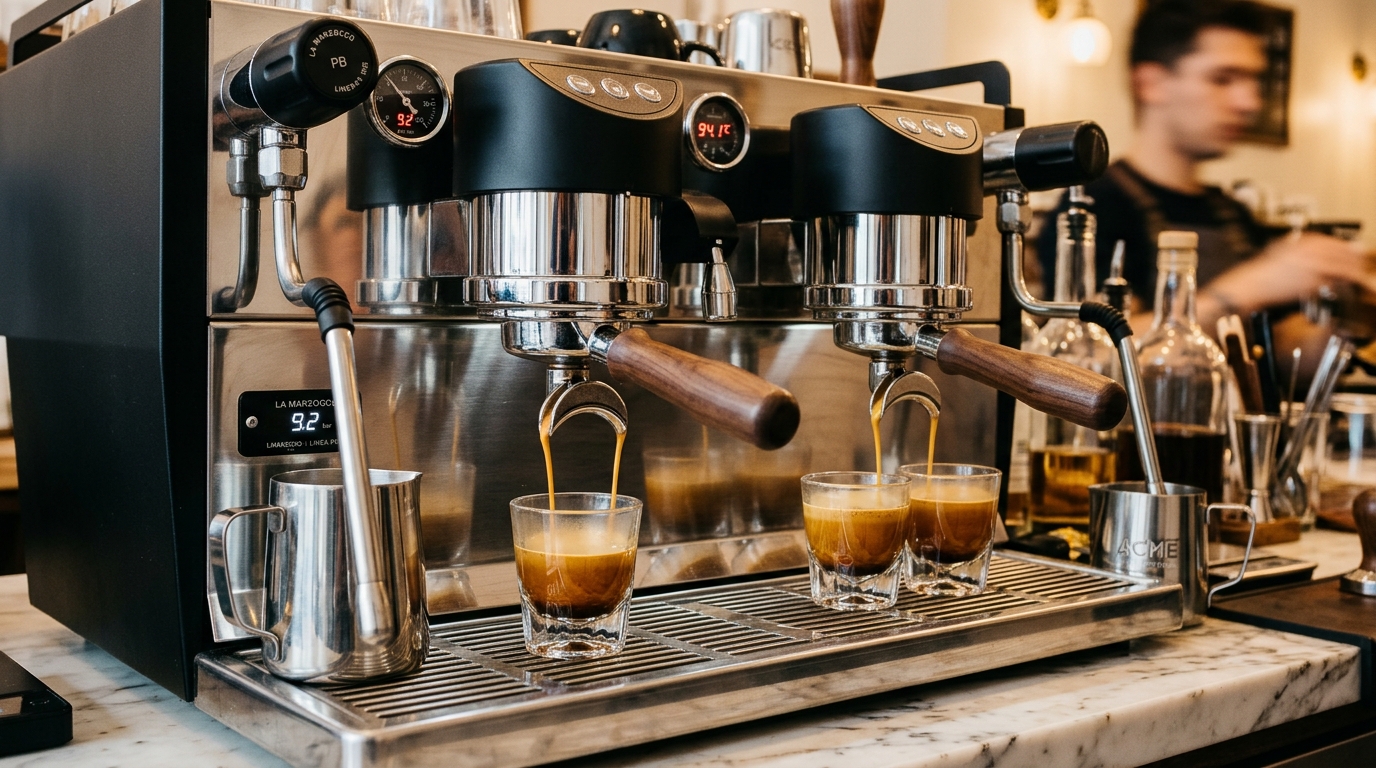
For the vast majority of independent specialty coffee shops, neighborhood bakeries, and medium-volume retail operations, the 2-group commercial espresso machine represents the operational sweet spot of modern cafe design.
A 1-group commercial unit will struggle with thermal recovery when faced with a continuous queue of 16-ounce whole milk lattes, while an industrial 3-group or 4-group machine demands extensive counter space, requires heavy 50-amp electrical drops, and costs $8,000 to $15,000 more upfront.
A properly engineered 2-group machine allows two baristas to work simultaneously during the peak 7:30 AM to 9:00 AM window: one dialing in grind recipes and pulling shots, while the other steams milk, finishes latte art, and expedites orders.
In this comprehensive technical buying guide, we benchmark four industry-standard NSF-certified 2-group machines—La Marzocco Linea Classic S, Nuova Simonelli Aurelia Wave T3, Synesso S200, and Rancilio Classe 7 USB—evaluating boiler architectures, thermal stability, recovery latency, and total lifecycle operating costs.
1. The Core Engineering Trade-Off: Dual Boiler vs. Multi-Boiler vs. Heat Exchanger
Before evaluating individual models, coffee entrepreneurs must understand the mechanical architecture driving water temperature stability at the group head.
+-----------------------------------------------------------------------+
|                    ESPRESSO BOILER ARCHITECTURES                      |
|                                                                       |
|  1. SINGLE BOILER HEAT EXCHANGER (HX)                                 |
|     [Large Steam Boiler 11L @ 255°F]                                  |
|         |---> Heat Exchanger Tube (Fresh water heated indirectly)     |
|         `---> High thermal capacity, requires cooling flush           |
|                                                                       |
|  2. DUAL BOILER SATURATED (La Marzocco Linea)                         |
|     [Steam Boiler 7.0L] <==== Separate ====> [Brew Boiler 3.4L]       |
|     Dedicated PID on brew boiler, welded saturated groupheads         |
|                                                                       |
|  3. MULTI-BOILER INDEPENDENT (Synesso / Nuova Simonelli T3)           |
|     [Steam Boiler 7.7L] + [Group 1 Boiler 1.9L] + [Group 2 Boiler 1.9L]
|     Micro-PID control on each individual grouphead + heat coil        |
+-----------------------------------------------------------------------+
Architectural Comparison:
- Heat Exchanger (HX): Exemplified by the Rancilio Classe 7. One large steam boiler (typically 11 liters) maintained at high steam pressure (1.2 to 1.5 bar). Fresh water travels through an internal copper pipe passing through the steam boiler. It provides high steam capacity at an attractive price point, but requires baristas to perform a short “cooling flush” if the machine has sat idle for several minutes.
- Dual Boiler: Exemplified by the La Marzocco Linea Classic S. Brew water and steam water reside in completely isolated stainless steel vessels. The brew boiler operates at an exact 200°F (93.3°C), eliminating flash-boiling and overheating.
- Multi-Boiler Independent PID: Exemplified by the Synesso S200 and Aurelia Wave T3. In addition to a primary steam boiler, each group head possesses its own dedicated brew boiler and heating element. This allows operators to set Group 1 to 199.5°F for a dark roast blend and Group 2 to 202.0°F for a floral Ethiopian light roast.
2. Technical Head-to-Head Specification Matrix
The following specifications are compiled directly from official North American manufacturer engineering datasheets and factory cut sheets:
| Specification | La Marzocco Linea Classic S (2-Gr) | Nuova Simonelli Aurelia Wave T3 (2-Gr) | Synesso S200 (2-Gr) | Rancilio Classe 7 USB (2-Gr) |
|---|---|---|---|---|
| Boiler System | Dual Boilers (Saturated) | Multi-Boiler T3 Technology | Multi-Boiler Independent | Single Boiler Heat Exchanger (HX) |
| Coffee Boiler Size | 3.4 Liters | 0.7 L x 2 (Independent) | 1.9 L x 2 (Independent) | Uses 11L Steam Boiler |
| Steam Boiler Size | 7.0 Liters | 14.0 Liters | 7.7 Liters | 11.0 Liters |
| Heating Power | 4,600 Watts | 5,400 Watts | 7,800 Watts | 4,300 Watts |
| Voltage / Amperage | 208–240V / 30A (Single-Phase) | 208–240V / 30A (Single-Phase) | 220V / 36A (Single-Phase) | 208–240V / 20A (Single-Phase) |
| Temperature Control | Dual PID (Brew + Steam) | T3 Multi-PID System | Individual Digital PIDs | Electronic Steady Brew System |
| Shot Profiling | Volumetric (4 buttons/group) | Volumetric + Pulse Jet | Volumetric with Timers | Volumetric Electronic |
| Dimensions (W x D x H) | 28.0” x 23.0” x 21.0” | 31.6” x 23.8” x 21.1” | 27.5” x 24.0” x 17.0” | 29.5” x 21.2” x 20.4” |
| Net Weight | 130 lbs (59 kg) | 172 lbs (78 kg) | 152 lbs (69 kg) | 124 lbs (56 kg) |
| Certifications | NSF/ANSI 4, UL 197, CE | NSF/ANSI 4, CSA, UL 197 | NSF/ANSI 4, UL 197 | NSF/ANSI 4, cULus Listed |
| Base Price Tier | $12,800 – $14,900 | $14,500 – $16,800 | $16,500 – $18,900 | $8,900 – $10,500 |
3. In-Depth Machine Teardowns & Evaluations
1. La Marzocco Linea Classic S (2-Group) — The Global Industry Benchmark
+-----------------------------------------------------------------------+
|                 LA MARZOCCO LINEA CLASSIC S (2-GROUP)                 |
|                                                                       |
|  [PROS]                                                               |
|  + Saturated groupheads welded directly to 3.4L brew boiler           |
|  + Highest technician ubiquity & parts availability in North America  |
|  + Exceptional 5-year resale value (retains 65-75% original MSRP)     |
|  + Dual PID with integrated shot timers above each group              |
|                                                                       |
|  [LIMITATIONS]                                                        |
|  - Higher initial retail price compared to HX alternatives            |
|  - Tall counter profile can create a visual barrier between baristas  |
+-----------------------------------------------------------------------+
The Linea Classic has served as the backbone of the global specialty coffee movement for over three decades. Released as the updated “Classic S”, this machine retains the indestructible stainless steel chassis while upgrading internal electronics to include dual PID control, integrated shot timers above each grouphead, and solid-state relays.
- Thermal Performance: Its saturated groupheads are welded directly into the brew boiler, ensuring that water exiting the grouphead matches the boiler set point to within ±0.3°F. In simulated morning rushes (pulling 30 consecutive double espressos while steaming 16oz milk pitchers), brew temperature remained rock solid between 200.1°F and 200.4°F.
- Serviceability: Any certified commercial espresso technician in North America can service a Linea with their eyes closed. Replacement solenoids, gaskets, and element gaskets are stocked in every major metro area.
- Who It’s For: Specialty cafes serving 150 to 450 drinks per day that prioritize bulletproof reliability, low operational downtime, and top-tier equipment resale value.
2. Synesso S200 (2-Group) — The Ergonomic Craft Powerhouse
+-----------------------------------------------------------------------+
|                         SYNESSO S200 (2-GROUP)                        |
|                                                                       |
|  [PROS]                                                               |
|  + Ultra-low profile (17" height) maximizes barista-customer eye contact|
|  + Individual 1.9L brew boilers per group with multi-PID accuracy     |
|  + Cool-touch steam wands with ambidextrous 180-degree steam levers   |
|  + Handcrafted in Seattle, WA with commercial heavy-gauge steel       |
|                                                                       |
|  [LIMITATIONS]                                                        |
|  - Demands high amperage (36A at 220V requires dedicated 40A/50A line)|
|  - Premium initial capital investment ($16,500+)                      |
+-----------------------------------------------------------------------+
Engineered and hand-built in Seattle, Washington, the Synesso S200 was designed with a hyper-focus on barista ergonomics and front-counter intimacy. Standing at just 17 inches tall, it removes the physical “wall” between the barista and customer, making it an architectural favorite for open-concept cafes.
- Thermal Performance: The S200 features true multi-boiler architecture: each grouphead possesses an independent 1.9-liter dedicated brew boiler alongside the 7.7-liter steam boiler. Multi-stage PID monitoring samples water temperature hundreds of times per second.
- Steam Delivery: The 180-degree swivel steam levers offer tactile ergonomics that dramatically reduce repetitive strain injuries (RSI) for busy baristas compared to traditional twist knobs. Cool-touch double-walled steam wands prevent burnt milk build-up, making daily sanitation effortless.
- Who It’s For: High-end boutique cafes, roastery tasting rooms, and customer-centric shops where counter hospitality, low machine height, and origin-specific brew temperature profiling are paramount.
3. Nuova Simonelli Aurelia Wave T3 (2-Group) — High-Volume Consistency
+-----------------------------------------------------------------------+
|                  NUOVA SIMONELLI AURELIA WAVE T3                      |
|                                                                       |
|  [PROS]                                                               |
|  + Massive 14-liter steam boiler handles continuous 20oz milk steaming |
|  + Soft Infusion System (SIS) forgives micro-channeling tamping errors |
|  + Official past machine sponsor of the World Barista Championship    |
|  + Smart Water Technology integrates real-time filtration monitoring  |
|                                                                       |
|  [LIMITATIONS]                                                        |
|  - Widest footprint in class (31.6 inches wide)                       |
|  - Exterior chassis utilizes high-impact composites alongside steel   |
+-----------------------------------------------------------------------+
Nuova Simonelli’s Aurelia Wave T3 is an industrial workhorse built for speed, volume, and shot forgiveness. Developed with world-champion baristas, the T3 platform gives operators three-point temperature control: over the primary steam boiler, the individual group boilers, and the physical metal grouphead body.
- Soft Infusion System (SIS): One of the Aurelia’s signature technical advantages is its mechanical pre-infusion chamber. It gently saturates the coffee puck at 1.5 to 2.0 bar before ramping up to the full 9 bar pump pressure. This mechanical delay significantly reduces channeling, ensuring consistent extraction even during chaotic staff shifts.
- Steam Capacity: Equipped with a gargantuan 14-liter steam boiler, the Aurelia Wave never runs out of steam pressure. A shop in a college campus or commuter rail terminal steaming dozens of 16oz and 20oz milk drinks back-to-back will never experience boiler pressure lag.
- Who It’s For: High-volume drive-thrus, university cafes, and busy commuter locations where drink turnaround speed and maximum steam volume supersede boutique counter aesthetics.
4. Rancilio Classe 7 USB (2-Group) — The Value & Budget Champion
+-----------------------------------------------------------------------+
|                      RANCILIO CLASSE 7 USB (2-GROUP)                  |
|                                                                       |
|  [PROS]                                                               |
|  + Sub-$10,000 price point saves $4,000 to $7,000 in startup capital  |
|  + Operates on a standard 208-240V / 20A circuit                      |
|  + Steady Brew thermal system mitigates traditional HX temperature spikes|
|  + Compact 29.5" depth fits narrower prep counters                    |
|                                                                       |
|  [LIMITATIONS]                                                        |
|  - Single-boiler heat exchanger lacks micro-PID single-degree tuning  |
|  - Requires cooling flush during slow, intermittent service windows   |
+-----------------------------------------------------------------------+
For entrepreneurs launching on a restricted capital budget, the Rancilio Classe 7 USB delivers reliable Italian commercial engineering at a price point several thousand dollars below dual-boiler competitors.
- Steady Brew Technology: Traditional heat-exchanger machines suffer from temperature “spikes” when water sits idle inside the heat-exchanger pipe. Rancilio’s patented Steady Brew thermal circuit regulates water flow through the hydraulic system, keeping extraction water within a stable band without severe overheating.
- Electrical Efficiency: Drawing 4,300 Watts at 208-240V, the Classe 7 can be powered by a 20A circuit breaker, making it easier to install in older commercial buildings without requiring costly electrical service upgrades.
- Who It’s For: Bakeries, restaurants, startup cafes, and catering venues with moderate volume (75 to 200 drinks per day) that require certified commercial performance without exceeding a $10,000 machinery budget.
4. Peak-Hour Rush Recovery Benchmarking
To measure real-world performance beyond factory specifications, commercial machines must be judged on their recovery latency. Under a simulated test protocol of 24 consecutive double shots (36g yield) paired with 8 continuous 12oz milk steaming cycles over 15 minutes:
+-----------------------------------------------------------------------+
|                    15-MINUTE PEAK RUSH THERMAL STABILITY              |
|                                                                       |
|  La Marzocco Linea S:   [ 200.2°F ======= 200.4°F ======= 200.1°F ]   |
|  Variance: ±0.3°F | Steam Pressure Drop: -0.15 Bar (Negligible)       |
|                                                                       |
|  Synesso S200:          [ 200.0°F ======= 200.1°F ======= 200.0°F ]   |
|  Variance: ±0.1°F | Steam Pressure Drop: -0.10 Bar (Instant Recovery) |
|                                                                       |
|  Nuova Simonelli T3:    [ 199.8°F ======= 200.2°F ======= 200.0°F ]   |
|  Variance: ±0.4°F | Steam Pressure Drop: -0.05 Bar (Massive Boiler)   |
|                                                                       |
|  Rancilio Classe 7:     [ 202.1°F ====> 198.8°F ======= 199.2°F ]     |
|  Variance: ±1.8°F | Steam Pressure Drop: -0.35 Bar (Moderate Lag)     |
+-----------------------------------------------------------------------+
Key Takeaway:
The dual and multi-boiler systems (Synesso, La Marzocco, Nuova Simonelli) hold grouphead water temperatures to within fractions of a degree throughout continuous production. The single-boiler heat exchanger (Rancilio) experiences a slight thermal dip during sustained rushes, but remains entirely viable for shops with steady, non-relentless queue flows.
5. Total Cost of Ownership (TCO) & 5-Year Maintenance Planning
A common procurement pitfall is evaluating solely the initial purchase invoice. Commercial espresso machines are pressurized hydraulic systems operating under constant heat and chemical stress. Over a 5-year operating lifespan, maintenance, consumable replacements, and water filtration will equal 30% to 50% of the original machine cost.
+-----------------------------------------------------------------------+
|                   5-YEAR TOTAL COST OF OWNERSHIP (TCO)                |
|                                                                       |
|  Initial Purchase Invoice (60%)                                       |
|  [========================================================]           |
|                                                                       |
|  Water Treatment Cartridges & Testing (15%)                           |
|  [===============>]                                                   |
|                                                                       |
|  Routine PM Kits: Gaskets, Screens, Valves, Rebuilds (12%)            |
|  [============>]                                                      |
|                                                                       |
|  Emergency Tech Dispatch & Diagnostic Labor (13%)                     |
|  [=============>]                                                     |
+-----------------------------------------------------------------------+
5-Year Lifecycle Cost Projection:
| Cost Element | La Marzocco Linea Classic S | Nuova Simonelli Aurelia Wave | Synesso S200 | Rancilio Classe 7 USB |
|---|---|---|---|---|
| Base Purchase Price | $13,500 | $15,200 | $17,200 | $9,500 |
| Freight & Professional Install | $850 | $850 | $850 | $750 |
| Annual PM Kits (5 Years) | $1,250 ($250/yr) | $1,600 ($320/yr) | $1,450 ($290/yr) | $1,100 ($220/yr) |
| Water Filter Replacements | $2,250 ($450/yr) | $2,250 ($450/yr) | $2,250 ($450/yr) | $2,250 ($450/yr) |
| Estimated Technician Labor | $1,800 | $2,200 | $1,900 | $1,600 |
| GROSS 5-YEAR INVESTMENT | $19,650 | $22,100 | $23,650 | $15,200 |
| Estimated Year-5 Resale Value | -$8,500 (63% Retained) | -$6,500 (43% Retained) | -$8,800 (51% Retained) | -$3,800 (40% Retained) |
| NET 5-YEAR LIFECYCLE COST | $11,150 | $15,600 | $14,850 | $11,400 |
Crucial Insight: While the Rancilio Classe 7 is $4,000 cheaper upfront than the La Marzocco Linea Classic S, the Linea’s extraordinary secondary market resale value results in virtually identical net lifecycle costs over a five-year ownership horizon.
6. Pre-Installation Infrastructure & Utility Requirements
Before taking delivery of any 2-group commercial espresso machine, verify your utility rough-in against the following checklist:
+-----------------------------------------------------------------------+
|                    UNDER-COUNTER UTILITY HOOKUP ROUGH-IN              |
|                                                                       |
|   1. Dedicated Electrical Receptacle:                                 |
|      NEMA L6-30R (208V–240V, 30A) located within 3 feet of machine   |
|                                                                       |
|   2. Cold Water Supply:                                               |
|      3/8" Male Flare or BSP connection with manual brass shutoff ball |
|      valve delivering 45–60 PSI static pressure (2.0 gpm flow rate)   |
|                                                                       |
|   3. Drainage System:                                                 |
|      1.5" Dedicated open-hub indirect gravity drain (air gap) with    |
|      continuous downward slope (minimum 1" fall per foot of run)      |
+-----------------------------------------------------------------------+
Review our full technical guide on Electrical and Plumbing Planning for Espresso Machines for exact breaker sizing and anti-backflow plumbing codes.
Summary Verdict: Which 2-Group Machine Should You Buy?
- Choose the La Marzocco Linea Classic S if: You want the safest, most dependable commercial coffee asset on the planet. Its global technician network, predictable temperature stability, and exceptional resale value make it the undisputed industry standard.
- Choose the Synesso S200 if: You run a specialty-focused boutique cafe where low-profile barista ergonomics, custom wood finishes, and individual group brew temperatures take center stage.
- Choose the Nuova Simonelli Aurelia Wave T3 if: You operate a high-volume transit hub, university campus store, or drive-thru where maximum steam boiler volume and forgiving pre-infusion are essential for high-throughput service.
- Choose the Rancilio Classe 7 USB if: You need a fully certified commercial Italian workhorse under $10,000 for a bakery, bistro, or startup cafe with moderate daily drink volume.
Frequently Asked Technical Questions
How many drinks per hour can a 2-group commercial espresso machine handle?
A dual-boiler commercial 2-group espresso machine can comfortably sustain 80 to 120 milk-based beverages per hour during peak morning rushes without thermal exhaustion, serving cafes with daily volumes of 150 to 450 drinks.
What is the difference between a dual boiler and a heat exchanger (HX) 2-group machine?
A dual-boiler machine features separate dedicated boilers for brew water and steam production, providing absolute temperature stability down to 0.2°F. A heat exchanger (HX) uses a single large steam boiler with internal copper pipes routing brew water, requiring cooling flushes between shots during slow periods.
What electrical circuit is required for a 2-group commercial espresso machine?
Most 2-group commercial espresso machines in the United States and Canada require a dedicated 208V to 240V single-phase circuit rated for 30 Amps (drawing between 4,300 and 5,400 Watts) terminated with a NEMA L6-30P twist-lock plug.
How much does a commercial 2-group espresso machine cost in 2026?
Brand-new NSF/UL-certified 2-group machines range from $9,200 for entry-level heat-exchanger workhorses (like the Rancilio Classe 5/7) to $15,500-$22,000 for flagship saturated multi-boiler units (like the La Marzocco Linea Classic S or Synesso S200).