Commercial Espresso Grinders: On-Demand vs Doser vs GbW (2026)
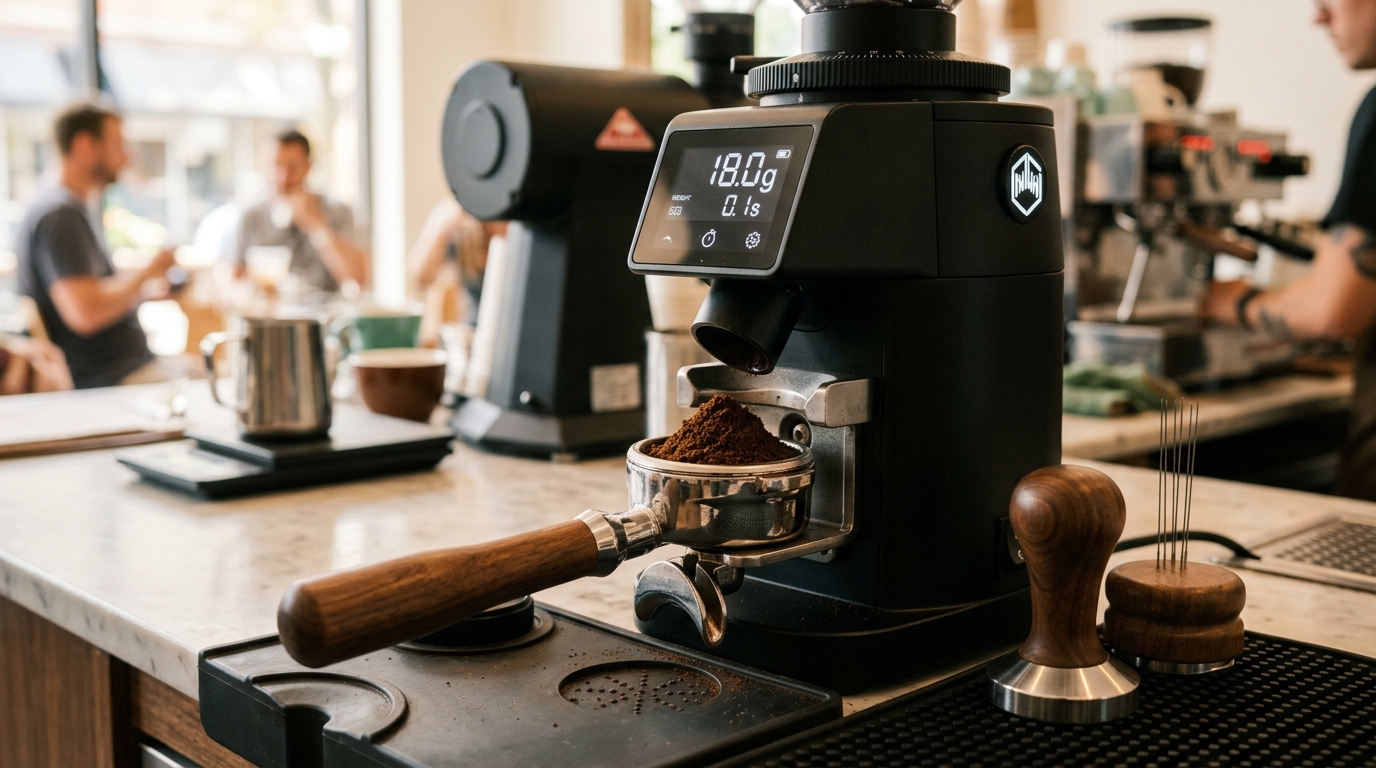
In commercial espresso extraction, there is an undisputed golden rule of cafe engineering: your espresso machine controls extraction water, but your grinder dictates extraction physics.
You can pair an elite $22,000 multi-boiler espresso machine with the world’s most pristine mineral water, but if your grinder generates excessive micro-fines, heats the coffee grounds during a 20-minute morning rush, or delivers inconsistent dose masses between baristas, your espresso will channel, taste astringent, and fluctuate wildly from shot to shot.
Over the past two decades, commercial grinder technology has undergone three major evolutionary leaps:
- First Generation: Mechanical Doser Grinders (manual pull-lever star wheels).
- Second Generation: Electronic Timed On-Demand Grinders (programmable run-time in 0.05-second increments).
- Third Generation: Gravimetric Grind-by-Weight (GbW) Grinders (real-time load-cell mass measurement).
This comprehensive technical guide evaluates the mechanical differences, grind retention physics, thermal dissipation architectures, and financial return on investment (ROI) across all three categories to help coffee shop operators choose the right grinding system in 2026.
1. The Mechanics: How Each Grinding System Operates
+-----------------------------------------------------------------------+
|                    COMMERCIAL GRINDER ARCHITECTURES                   |
|                                                                       |
|  1. TRADITIONAL DOSER GRINDER (e.g., Mazzer Super Jolly Manual)       |
|  [Hopper] -> [Burr Chamber] -> [Storage Drum] -> [Mechanical Star Wheel]
|  - Coffee sits exposed to oxygen inside the doser chamber.            |
|  - Dispenses via spring-loaded manual lever (~5.5g to 8.5g per pull). |
|                                                                       |
|  2. TIMED ON-DEMAND GRINDER (e.g., Eureka Zenith 65 Neo)              |
|  [Hopper] -> [Burr Chamber] -> [Chute / Declumper] -> [Portafilter]   |
|  - Digital timer activates motor for exact duration (e.g., 4.25 sec). |
|  - Direct grind into basket; subject to bean hopper weight variance.  |
|                                                                       |
|  3. GRAVIMETRIC GRIND-BY-WEIGHT (e.g., Mahlkönig E65S GbW)           |
|  [Hopper] -> [Burr Chamber] -> [Load Cell Fork: Real-Time Gram Scale] |
|  - High-speed microprocessor tares portafilter, doses to exact 18.0g. |
|  - Zero barista scale handling; automatic burr distance detection.   |
+-----------------------------------------------------------------------+
1. Traditional Doser Grinders: The 20th-Century Legacy
For decades, the classic Italian cafe setup featured a doser grinder like the original Mazzer Super Jolly or Faema MD. Whole beans were ground in advance into an acrylic holding cylinder containing six radial compartments arranged around a central axis. Baristas pulled a side lever with a mechanical ratchet, rotating the star wheel 60 degrees to drop a pre-measured volume of grounds into the portafilter.
- The Modern Reality: Doser grinders were engineered for high-volume European cafes serving uniform dark Italian roasts within minutes of grinding. In modern specialty coffee shops—where 18.0g recipes must be maintained within $\pm 0.2\text{g}$ and fresh volatile aromatics dissipate within 90 seconds of grinding—doser grinders are an operational liability. Coffee grounds sitting in the holding chamber rapidly oxidize, turn stale, and cake against the acrylic walls.
2. Electronic Timed On-Demand Grinders: The Workhorse Standard
In an on-demand grinder, the holding chamber is eliminated. The grinder discharges freshly ground coffee directly through an anti-static declumping chute into the waiting portafilter basket.
- How Timed Dosing Works: The barista presses their portafilter against a microswitch or push-button. A digital solid-state timer engages the electric motor for a precise duration—for example, exactly 4.15 seconds.
- The Operational Challenge: While vast improvements over doser grinders, timed grinders dose by time, not mass. When a 4-lb bean hopper is full, the downward pressure (head pressure) pushes beans into the burrs faster than when the hopper is nearly empty. Furthermore, as burrs heat up during morning rushes, thermal expansion causes grind size and throughput speed to drift, requiring baristas to constantly check doses on separate tabletop digital scales.
3. Gravimetric Grind-by-Weight (GbW): Precision Automation
Grind-by-Weight represents the pinnacle of modern cafe workflow engineering. Exemplified by the Mahlkönig E65S GbW, E80S GbW, and Victoria Arduino Mythos 2, these grinders integrate a calibrated high-frequency digital load cell directly into the portafilter holder fork.
- The Gravimetric Workflow: The barista locks the empty portafilter into the fork hands-free. The grinder instantly tares the portafilter mass, calculates the remaining target weight (e.g., 18.0g), fires the motor, and applies a predictive algorithm that cuts motor power fractions of a second before reaching the target to account for coffee in mid-air transit.
- The Result: Absolute repeatability to within $\pm 0.1\text{ grams}$, completely eliminating the need for baristas to manually weigh portafilters on tabletop scales between shots.
2. Technical Head-to-Head Specification Matrix
The following specifications are compiled from verified North American commercial engineering datasheets:
| Feature / Metric | Mazzer Super Jolly (Manual Doser) | Eureka Zenith 65 Neo (Timed On-Demand) | Mazzer Super Jolly V Pro (Timed Electronic) | Mahlkönig E65S GbW (Grind-by-Weight) | Nuova Simonelli Mythos One (Clima Pro) |
|---|---|---|---|---|---|
| Dosing Mechanism | Manual Mechanical Star Wheel | Digital Electronic Timer (0.05s) | Touchscreen Dual Timers (0.01s) | Integrated High-Speed Load Cell (GbW) | Timed On-Demand with Heated Chamber |
| Dosing Precision | $\pm 1.0\text{g}$ to $2.0\text{g}$ | $\pm 0.4\text{g}$ | $\pm 0.3\text{g}$ | $\pm 0.1\text{g}$ (Guaranteed) | $\pm 0.2\text{g}$ |
| Burr Type / Geometry | 64mm Flat (Hardened Steel) | 65mm Flat (Diamond Inside) | 64mm Flat (Special Hardened) | 65mm Flat (Special Tool Steel) | 75mm Flat (Titanium Coated) |
| Grinding Speed | 2.5 – 3.2 g/sec | 4.0 – 5.5 g/sec | 3.5 – 4.5 g/sec | 4.5 – 6.0 g/sec | 5.0 – 6.5 g/sec |
| Motor Power (Watts) | 350W @ 1600 RPM | 280W @ 1370 RPM | 350W @ 1600 RPM | 440W @ 1650 RPM | 800W @ 1400 RPM |
| Active Cooling System | None | Passive Convection | Dual Dual-Speed Fans | Active Temperature-Controlled Fan | Heated & Cooled Chamber (35°C–45°C) |
| Total Retention | 8.0g – 14.0g (Heavy) | 1.8g – 3.2g (Moderate) | 1.5g – 2.5g (Low) | 1.8g – 2.4g (Low) | 0.8g – 1.5g (Ultra-Low) |
| Hopper Capacity | 2.7 lbs (1.2 kg) | 2.6 lbs (1.2 kg) | 2.4 lbs (1.1 kg) | 2.6 lbs (1.2 kg) | 2.8 lbs (1.3 kg) |
| Base Price Tier | $850 – $1,100 | $1,250 – $1,450 | $1,650 – $1,900 | $2,750 – $3,200 | $3,400 – $3,800 |
3. The Science of Grind Retention & Coffee Staling
To understand why modern cafes avoid doser grinders, operators must examine the physics of grind retention. Retention is divided into two distinct engineering categories:
+-----------------------------------------------------------------------+
|                    GRIND RETENTION MECHANICS                          |
|                                                                       |
|  1. DEAD SPACE RETENTION:                                             |
|     Ground coffee packed permanently into screw recesses, burr       |
|     carrier gaps, and motor shaft crevices (Does not exchange).       |
|                                                                       |
|  2. EXCHANGE RETENTION (THE ENEMY OF COFFEE):                         |
|     Freshly ground coffee pushes old, oxidized grounds out of the     |
|     chute into your portafilter!                                      |
|                                                                       |
|  [Burrs Grind 18g Fresh] ===> [Pushes 4g Stale Coffee From Chute]     |
|                                      |                                |
|                                      v                                |
|  [Portafilter Basket Receives: 14g Fresh + 4g Stale Rancid Grounds]   |
+-----------------------------------------------------------------------+
Why Exchange Retention Destroys Shot Quality:
When a cafe goes quiet for 15 minutes between customers, the 2 to 6 grams of ground coffee trapped in the exit chute and declumper is exposed to ambient air and high motor residual heat (110°F to 130°F).
When the next customer orders a flat white:
- The grinder activates and dispenses 18g.
- The first 3 to 5 grams entering the basket are stale, oxidized grounds from 15 minutes prior.
- Stale coffee extracts significantly faster because volatile carbon dioxide ($CO_2$) has escaped, causing immediate micro-channeling, watery crema, and astringent sourness.
In on-demand and GbW grinders, exit chutes are designed with steep vertical angles, specialized anti-static flappers, and minimal chute volume, reducing exchange retention to less than 1.5 grams.
4. Burr Geometry: Flat vs. Conical and Thermal Dissipation
The diameter and cutting geometry of your grinder burrs dictate both particle size distribution and thermal stability.
+-----------------------------------------------------------------------+
|                    BURR GEOMETRY & RPM COMPARISON                     |
|                                                                       |
|  FLAT BURRS (e.g., Mahlkönig, Eureka, Mazzer)                         |
|  - Two matching parallel discs spinning face-to-face.                 |
|  - Produces unimodal (uniform) particle distribution.                 |
|  - Enhances clarity, vibrant acidity, and origin separation.          |
|  - Operates at higher RPMs (1400–1650 RPM), requiring cooling fans.  |
|                                                                       |
|  CONICAL BURRS (e.g., Mazzer Kony, Compak K10)                        |
|  - Cone-shaped inner burr spinning inside a matching outer ring.      |
|  - Produces bimodal (two-peak) particle distribution.                 |
|  - Enhances heavy body, chocolate notes, and viscous mouthfeel.       |
|  - Operates at lower RPMs (450–600 RPM) with minimal motor heat.      |
+-----------------------------------------------------------------------+
The Thermal Heat Hazard:
During a high-volume rush (e.g., 60 drinks in 45 minutes), an electric motor running continuously transfers friction heat into the burr carriers. If burr temperature exceeds 122°F (50°C), roasted coffee oils begin to liquefy before extraction, drastically altering the friction coefficient and causing grind size to shift coarser.
To counteract this, elite grinders like the Mahlkönig E65S GbW incorporate temperature sensors and active cooling fans that exhaust heat from the motor compartment, while the Nuova Simonelli Mythos utilizes active thermal heating and cooling (Clima Pro) to lock the grinding chamber at a steady 95°F to 104°F (35°C–40°C) from the first morning shot to the last.
5. Financial ROI Model: The Real Cost of Grinder Waste & Labor
Many cafe founders balk at the $3,000 price tag of a Grind-by-Weight grinder compared to a $1,000 entry-level timed grinder. However, financial modeling reveals that GbW technology typically pays for itself in under 10 months through labor velocity and bean waste elimination.
+-----------------------------------------------------------------------+
|                    ANNUAL FINANCIAL ROI: TIMED VS GBW                 |
|                                                                       |
|  1. DAILY BEAN WASTE SAVINGS:                                         |
|  - Timed Grinder Purges & Dial-in Drift: 12g wasted/day               |
|  - 12g x 365 Days = 4.38 kg (9.6 lbs) of specialty coffee ($18/lb)    |
|  - Annual Coffee Savings: $173/year                                   |
|                                                                       |
|  2. BARISTA LABOR VELOCITY SAVINGS:                                   |
|  - Eliminating manual scale taring saves 4.5 seconds per espresso.    |
|  - Average Volume: 250 espresso drinks per day.                       |
|  - 250 drinks x 4.5 sec = 1,125 seconds (18.75 minutes saved/day).    |
|  - 18.75 min x 365 days = 114.0 hours of labor saved per year.        |
|  - At $16.50/hr Barista Wage = $1,881.00 in Direct Labor Savings!     |
|                                                                       |
|  TOTAL ANNUAL FINANCIAL BENEFIT: $2,054.00 PER YEAR                   |
|  GbW Upgrade Cost ($1,600 difference) Pays for Itself in 9.3 Months!  |
+-----------------------------------------------------------------------+
6. Sizing Recommendations by Cafe Concept & Daily Volume
| Daily Drink Volume | Recommended Grinder Class | Top Recommended Models | Key Reasons for Selection |
|---|---|---|---|
| Mobile Cart / Kiosk (50–120 cups/day) | Compact On-Demand (64mm–65mm) | Eureka Zenith 65 Neo or Mazzer Mini E | Small counter footprint, low power consumption, quiet operation. |
| Neighborhood Cafe (150–300 cups/day) | Commercial Timed or Entry GbW | Mazzer Super Jolly V Pro or Mahlkönig E65S | Robust motor, dual-fan cooling, fast 4-second dosing cycle. |
| High-Volume Flagship (350–700+ cups/day) | Premium Grind-by-Weight (65mm–80mm) | Mahlkönig E65S GbW or Mahlkönig E80S GbW | Eliminates barista scale handling, load-cell precision, rapid queue throughput. |
| Single-Origin / Decaf Station | Single-Dose or Precision On-Demand | Mahlkönig EK43S or Fiorenzato F64 EVO | Zero retention, stepless dial, effortless switching between roast profiles. |
Summary Verdict: Which Grinding System Should You Choose?
- Choose a Traditional Doser Grinder ONLY if: You are operating a low-volume restaurant or bar where coffee is secondary, or you acquire an NSF-certified used unit for under $400 to serve as an emergency back-of-house backup.
- Choose an Electronic Timed On-Demand Grinder (e.g., Eureka Zenith 65 Neo) if: You are launching a startup specialty cafe with a machinery budget under $1,500 per grinder, and your baristas are rigorously trained to verify doses on tabletop scales during shift calibrations.
- Choose a Gravimetric Grind-by-Weight Grinder (e.g., Mahlkönig E65S GbW) if: You operate a medium-to-high volume cafe (150+ drinks/day) where speed of service, shot consistency, and eliminating barista scale-handling fatigue are critical to customer retention and labor efficiency.
Pairing your precision grinder with the correct espresso machinery is essential for cafe throughput. Review our Best 2-Group Commercial Espresso Machines Guide and our 1-Group vs 2-Group Volume Analysis.
Frequently Asked Technical Questions
What is the difference between an on-demand grinder and a doser grinder?
A doser grinder grinds coffee in advance into a mechanical storage chamber with a rotating star-vane lever that dispenses pre-ground coffee in rough volume increments. An on-demand grinder grinds whole beans freshly for every individual portafilter order, either timed to fractions of a second or measured in real time by weight.
How does a Grind-by-Weight (GbW) commercial espresso grinder work?
A Grind-by-Weight grinder utilizes an integrated high-frequency digital load cell built directly into the portafilter fork. It tares the portafilter weight in milliseconds and continuously monitors the ground coffee mass, automatically halting the motor within +/- 0.1 grams of the target recipe, completely eliminating manual scales.
How much coffee does a traditional doser grinder waste compared to on-demand?
A typical high-volume cafe using a traditional doser grinder loses between 8g and 15g of stale coffee grounds during every recipe adjustment and morning calibration. Over a 365-day year, this cumulative waste equals 12 to 20 kg (26 to 44 lbs) of roasted specialty coffee, costing $350 to $700 annually in lost margin.
When should a cafe upgrade from 64mm to 75mm or 80mm burrs?
Cafes serving more than 200 espresso drinks per day should upgrade to 75mm or 80mm burrs. Larger burrs possess greater cutting surface area, enabling faster grind speeds (5.0 to 6.5 g/sec vs 2.5 to 3.5 g/sec) while rotating at lower RPMs or operating for shorter bursts, preventing thermal heat transfer to roasted coffee oils.