Commercial Super-Automatic Espresso Machines: 2026 Guide
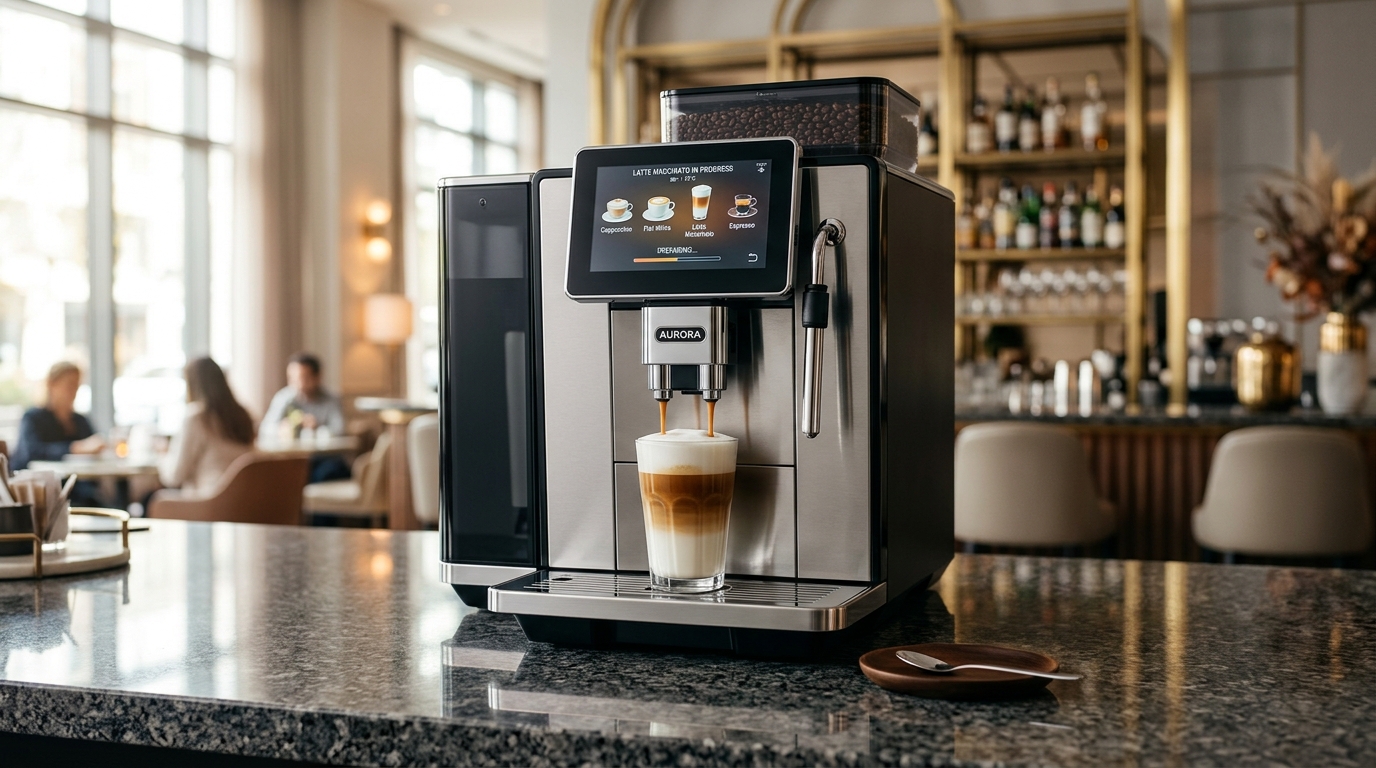
In the commercial coffee equipment industry, no category has evolved more rapidly over the past five years than commercial super-automatic espresso machines.
For decades, the term “super-automatic” conjured images of cheap, plastic vending machines dispensing lukewarm, bitter coffee in hotel lobbies or gas stations. Specialty coffee purists dismissed automated machines, insisting that authentic espresso required a skilled human barista manually grinding, tamping, and steaming on an analog Italian dual-boiler machine.
Today, that stereotype is completely obsolete. Driven by Swiss and Italian aerospace-grade robotics, modern commercial super-automatics—such as the Eversys Cameo, Franke A800 FoamMaster, and Schaerer Coffee Soul—utilize heavy stainless steel brewing chambers, precision ceramic burrs, real-time extraction telemetry, and microfoam air-injection pumps that produce flat whites and cortados virtually indistinguishable from champion barista craft.
For high-volume bakeries, luxury hotels, airport terminals, fast-casual restaurants, and corporate dining facilities facing severe hospitality labor shortages, super-automatics offer a transformative business model: flawless drink consistency with zero barista training.
This comprehensive technical guide evaluates the internal mechanics, milk-texturing physics, financial labor models, and operational trade-offs of commercial bean-to-cup machines in 2026.
1. How a Modern Commercial Super-Automatic Operates
Unlike residential bean-to-cup appliances that utilize lightweight plastic brewing blocks and thermal heating coils, commercial super-automatic systems are built with industrial-grade thermodynamic components.
+-----------------------------------------------------------------------+
|             COMMERCIAL SUPER-AUTOMATIC INTERNAL ARCHITECTURE          |
|                                                                       |
|  [Bean Hopper 1]    [Bean Hopper 2]     [Bean Hopper 3: Decaf]        |
|        |                  |                    |                      |
|        +------------------+--------------------+                      |
|                           |                                           |
|                           v                                           |
|   +---------------------------------------------------------------+   |
|   | Precision Ceramic / Titanium Burr Grinders (Electronic Dosing)|   |
|   +---------------------------------------------------------------+   |
|                           |                                           |
|                           v (Dry dose: 8g to 24g)                     |
|   +---------------------------------------------------------------+   |
|   | Heated Metal Infusion Chamber & Hydraulic Piston Compression  |   |
|   | (Simulates 35-45 lbs of calibrated mechanical tamping force)  |   |
|   +---------------------------------------------------------------+   |
|                           |                                           |
|                           v (9 Bar Pressure Extraction)               |
|   +---------------------------------------------------------------+   |
|   | Dual Dedicated Boilers: Coffee Brew Boiler + High-Output Steam|   |
|   +---------------------------------------------------------------+   |
|                           |                                           |
|            +--------------+--------------+                            |
|            | (Espresso Outflow)          | (Steam & Milk Delivery)    |
|            v                             v                            |
|   +---------------------------------------------------------------+   |
|   | Automatic Venturi Foam Pump (Air micro-injection: 0.1mm foam) |   |
|   +---------------------------------------------------------------+   |
|                           |                                           |
|                           v                                           |
|               [Finished Specialty Beverage]                           |
+-----------------------------------------------------------------------+
The 4 Mechanical Steps of Automated Extraction:
- Precision Dual Grinding: Beans drop from dual or triple transparent hoppers into dedicated commercial grinders. Electronic optical sensors measure grind volume, while self-adjusting stepper motors automatically tighten or loosen burr spacing throughout the day based on extraction flow rates.
- Hydraulic Piston Tamping: Grounds fall into a heavy stainless steel or heated brass brewing chamber capable of holding massive doses (up to 24 grams for double-ristretto recipes). A hydraulic ram compresses the coffee bed with an exact, repeatable pressure of 35 to 45 lbs of tamping force, eliminating human wrist strain and puck density variances.
- Multi-Stage Pre-Infusion & 9-Bar Extraction: Water from a dedicated PID-regulated brass brew boiler saturates the compressed puck at low pressure (2 bar) for a programmable dwell time (2 to 4 seconds) before an industrial rotary pump ramps to 9 bar, delivering rich, golden crema.
- Venturi Microfoam Air Injection: Rather than relying on a barista waving a manual steam pitcher, cold whole milk or oat milk is siphoned from an under-counter refrigerated milk module. A precision venturi air pump injects microscopic air bubbles into the milk stream under high steam pressure, generating silky, glossy microfoam with bubbles smaller than 0.1mm—the exact texture required for pourable latte art.
2. Technical Head-to-Head Specification Matrix
The following table compares the top commercial super-automatic platforms against a traditional manual 2-group setup:
| Feature / Specification | Eversys Cameo c’2m (Swiss) | Franke A800 FoamMaster (Swiss) | Schaerer Coffee Soul 10 (Swiss) | Traditional 2-Group Barista Setup (e.g., La Marzocco Linea) |
|---|---|---|---|---|
| Daily Production Capacity | 175 – 250 drinks/hour | 250 – 350 drinks/hour | 150 – 250 drinks/hour | 80 – 120 drinks/hour |
| Brew Chamber Material | Heavy Heated Stainless Steel | Reinforced Metal Alloy | Heavy Brass & Composite | Brass Group / Stainless Boiler |
| Max Ground Coffee Dose | Up to 24 grams | Up to 22 grams | Up to 20 grams | Up to 22 grams (Manual basket) |
| Milk Frothing Technology | Everfoam (Auto Steam + Venturi) | FoamMaster (Hot/Cold Microfoam) | Best Foam System | Manual Barista Steam Wand |
| Alternative Milk Handling | Dual Milk Lines (Dairy + Oat) | Dual Milk (Independent Lines) | Twin Milk Module | Manual (Dedicated Pitchers) |
| Touchscreen Interface | 10.1” Customizable Android OS | 10.4” Interactive Multimedia | 10.4” Full Touchscreen | Analog Pushbuttons / Toggle |
| Telemetry / Cloud IoT | e’Connect Real-time Dashboard | Franke Digital Services Cloud | Schaerer Coffee Link | Third-party IoT dongle required |
| Electrical Requirement | 208–240V / 30A (Single-Phase) | 208–240V / 30A or 3-Phase | 208–240V / 30A (Single-Phase) | 208–240V / 30A (Single-Phase) |
| Dimensions (W x D x H) | 17.0” x 23.6” x 23.0” | 13.4” x 23.6” x 29.3” | 13.2” x 23.6” x 22.8” | 28.0” x 23.0” x 21.0” |
| Base Price Tier | $22,500 – $26,000 | $24,000 – $29,000 | $16,500 – $19,500 | $17,000 – $22,000 (With Grinders) |
3. The Great Debate: Super-Automatic vs. Traditional Manual Bar
Choosing between a manual barista bar and a super-automatic system is not merely an equipment decision—it defines your operational labor model, customer experience, and brand identity.
+-----------------------------------------------------------------------+
|                    OPERATIONAL COMPARISON AT A GLANCE                 |
|                                                                       |
|  TRADITIONAL MANUAL BARISTA BAR       COMMERCIAL SUPER-AUTOMATIC      |
|  [Requires Master Barista Craft]      [Push-Button Beverage Delivery] |
|                                                                       |
|  - Drink Prep Time: 55 to 75 seconds  - Drink Prep Time: 25 to 35 sec |
|  - Staff Training: 40+ Hours          - Staff Training: 15 Minutes    |
|  - Labor Cost: Senior Baristas ($18/h)- Labor Cost: Cashier / Clerk   |
|  - Consistency: Human Dependent       - Consistency: 100% Guaranteed  |
|  - Specialty Brand Appeal: HIGHEST    - Specialty Brand Appeal: B2B   |
+-----------------------------------------------------------------------+
1. Speed of Service & Throughput:
A seasoned barista operating a manual 2-group machine takes between 55 and 75 seconds to grind, weigh, tamp, pull a double shot, steam milk in a pitcher, pour latte art, and rinse the portafilter. A modern super-automatic machine completes this entire sequence in 25 to 35 seconds at the touch of a single screen icon. In environments with concentrated peak rush windows (e.g., morning commuter trains or conference breaks), a super-automatic delivers more than double the revenue throughput per hour.
2. Labor Dependency & Employee Turnover:
The specialty coffee industry suffers an annual employee turnover rate exceeding 100%. Training a new hire to dial in grind sizes, distribute grounds without channeling, and steam silky microfoam requires weeks of supervision. With a super-automatic machine, a new staff member can be fully trained in 15 minutes. Any employee can produce a menu-standard vanilla oat latte, eliminating store closures caused by barista sick leave or sudden resignations.
3. Customer Perception & Brand Positioning:
This is the single biggest argument against super-automatics in specialty coffee. Customers visiting an independent third-wave cafe expect the romantic theater of the barista: the clinking of portafilters, the sound of whole beans grinding, and hand-poured latte art. If your brand positioning is rooted in artisan craft, hiding the process behind an automated touchscreen can alienate discerning coffee enthusiasts.
4. Financial Labor Model: The 3-Year Cost Reality
While a premium super-automatic requires a higher initial capital outlay ($24,000 vs $18,000 for a manual setup with grinders), its impact on annual labor savings transforms cafe unit economics.
+-----------------------------------------------------------------------+
|                    3-YEAR LABOR & EQUIPMENT COST MODEL                |
|                                                                       |
|  SCENARIO: Retail cafe open 12 hours/day, 365 days/year.              |
|                                                                       |
|  OPTION A: TRADITIONAL MANUAL BARISTA BAR                             |
|  - Requires 2 Baristas on shift during peak hours (16 labor hrs/day). |
|  - 16 hrs x 365 days = 5,840 labor hours / year.                      |
|  - At $17.50/hr (Wages + Payroll Tax + Benefits) = $102,200/year.     |
|  - 3-Year Labor Cost:                                     $306,600    |
|  - Initial Equipment Outlay (Linea + 2 Grinders + Rinser):  $20,500    |
|  - 3-Year Maintenance & PM Service:                        $4,500    |
|  TOTAL 3-YEAR OPERATIONAL OUTLAY:                         $331,600    |
|                                                                       |
|  OPTION B: COMMERCIAL SUPER-AUTOMATIC (Eversys / Franke)              |
|  - Requires only 1 Cashier/Operator on shift (12 labor hrs/day).      |
|  - 12 hrs x 365 days = 4,380 labor hours / year.                      |
|  - At $16.00/hr (Entry-level cross-trained team member) = $70,080/yr.  |
|  - 3-Year Labor Cost:                                     $210,240    |
|  - Initial Equipment Outlay (Eversys Cameo System):        $24,500    |
|  - 3-Year Preventative Service Contract:                   $6,000    |
|  TOTAL 3-YEAR OPERATIONAL OUTLAY:                         $240,740    |
|                                                                       |
|  NET 3-YEAR CASH SAVINGS WITH SUPER-AUTOMATIC:             $90,860!   |
+-----------------------------------------------------------------------+
The Financial Conclusion:
In concepts where coffee is complementary to a broader food program (e.g., high-end bakeries, gourmet delis, luxury car dealerships, and corporate dining), operating a super-automatic saves over $30,000 annually in direct labor costs, fully offsetting its capital investment within the first nine months of operation.
5. Cleaning & Sanitation: The Clean-in-Place (CIP) Standard
In manual machines, sanitation depends on tired baristas remembering to backflush groups with chemical powder and soak steam wands at closing. Neglect leads to sour milk buildup and health department violations.
Modern super-automatics feature automated Clean-in-Place (CIP) protocols:
- Franke CleanMaster: Integrated chemical dosing modules automatically dispense the exact ratio of alkaline detergent and acid descaling agents through internal milk hoses and brewing chambers. Staff simply connect the cleaning adapter, press “Start Nightly Clean”, and walk away. The machine sanitizes itself for 20 minutes, flushes thoroughly, and enters an energy-saving sleep mode.
- Health Code Certification: Units carry NSF/ANSI Standard 4 and HACCP food-safety certifications, guaranteeing that internal milk temperatures remain below 41°F (5°C) inside refrigerated modules even during 95°F summer ambient heat.
6. Sizing & Selection Framework: Which Concepts Should Automate?
+-----------------------------------------------------------------------+
|                    EQUIPMENT SELECTION DECISION TREE                  |
|                                                                       |
|   Is artisan barista theater and hand-poured latte art your primary   |
|   customer value proposition?                                         |
|      |                                                                |
|      +--- YES ===> TRADITIONAL MANUAL 2-GROUP MACHINE                 |
|      |             (La Marzocco Linea Classic S or Synesso S200)      |
|      |                                                                |
|      +--- NO  ===> Is daily drink speed (>200 drinks/hr) and minimal  |
|                    labor dependency your priority?                    |
|                      |                                                |
|                      +--- YES ===> COMMERCIAL SUPER-AUTOMATIC         |
|                      |             (Eversys Cameo or Franke A800)     |
+-----------------------------------------------------------------------+
Concepts That Should Choose a Super-Automatic:
- Artisan Bakeries & Pastry Shops: Customers come for bread and croissants; coffee is an incremental high-margin add-on. A super-automatic allows pastry staff to produce barista-level lattes without hiring dedicated coffee specialists.
- High-Volume Drive-Thrus & Kiosks: Maximum throughput speed is the only metric that matters. Cutting service times from 60s to 30s per vehicle doubles drive-thru window revenue.
- Boutique Hotels & Executive Lounges: Premium 24/7 guest service without staffing full-time baristas overnight.
- Corporate Campuses & High-End Co-Working Spaces: Providing tenants with specialty-grade flat whites and cappuccinos on a touchless self-service keycard billing system.
Concepts That Should Stick to a Traditional Manual Bar:
- Third-Wave Specialty Roasteries & Coffee Shops: Where the barista-customer relationship, single-origin dial-in conversations, and manual craftsmanship are central to the brand.
Whether choosing manual or automated machinery, proper utility infrastructure is mandatory. Consult our Electrical and Plumbing Planning Guide and our Water Filtration Guide.
Frequently Asked Technical Questions
What is a commercial super-automatic espresso machine?
A commercial super-automatic espresso machine is a fully automated, bean-to-cup commercial beverage system that integrates whole-bean grinding, mechanical tamping, precision pressure extraction, and automated milk texturing into a single self-contained unit operated via a digital touchscreen interface.
Can a modern super-automatic machine match the espresso quality of a traditional manual barista?
Yes. Premium commercial super-automatics (such as the Swiss-engineered Eversys Cameo or Franke A800) utilize heavy metal brewing chambers, precision ceramic burrs, and real-time electronic extraction feedback loops, producing espresso and microfoam that rival certified specialty baristas while guaranteeing 100% consistency across thousands of drinks.
How much does a commercial super-automatic espresso machine cost?
Commercial NSF/UL-certified super-automatic machines range from $12,000 for mid-volume bakery/restaurant units (e.g., Schaerer Coffee Soul) to $22,000–$34,000 for high-volume enterprise systems (e.g., Eversys Enigma or Franke A1000) capable of producing 250 to 350 drinks per hour.
How are commercial super-automatic machines cleaned?
Modern super-automatic units feature automated daily clean-in-place (CIP) cycles. Operators connect an integrated chemical cleaning cartridge, press a touchscreen button, and the system autonomously flushes, chemical-washes, and sanitizes all internal coffee lines and milk frothing manifolds without manual disassembly.