Commercial Coffee Water Testing: SCA Mineral Standards Guide (2026)
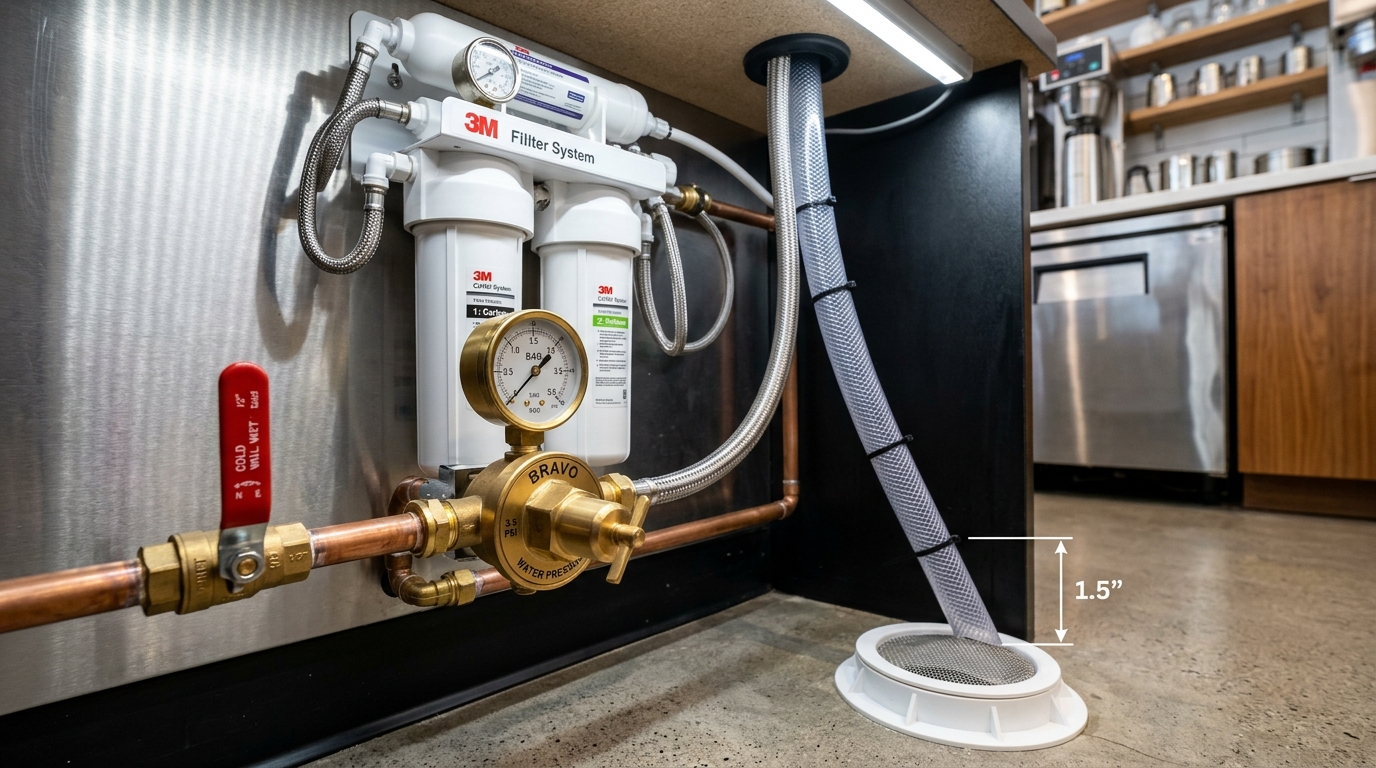
In the craft of coffee brewing, baristas spend thousands of hours studying origin elevations, anaerobic fermentation techniques, roasting development profiles, and grinder particle distributions.
Yet all of that agronomic and roasting excellence is dissolved into a liquid medium that is 98.5% water in filter coffee and 90% water in espresso.
If your water chemistry is deficient, your coffee will fail. Water with deficient mineral hardness produces flat, hollow, sharp, vegetal brews that lack sweetness and body. Conversely, water with excessive bicarbonate alkalinity acts like a chemical sponge, completely extinguishing vibrant fruit notes and leaving the cup dull and chalky.
Even worse, flawed water chemistry destroys equipment. A lack of buffering minerals induces aggressive acidic boiler corrosion, while excessive calcium causes limescale to weld solenoid valves shut and burn out immersion heating elements in under a year.
Unfortunately, many cafe operators believe that purchasing a $15 digital TDS pen from Amazon constitutes “water testing.”
This technical guide exposes the limitations of simple TDS meters, details the Specialty Coffee Association (SCA) water quality standards, explains the mathematics of the Langelier Saturation Index (LSI), and outlines the step-by-step chemical titration protocols required to safeguard both beverage flavor and commercial machinery in 2026.
1. The Myth of the Handheld TDS Meter
A handheld Total Dissolved Solids (TDS) meter is an electrical conductivity sensor. It passes a small electrical current between two titanium electrodes, measures the resistance, and applies a generic conversion factor (typically 0.5 to 0.7) to estimate parts per million (PPM).
+--------------------------------------------------------------------------+
|                     WHAT A TDS METER CANNOT TELL YOU                     |
|                                                                          |
|   SCENARIO A: 150 PPM TDS (THE GOLDEN EXTRACTION WATER)                  |
|   - Calcium (Ca²⁺): 50 PPM        -> Extracts sweet, rich carbohydrates  |
|   - Magnesium (Mg²⁺): 25 PPM      -> Extracts bright, vibrant aromatics  |
|   - Bicarbonate (HCO₃⁻): 50 PPM   -> Buffers harsh organic acids         |
|   - Chlorides (Cl⁻): 0 PPM        -> ZERO CORROSION RISK                 |
|   - SENSORY RESULT: World-class balance, round sweetness, pristine origin|
|                                                                          |
|   SCENARIO B: 150 PPM TDS (THE BOILER-DESTROYING DISASTER)               |
|   - Calcium (Ca²⁺): 10 PPM        -> Inadequate extraction; hollow cup   |
|   - Sodium (Na⁺): 60 PPM          -> Salty, flat, heavy mouthfeel        |
|   - Bicarbonate (HCO₃⁻): 20 PPM   -> Insufficient buffer; sour acidity   |
|   - Chlorides (Cl⁻): 60 PPM       -> SEVERE STAINLESS STEEL PITTING      |
|   - EQUIPMENT RESULT: Boiler wall breached by pinholes in 12 months      |
|                                                                          |
|   >>> BOTH WATERS READ EXACTLY 150 PPM ON A HANDHELD TDS METER! <<<      |
+--------------------------------------------------------------------------+
To understand water chemistry, you must stop measuring generic “TDS” and begin testing the specific chemical ions dissolved in the water.
2. The SCA Water Quality Standards: Target Parameters Decoded
The Specialty Coffee Association (SCA) conducted decades of sensory trials to establish the scientific parameters for water that maximizes sweetness and aromatics without causing scale or corrosion:
| Chemical Parameter | SCA Target Standard | Acceptable Commercial Range | Impact on Coffee Sensory Extraction | Impact on Machine Longevity |
|---|---|---|---|---|
| Total Hardness | 68 PPM ($CaCO_3$) | 50 – 175 PPM ($CaCO_3$) | Calcium & Magnesium bind to volatile fruit acids and caramelized sugars. | Excessive hardness (>175 PPM) creates rapid, catastrophic limescale. |
| Carbonate Alkalinity | 40 PPM ($CaCO_3$) | 40 – 75 PPM ($CaCO_3$) | Acts as an acid buffer. Regulates perceived sourness and citric bite. | Below 30 PPM allows water to turn acidic; above 80 PPM forces scale. |
| pH | 7.0 (Neutral) | 6.5 – 8.0 | Prevents acid hydrolysis while maintaining flavor clarity. | pH < 6.5 aggressively leaches copper and brass; pH > 8.0 accelerates scale. |
| Total Dissolved Solids | 150 PPM | 75 – 250 PPM | Provides baseline ionic strength for osmotic extraction. | Values < 50 PPM cause aggressive leaching; > 300 PPM muds flavor. |
| Chlorides ($Cl^-$) | < 10 PPM | Strictly < 30 PPM Max | Imparts a chemical, salty, or flat aftertaste at high levels. | > 30 PPM causes irreversible pitting corrosion on stainless steel. |
| Total Chlorine ($Cl_2$) | 0 PPM | 0 PPM (Absolute Zero) | Reacts with phenols to produce foul, medicinal chlorophenol flavors. | Attacks rubber gaskets, EPDM O-rings, and silicone seals. |
| Iron / Manganese | 0 PPM | 0 PPM (Absolute Zero) | Imparts an intense metallic, bitter, blood-like off-flavor. | Stains internal boiler walls and fouls liquid level probes. |
3. Extraction Chemistry: Hardness Cations vs. Bicarbonate Buffers
To understand how water interacts with coffee during brewing, you must visualize extraction as an intermolecular tug-of-war:
+--------------------------------------------------------------------------+
|                  THE FLAVOR EXTRACTION TUG-OF-WAR                        |
|                                                                          |
|   EXTRACTING CATIONS (The Harvesters):                                   |
|   - Calcium (Ca²⁺) & Magnesium (Mg²⁺)                                    |
|   - Small, highly charged positive ions with dense electron fields.      |
|   - They bond to oxygen-rich organic compounds inside coffee grounds,    |
|     literally pulling sugars, fruit esters, and roasted aromatics out    |
|     of the cellular matrix and into solution.                            |
|                                                                          |
|                               VS.                                        |
|                                                                          |
|   ALKALINITY ANIONS (The Buffering Sponge):                              |
|   - Bicarbonate (HCO₃⁻)                                                  |
|   - Negatively charged alkaline buffer.                                  |
|   - When bright, acidic coffee compounds (citric, malic, chlorogenic)    |
|     dissolve into water, they release hydrogen ions (H⁺).                |
|   - Bicarbonate absorbs these H⁺ ions:                                   |
|                                                                          |
|          H⁺ + HCO₃⁻  <=====>  H₂O + CO₂                                  |
|                                                                          |
|   - RESULT: If alkalinity is too high (120 PPM), all sparkling acidity  |
|     is neutralized. The coffee tastes flat, muted, and muddy.            |
|   - If alkalinity is too low (15 PPM), none of the acids are buffered.   |
|     The coffee tastes sour, vinegar-sharp, and unpleasantly biting.      |
+--------------------------------------------------------------------------+
The Magnesium vs. Calcium Nuance:
- Magnesium ($Mg^{2+}$): Possesses a smaller ionic radius and higher charge density than calcium. It is the most powerful mineral for extracting delicate floral, fruity, and light volatile aromatics. Furthermore, magnesium carbonate is roughly ten times more soluble than calcium carbonate, meaning high magnesium levels extract exceptional flavor with significantly lower risk of boiler scale.
- Calcium ($Ca^{2+}$): Excellent for extracting creamy mouthfeel, heavy caramelized sugars, and chocolate notes, but poses the primary risk for scale formation inside steam boilers.
4. The Langelier Saturation Index (LSI): Thermodynamic Scaling Math
Developed by Dr. Wilfred Langelier, the Langelier Saturation Index (LSI) is an equilibrium model that determines whether water will dissolve or precipitate calcium carbonate ($CaCO_3$):
$$\text{LSI} = \text{pH} - \text{pH}_s$$
Where $\text{pH}$ is the actual measured pH of the water, and $\text{pH}_s$ is the saturation pH at which water is in chemical equilibrium with calcium carbonate at a specific temperature.
  LSI Value Spectrum:
  < -0.5               -0.2 to +0.2               > +0.5
  +-------------------------+-------------------------+
  CORROSIVE & ETCHING       BALANCED & STABLE         SCALE-FORMING
  Water dissolves metal     Ideal operation           Precipitates CaCO3
  Leaches copper/brass      Protective barrier        Chokes boilers & valves
The Steam Boiler Thermodynamic Trap:
The formula for $\text{pH}_s$ depends heavily on water temperature:
$$\text{pH}_s = (9.3 + A + B) - (C + D)$$
Where temperature factor $A$ decreases significantly as water heats up.
Consider this real-world cafe example:
- You test your filtered tap water on the counter at room temperature (70°F / 21°C). The calculated LSI is -0.05. You conclude your water is perfectly balanced and safe.
- That same water enters the commercial espresso steam boiler, where it is heated to 260°F (127°C) at 1.4 bars of steam pressure.
- Because calcium carbonate solubility plunges at high temperatures, the LSI inside the steam boiler shifts from -0.05 to +0.78.
- Result: Water that appeared neutral on the counter is violently precipitating hard limescale on the heating element every second the cafe is open. Review our Boiler Descaling Protocol to manage scale buildup.
5. Professional On-Site Water Testing Protocol (Drop Titration)
To maintain control over water quality, coffee shop managers must perform monthly liquid drop-titration tests. Strip tests (paper test strips) are notoriously inaccurate, varying by 30% to 50% due to color-chart subjectivity.
+--------------------------------------------------------------------------+
|                  LIQUID DROP-TITRATION TESTING PROTOCOL                  |
|                                                                          |
|   REQUIRED TEST KIT:                                                     |
|   - API GH & KH Test Kit (or Hach Drop-Count Titration Kit)              |
|   - High-Precision Taylor Water Chloride Drop Kit                        |
|   - Calibrated Digital pH Meter (with 4.01 and 7.00 buffer solutions)    |
|                                                                          |
|   TEST 1: CARBONATE ALKALINITY (KH):                                     |
|   1. Fill clean test vial with exactly 5.0 mL of filtered coffee water.  |
|   2. Add KH reagent drop by drop. Invert vial between each drop.         |
|   3. Count drops until color transitions decisively from BLUE to YELLOW. |
|   4. CALCULATION: 1 drop = 1 German degree of hardness (dKH).            |
|      Multiply dKH by 17.848 to obtain PPM CaCO₃ equivalent.              |
|      (e.g., 3 drops = 3 dKH × 17.85 = 53.5 PPM Alkalinity).              |
|                                                                          |
|   TEST 2: TOTAL GENERAL HARDNESS (GH):                                   |
|   1. Fill test vial with 5.0 mL of water.                                |
|   2. Add GH reagent drop by drop. Invert between drops.                  |
|   3. Count drops until color transitions from ORANGE to GREEN.           |
|   4. CALCULATION: 1 drop = 1 dGH.                                        |
|      Multiply dGH by 17.848 to obtain PPM Total Hardness.                |
|      (e.g., 4 drops = 4 dGH × 17.85 = 71.4 PPM Total Hardness).          |
|                                                                          |
|   TEST 3: CHLORIDE TESTING (MANDATORY FOR STAINLESS BOILERS):            |
|   1. Add chloride indicator reagent; titrate with silver nitrate.        |
|   2. Record PPM. If Chloride exceeds 30 PPM, IMMEDIATELY investigate     |
|      Reverse Osmosis filtration.                                         |
+--------------------------------------------------------------------------+
6. Seasonal Municipal Water Shifts: When Clean Water Turns Toxic
Municipal tap water is not a static chemical formula; it changes dynamically throughout the calendar year based on weather, reservoir turnover, and municipal treatment adjustments:
+--------------------------------------------------------------------------+
|                  SEASONAL MUNICIPAL WATER VULNERABILITIES                |
|                                                                          |
|   WINTER HAZARD: ROAD SALT RUNOFF                                        |
|   - In northern US states and Canada, highway departments spread         |
|     thousands of tons of sodium chloride (NaCl) and calcium chloride     |
|     (CaCl₂) on roads. Snowmelt carries massive chloride spikes into      |
|     municipal reservoirs, driving tap chloride levels from 15 PPM to     |
|     over 75 PPM, triggering winter boiler pitting corrosion.             |
|                                                                          |
|   SPRING HAZARD: SNOWMELT DILUTION & ACID SPIKES                         |
|   - Heavy mountain snowmelt dilutes natural mineral aquifers. Raw water  |
|     hardness plunges, stripping buffer alkalinity and lowering pH,       |
|     turning municipal tap water aggressive and corrosive.                |
|                                                                          |
|   SUMMER HAZARD: ALGAL BLOOMS & CHLORINE SURGES                          |
|   - Warmer reservoir temperatures accelerate bacterial and algal growth. |
|     Municipal water plants respond by doubling chlorine or chloramine    |
|     disinfection doses. Unprotected carbon filters become exhausted,     |
|     allowing medicinal bleach off-flavors to penetrate espresso bars.    |
+--------------------------------------------------------------------------+
Review our dedicated filtration architecture guides:
- Reverse Osmosis with Remineralization vs. Ion-Exchange Softening
- Commercial Water Filtration Systems: Everpure vs. OptiPure vs. 3M
7. The Coffee Shop Manager’s Water Quality Audit Sheet
To protect your business against $5,000 emergency repair bills and maintain elite sensory consistency, mandate this testing log for your lead baristas:
- Monthly On-Site Titration: Test GH, KH, and Chlorides on the 1st of every month. Log data in a shared binder or digital spreadsheet.
- Quarterly Filter Cartridge Delta Check: Measure pressure drop across your filtration manifold. If incoming dynamic pressure drops by more than 10 PSI during brewing, cartridges are clogged and require replacement.
- Bi-Annual Laboratory Analysis: Send an un-aerated 500 mL water sample to a certified agricultural or coffee testing lab (such as Ward Labs) twice per year to verify heavy metals, silica, and sulfate concentrations.
- Immediate Action Thresholds:
- If Alkalinity drops below 35 PPM: Increase bypass blending or replace remineralization cartridge immediately.
- If Total Hardness exceeds 150 PPM: Adjust ion-exchange bypass downward to prevent boiler scaling.
- If Chlorides exceed 30 PPM: Halt ion-exchange bypass and switch to 100% Reverse Osmosis with post-calcite remineralization.
Frequently Asked Technical Questions
Why is an inexpensive digital TDS meter insufficient for coffee water testing?
A handheld TDS meter does not measure physical dissolved solids; it measures electrical conductivity and estimates Total Dissolved Solids using a mathematical multiplier. Crucially, a TDS meter cannot differentiate between beneficial calcium and magnesium ions that extract sweet coffee compounds, neutral bicarbonate buffers, or corrosive chlorides and salty sodium. Relying strictly on TDS blindness can allow lethal chloride corrosion to destroy an espresso boiler while the screen displays an 'acceptable' 130 PPM.
What is the difference between General Hardness (GH) and Carbonate Hardness (KH)?
General Hardness (GH) measures the total concentration of divalent mineral cations—primarily calcium (Ca²⁺) and magnesium (Mg²⁺)—which act as molecular claws that bond to and extract flavor compounds from coffee grounds. Carbonate Hardness (KH / Alkalinity) measures the concentration of negative bicarbonate anions (HCO₃⁻) and carbonate ions (CO₃²⁻), which act as a chemical buffer that neutralizes acidic hydrogen ions, regulating the perceived sourness of the beverage.
What is the official SCA standard for commercial coffee water?
The Specialty Coffee Association (SCA) water quality target defines: Total Hardness between 50 and 175 PPM CaCO₃ (target: 68 PPM), Carbonate Alkalinity between 40 and 75 PPM CaCO₃ (target: 40 PPM), pH between 6.5 and 8.0 (target: 7.0), Total Chlorine at 0 PPM, and Total Dissolved Solids (TDS) between 75 and 250 PPM (target: 150 PPM).
What is the Langelier Saturation Index (LSI) and why does temperature matter?
The Langelier Saturation Index (LSI) is a thermodynamic equation that calculates whether water will precipitate calcium carbonate scale (LSI > +0.5), remain chemically balanced (LSI between -0.2 and +0.2), or dissolve existing protective oxide layers and corrode metal (LSI < -0.5). Because calcium carbonate becomes LESS soluble as temperature rises, water that appears balanced at room temperature (70°F / 21°C) can become violently scale-forming inside a 260°F (127°C) steam boiler.
How often should a commercial coffee shop test its water chemistry?
Commercial cafes should perform on-site drop-titration testing for Total Hardness, Carbonate Alkalinity, and Chlorides at least once per month. In regions subject to winter road salt runoff or agricultural seasonal shifts, testing every two weeks during seasonal transitions is strongly recommended to catch municipal chemical spikes before scale or corrosion damages equipment.