OptiPure vs. Pentair Everpure vs. 3M Water Filtration (2026)
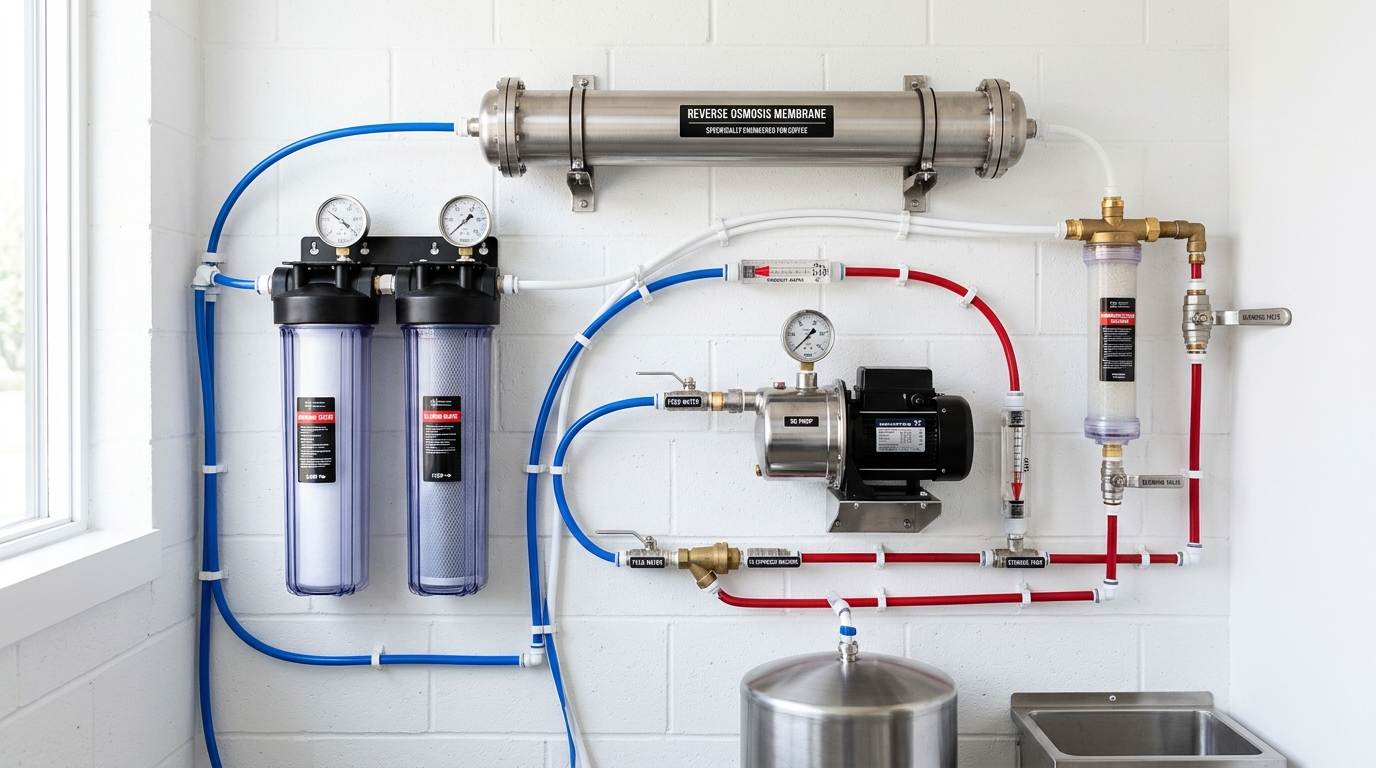
In the commercial foodservice and hospitality equipment industry, three corporate giants dominate commercial water filtration in North America: Pentair Everpure, OptiPure (Procam Controls), and 3M Purification (Cuno).
Walk into virtually any independent third-wave roastery, national specialty coffee chain, high-volume bakery, or drive-thru in the United States or Canada, and mounted beneath the espresso counter or on the utility room wall you will find the distinct aluminum, composite, or stainless manifolds of one of these three manufacturers.
Choosing the right filtration platform is one of the most critical infrastructure decisions you will make during your cafe buildout.
Because filter heads and cartridges utilize proprietary, non-interchangeable bayonet connections, the brand you mount to your wall dictates your replacement cartridge supply chain, annual operating costs, flow rate thresholds, and boiler scale protection for the next decade.
This comprehensive technical guide delivers an authoritative head-to-head comparison of OptiPure vs. Pentair Everpure vs. 3M Purification, analyzing manifold engineering, filtration media chemistry, commercial Reverse Osmosis systems, and total annual operating costs in 2026.
1. Manifold Architecture: Sanitary Quick Change (SQC) Engineering
Gone are the days when cafe technicians had to wrestle with bulky, dripping, threaded 10-inch plastic filter bowls using clumsy plastic wrenches, spilling gallons of stagnant water onto cabinet floors.
Modern commercial coffee bars exclusively deploy Sanitary Quick Change (SQC) manifold heads:
+--------------------------------------------------------------------------+
|                  SANITARY QUICK CHANGE (SQC) HEAD MECHANICS              |
|                                                                          |
|   1. INTEGRATED AUTO-SHUTOFF VALVE                                       |
|   - An internal spring-loaded mechanical plunger rests inside the head.  |
|   - When a cartridge is rotated 1/4 turn to remove:                      |
|     * The spring instantly snaps the inlet water valve CLOSED.           |
|     * Water pressure is sealed upstream.                                 |
|     * Zero water leaks onto the floor; NO MAIN WATER SHUTOFF REQUIRED!   |
|                                                                          |
|   2. HYGIENIC SEALED ENCAPSULATION                                       |
|   - The internal filter media, carbon, and O-rings are sealed inside     |
|     a heavy-duty virgin polypropylene or aluminum canister.              |
|   - Baristas never touch wet filter media with bare hands during swaps.  |
|   - Eliminates bacterial contamination during cartridge changes.         |
|                                                                          |
|   3. 30-SECOND REPLACEMENT                                               |
|   - Twist old cartridge 90 degrees left -> Pull down.                    |
|   - Insert new cartridge -> Push up -> Twist 90 degrees right. Done.     |
+--------------------------------------------------------------------------+
The Three Proprietary Head Standards:
- Pentair Everpure QL3 & QL3B Heads: The most recognizable head in coffee history. Heavy-duty cast aluminum mounting bracket with brass 3/8-inch NPT threaded female ports. Features an integrated shutoff valve and optional built-in water pressure gauge port. Highly durable, though aluminum castings can show surface corrosion if exposed to chronic drip tray humidity.
- OptiPure QX & CT Series Manifolds: Engineered from ultra-durable, food-grade reinforced composite polymers with zero metallic corrosion risk. High-flow internal channels reduce friction loss, maintaining higher dynamic water pressure during simultaneous multi-appliance draws.
- 3M Purification VH3 & NH3 Series Heads: Engineered with 3M’s patented sanitary quick-change locking lugs and built-in pressure relief flush valves. Designed for industrial kitchen environments with extreme pressure tolerances up to 125 PSI.
2. Filtration Media Chemistry: Pre-Coat vs. Catalytic Carbon vs. Polyphosphates
The external canisters may look similar, but inside, the chemical filtration media functions according to fundamentally different chemical and physical engineering:
+--------------------------------------------------------------------------+
|                  FILTRATION MEDIA TECHNOLOGIES EVALUATED                 |
|                                                                          |
|   1. PENTAIR EVERPURE: SUB-MICRON PRE-COAT (MICRO-PURE II)               |
|   - Structure: Pleated internal accordion membrane pre-coated with       |
|     diatomaceous earth and microscopic powdered activated carbon.        |
|   - Particle Rating: Absolute 0.5 Micron mechanical filtration.          |
|   - PERFORMANCE: Traps 99.9% of Cryptosporidium/Giardia cysts, asbestos |
|     fibers, and micro-plastics. Exceptional taste and odor stripping.    |
|   - LIMITATION: Does NOT remove dissolved calcium/magnesium scale!       |
|                                                                          |
|   2. 3M PURIFICATION: INTEGRATED CARBON BLOCK (IMPACT TECHNOLOGY)        |
|   - Structure: Dual-zone media featuring a pleated 0.2µm pharmaceutical  |
|     membrane bonded directly to an extruded catalytic carbon block.      |
|   - Flow Rate: Industry-leading high-flow throughput (up to 5.0 GPM).    |
|   - PERFORMANCE: Unrivaled chloramine reduction and low pressure drop.   |
|   - LIMITATION: Requires upstream pre-filtration in high-silt areas.    |
|                                                                          |
|   3. OPTIPURE: ADVANCED CATALYTIC CARBON & BLENDING REVERSE OSMOSIS      |
|   - Structure: Specialized catalytic carbon designed specifically to     |
|     break the strong chemical bonds of municipal chloramines.            |
|   - PERFORMANCE: The premier brand for precision blending Reverse        |
|     Osmosis systems and mineral rebuilding in specialty coffee.          |
+--------------------------------------------------------------------------+
The Polyphosphate Scale Myth in Espresso:
Many general filter cartridges—such as the Everpure 4CB5-S or OptiPure CTO-Q10—carry an “-S” suffix, indicating they contain polyphosphate scale inhibitor crystals.
- How Polyphosphates Work: The cartridge slowly dissolves microscopic sodium hexametaphosphate molecules into the water. These phosphate chains wrap around calcium and magnesium ions, mechanically preventing them from forming hard calcite scale.
- The High-Heat Failure Point: Polyphosphate is highly effective in ice makers and low-temperature drip brewers (up to 160°F / 71°C). However, inside an espresso machine’s steam boiler operating at 260°F (127°C) under 1.4 bars of steam pressure, polyphosphates undergo thermal breakdown (hydrolysis).
- They convert into orthophosphates, losing their sequestering ability and actually precipitating into a dense, sticky white sludge on heating elements.
- The Rule: Never rely on polyphosphate cartridges for high-temperature commercial espresso steam boilers. Always use Weak-Acid Cation Ion-Exchange or Reverse Osmosis with Remineralization.
3. Head-to-Head Specification Matrix: OptiPure vs. Everpure vs. 3M
The following matrix compares flagship commercial coffee and espresso filtration setups across standard filtration and Reverse Osmosis platforms:
| Technical Feature | Pentair Everpure 4FC-S (Single Head) | 3M Purification HF40-S (Single Head) | OptiPure OP175/16 Commercial RO System |
|---|---|---|---|
| Primary Filtration Type | Sub-Micron Fibredyne Carbon Block | Dual-Zone Carbon Block (IMPACT) | High-Recovery Reverse Osmosis + Blend |
| Micron Rating | 0.5 Micron (Absolute) | 0.2 Micron (Pharmaceutical) | 0.0001 Micron (Molecular TFC Membrane) |
| Flow Rate (GPM) | 2.5 GPM (9.5 LPM) | 5.0 GPM (18.9 LPM) | 2.5 GPM (from pressurized tank) |
| Rated Gallon Capacity | 15,000 Gallons (56,700 L) | 25,000 Gallons (94,600 L) | 175 Gallons Per Day (Continuous) |
| Scale Protection Tech | Polyphosphate Sequestering | Polyphosphate Sequestering | 100% True Scale Stripping + Calcite |
| Chloride Removal ($Cl^-$) | NO (0% Chloride Reduction) | NO (0% Chloride Reduction) | YES (95% - 98% Chloride Rejection) |
| Chloramine Reduction | High (Fibredyne Catalytic Media) | Exceptional (High-Capacity Block) | 100% (Pre-Carbon + Membrane) |
| Initial System Hardware Cost | $240 – $320 (Head + 1 Cartridge) | $220 – $290 (Head + 1 Cartridge) | $2,400 – $3,200 (Complete System) |
| Replacement Cartridge Cost | $115 – $145 per cartridge | $95 – $125 per cartridge | $280 – $450 per annual set |
| Annual Maintenance Cost | $230 – $290 (2 swaps/yr) | $95 – $125 (1 swap/yr) | $350 – $500 (Annual pre/post/calcite) |
4. Deep Dive: Reverse Osmosis Systems Compared
When raw municipal water contains elevated chlorides (>30 PPM) or extreme total hardness (>200 PPM), standard carbon cartridges are insufficient. You must install a commercial Reverse Osmosis system:
+--------------------------------------------------------------------------+
|                  COMMERCIAL ESPRESSO RO PLATFORMS COMPARED               |
|                                                                          |
|   1. OPTIPURE OP175 / OP225 SERIES (THE SPECIALTY COFFEE BENCHMARK)      |
|   - Architecture: Compact wall-mount system with integrated booster pump.|
|   - Precision Blending Valve: Highly accurate, repeatable dial bypass.   |
|   - Mineral Polisher: Dedicated calcite/magnesium remineralization tube. |
|   - Daily Output: 175 to 225 Gallons Per Day (GPD).                      |
|   - WHY SPECIALTY ROASTERS CHOOSE IT: Engineered explicitly for coffee;  |
|     maintains exact SCA 130-150 PPM TDS targets with zero drift.         |
|                                                                          |
|   2. PENTAIR EVERPURE MRS-600HE (THE HIGH-EFFICIENCY INDUSTRIAL TITAN)   |
|   - Architecture: Dual-membrane high-efficiency recovery system.         |
|   - Recovery Rate: Industry-leading 75% to 80% (generates only 1 gallon  |
|     of reject drain water for every 4 gallons of purified water!).       |
|   - WHY BUSY CAFES CHOOSE IT: Dramatically cuts municipal water/sewer    |
|     utility bills in drought-prone or high-rate urban markets.           |
|                                                                          |
|   3. 3M PURIFICATION SCALEGARD LP (THE VALUE MODULAR ENTRY)              |
|   - Architecture: Compact bracket with simple bypass blending.           |
|   - WHY BUDGET VENUES CHOOSE IT: Lower upfront acquisition cost with     |
|     robust 3M SQC cartridge reliability for modest volume cafes.         |
+--------------------------------------------------------------------------+
5. Annual Operating Cost & Consumables Analysis (3-Year TCO)
Many cafe owners choose water filtration based solely on initial hardware price, completely ignoring the Total Cost of Ownership (TCO) over three years of commercial coffee service:
+--------------------------------------------------------------------------+
|                  3-YEAR COMMERCIAL WATER FILTRATION TCO AUDIT            |
|                                                                          |
|   SCENARIO: Busy Cafe Serving 350 Drinks/Day + Ice Machine (60,000 Gal)  |
|                                                                          |
|   1. PENTAIR EVERPURE (TWIN 4FC-S MANIFOLD)                              |
|   - Initial Manifold & Hardware: $420                                    |
|   - Cartridge Swaps (4 per year @ $130 ea): $520/year x 3 = $1,560       |
|   - TOTAL 3-YEAR INVESTMENT: $1,980                                      |
|                                                                          |
|   2. 3M PURIFICATION (SINGLE HF60-S MANIFOLD)                            |
|   - Initial Manifold & Hardware: $340                                    |
|   - Cartridge Swaps (2 per year @ $145 ea): $290/year x 3 = $870         |
|   - TOTAL 3-YEAR INVESTMENT: $1,210  (LOWEST REPLACEMENT COST!)          |
|                                                                          |
|   3. OPTIPURE OP175 COMMERCIAL RO WITH BLENDING                          |
|   - Initial RO System, Pump & 15-Gal Tank: $2,850                        |
|   - Annual Filter Sets (Pre-carbon, calcite, sanitizing): $380/yr x 3    |
|   - TOTAL 3-YEAR INVESTMENT: $3,990                                      |
|   - BENEFIT: 100% SCALE IMMUNITY; ZERO RISK OF $3,500 BOILER FAILURE!     |
+--------------------------------------------------------------------------+
While Reverse Osmosis carries a higher 3-year TCO ($3,990 vs. $1,210), that extra $2,780 over three years completely eliminates the risk of an unexpected $3,500 emergency boiler replacement and guarantees identical extraction quality across winter and summer seasons.
6. Sizing Guide: Matching Brand & Model to Your Cafe’s Footprint
Follow this equipment matrix to select the exact brand and configuration for your bar:
+--------------------------------------------------------------------------+
|                  WATER FILTRATION CONFIGURATION MATRIX                   |
|                                                                          |
|   1. SINGLE-GROUP BOUTIQUE CART OR BAKERY (100-200 Drinks/Day):          |
|      - Brand: 3M Purification                                            |
|      - Model: 3M BREW120-MS (0.5 Micron, 9,000 Gallon Capacity)          |
|      - Benefits: Compact single-cartridge footprint; low replacement cost|
|                                                                          |
|   2. STANDARD 2-GROUP SPECIALTY CAFE (Moderate Hardness, Low Chlorides): |
|      - Brand: Pentair Everpure                                           |
|      - Model: Everpure Coldrink / Insurice Twin 4FC-S System             |
|      - Benefits: Dual parallel heads provide 5.0 GPM flow rate;         |
|        redundant capacity protects batch brewers and espresso machine.   |
|                                                                          |
|   3. HIGH-VOLUME 3-GROUP CAFE, ROASTERY, OR HIGH-CHLORIDE REGION:        |
|      - Brand: OptiPure                                                   |
|      - Model: OptiPure OP175/16 Commercial RO System with Blending       |
|      - Benefits: 100% scale and chloride immunity; precision mineral     |
|        rebuilding; rock-solid hydraulic pressure from 16-gal tank.       |
+--------------------------------------------------------------------------+
Review our comprehensive operational and plumbing guidelines:
- Commercial Coffee Water Filtration Guide: Scale Prevention
- Commercial Espresso Machine & Coffee Electrical and Plumbing Guide
- Water Pressure Booster Pumps & Accumulator Tanks for Coffee Bars
7. The Final Verdict: Which Brand Should You Choose?
Choose OptiPure if:
- You operate a specialty coffee roastery, cupping room, or high-volume cafe requiring commercial Reverse Osmosis with precision mineral blending.
- Your raw municipal water contains elevated chlorides (>30 PPM) that void standard manufacturer boiler warranties.
- You demand coffee-specific engineering and technical customer support that understands SCA extraction standards.
Choose Pentair Everpure if:
- You want the most recognized, time-tested filtration brand in North American commercial hospitality.
- You prioritize sub-micron pre-coat media (Micro-Pure II) that strips microscopic cyst parasites, micro-plastics, and sediment without sacrificing taste.
- You operate in a market where every commercial restaurant equipment supplier stocks replacement cartridges on their shelves.
Choose 3M Purification if:
- You operate a high-volume commercial cafe, bakery, or drive-thru where high flow rates (up to 5.0 GPM per cartridge) and low replacement consumable costs are your primary financial drivers.
- You want pharmaceutical-grade 0.2-micron membrane technology paired with exceptional chloramine reduction capacity.
- You want the lowest 3-year Total Cost of Ownership (TCO) in standard commercial cartridge filtration.
Frequently Asked Technical Questions
What is the difference between Everpure, OptiPure, and 3M quick-change filter heads?
All three manufacturers utilize proprietary Sanitary Quick Change (SQC) heads that automatically shut off incoming water when a cartridge is unthreaded, allowing 30-second filter replacements without turning off the cafe's main water valve. However, the internal valving and mounting lugs differ: Everpure uses the metal QL3/QL3B bayonet head; OptiPure uses the high-flow QX/CT composite manifold; and 3M uses the high-pressure VH3/NH3 locking ring system. Cartridges are NOT cross-compatible between brands.
How does Everpure's proprietary Pre-Coat technology differ from standard carbon blocks?
Standard water filters use extruded carbon blocks that trap particulates on their outer surface. Everpure's flagship cartridges (such as the 4FC or MH²) utilize an internal accordion-folded membrane pre-coated with Micro-Pure II diatomaceous earth and powdered activated carbon. This pre-coat design provides roughly six times the surface area of a standard carbon block, offering absolute 0.5-micron filtration that captures micro-plastics, cyst pathogens, and silt without prematurely choking water flow.
Does a standard Everpure or 3M carbon filter prevent limescale in an espresso boiler?
No. A standard commercial carbon filter (e.g., Everpure 4FC or 3M HF40) strips chlorine, chloramines, bad tastes, odors, and particulate sediment, but leaves 100% of dissolved calcium and magnesium minerals in the water. To prevent scale, the cartridge must incorporate either polyphosphate sequestering crystals (denoted by an '-S' suffix, such as Everpure 4CB5-S), an ion-exchange resin (Everpure Claris), or be paired with a complete Reverse Osmosis system.
What is polyphosphate scale inhibition and is it safe for espresso machines?
Polyphosphate scale inhibition works by releasing microscopic food-grade phosphate compounds into the water stream. These molecules coat calcium and magnesium ions, chemically preventing them from precipitating into hard calcite rock crystals. While highly effective for cold ice machines and low-temperature drip brewers, polyphosphate breaks down and loses effectiveness at temperatures above 180°F (82°C), meaning it provides INADEQUATE scale protection inside high-temperature 260°F espresso steam boilers.
Which commercial water brand offers the most cost-effective replacement cartridges?
For basic sediment, chlorine, and taste filtration in mid-volume cafes, 3M Purification (formerly Cuno) generally offers the lowest replacement cartridge cost per gallon, with high-flow cartridges (such as the 3M HF40 / HF60) costing roughly $95 to $130 while treating 25,000 to 35,000 gallons. Pentair Everpure carries a slight price premium ($115 to $160 per cartridge) for their patented pre-coat media, while OptiPure represents the industry benchmark for commercial coffee-specific Reverse Osmosis and precision blending systems.