Water Pressure Booster Pumps & Accumulators for Coffee Bars (2026)
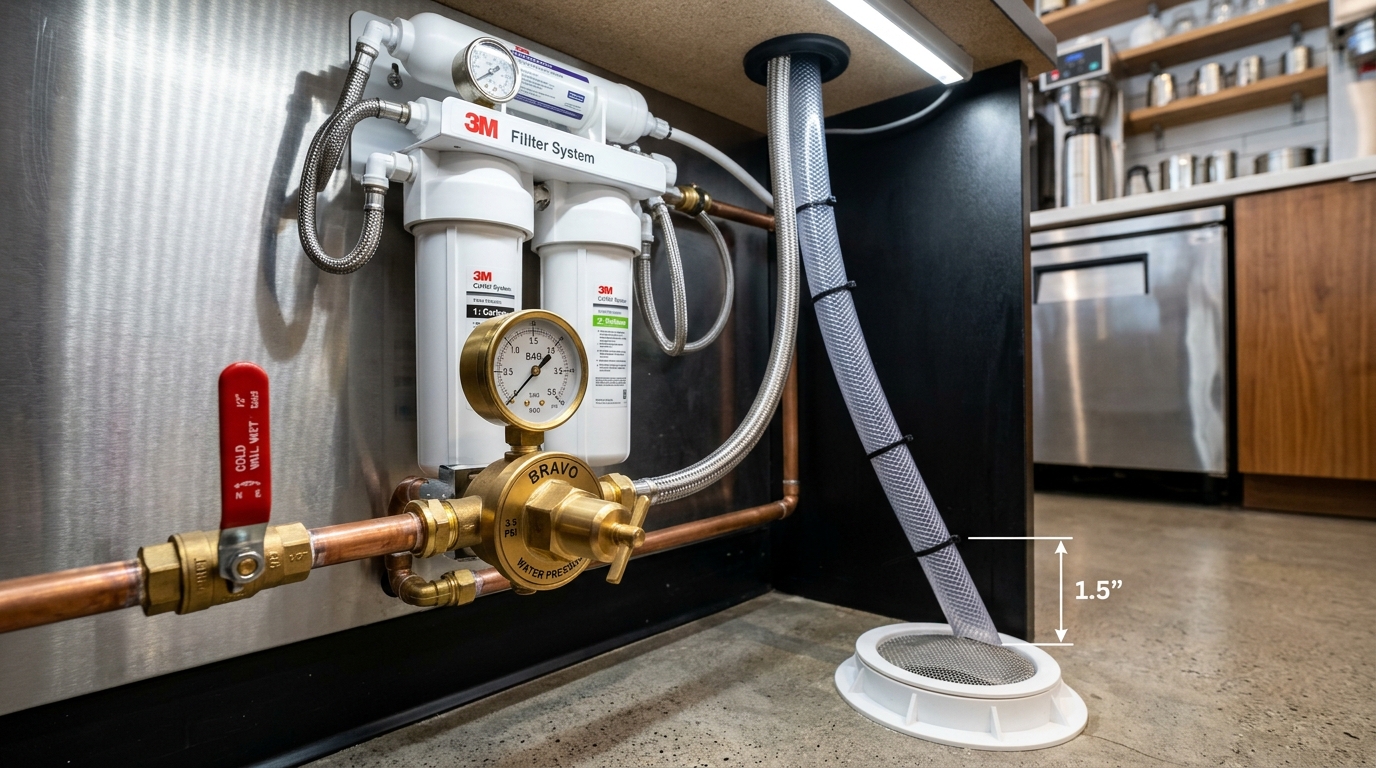
When commercial coffee shop entrepreneurs plan their buildout, they focus heavily on their primary showpieces: their multi-group espresso machine, precision grinders, and water filtration system.
Yet beneath the counter, a silent mechanical disaster frequently ruins coffee extraction during the most lucrative hours of the day: hydraulic pressure collapse.
Picture a chaotic 8:15 AM rush. Your cafe is packed. Two baristas are pulling double shots on a 2-group espresso machine. Simultaneously, the hot water autofill solenoid opens on your twin commercial batch brewer. At that exact split second, a barista presses down firmly on an in-counter pitcher rinser to wash a steaming jug, and the under-counter ice maker opens its water inlet valve.
Suddenly, total water demand spikes to 7.5 gallons per minute (GPM).
Because the cafe relies on undersized municipal lines or passive filtration flow, dynamic water pressure collapses from 50 PSI down to 12 PSI.
Deprived of incoming water, the espresso machine’s rotary vane pump screams in distress. Volumetric flow meters stutter and miscount pulses, cutting shots short by 6 grams. Pre-infusion collapses, inducing severe channeling through the espresso puck, transforming sweet, balanced single-origin shots into sour, astringent battery acid.
To eliminate this operational failure, commercial coffee bars must deploy an engineered Water Pressure Booster Pump and Pressurized Bladder Accumulator Tank system.
This technical engineering guide details hydraulic sizing equations, cavitation prevention, accumulator pre-charge calibration, and plumbing layouts for high-volume coffee bars in 2026.
1. The Physics of Morning Rush: Calculating Total Dynamic Flow Demand
Understanding why coffee bars suffer pressure drops requires auditing the simultaneous flow rate consumption of modern commercial beverage hardware:
+--------------------------------------------------------------------------+
|                  PEAK SERVICE HYDRAULIC DRAW AUDIT (GPM)                 |
|                                                                          |
|   EQUIPMENT APPLIANCE                        PEAK FLOW DEMAND            |
|   --------------------------------------------------------------------   |
|   1. Commercial Espresso Machine (Brew + Autofill)    1.5 – 2.2 GPM      |
|   2. Twin Batch Brewer (Solenoid Dump Cycle)          1.8 – 2.5 GPM      |
|   3. In-Counter Pitcher Rinser #1                     1.2 – 1.5 GPM      |
|   4. In-Counter Pitcher Rinser #2                     1.2 – 1.5 GPM      |
|   5. Commercial Ice Maker (Harvest Cycle)             1.0 – 1.8 GPM      |
|   6. Reverse Osmosis Permeate Generation (Inflow)     1.0 – 2.0 GPM      |
|   --------------------------------------------------------------------   |
|   TOTAL SIMULTANEOUS PEAK DRAW:                       7.7 – 11.5 GPM     |
|                                                                          |
|   >>> STANDARD 3/8" COPPER LINE FLOW LIMIT: ONLY 3.5 – 4.0 GPM! <<<      |
+--------------------------------------------------------------------------+
The Static vs. Dynamic Pressure Trap:
Many general contractors use a simple pressure gauge on an outdoor hose bib to assure cafe owners: “You have great water pressure—65 PSI!”
This is Static Pressure (water at rest).
The moment six commercial solenoids snap open simultaneously, water encounters the internal friction of narrow pipes, elbows, water filter cartridges, and pressure regulators. Under a 7.5 GPM draw, friction loss across an undersized 3/8-inch supply line causes Dynamic Pressure to plunge by 35 to 45 PSI, starving machinery.
2. Rotary Pump Cavitation: How Low Pressure Destroys Espresso Machines
Most commercial espresso machines utilize an internal or external Rotary Vane Positive Displacement Pump (manufactured by Procon or Fluid-o-Tech) driven by a 1/3-horsepower motor, engineered to deliver water at 9.0 bars (130 PSI).
+--------------------------------------------------------------------------+
|                    THE ROTARY PUMP CAVITATION MECHANISM                  |
|                                                                          |
|   1. WATER STARVATION AT PUMP INLET                                      |
|   - Inlet line pressure drops below 20 PSI (or enters negative vacuum).  |
|                                                                          |
|   2. MICRO-BOILING AT ROOM TEMPERATURE                                  |
|   - In a severe vacuum, the boiling point of water plunges.              |
|   - Water spontaneously vaporizes into thousands of microscopic vapor    |
|     bubbles (cavities) inside the intake chamber.                        |
|                                                                          |
|   3. EXPLOSIVE IMPLOSION                                                 |
|   - As vanes spin, bubbles enter high-pressure zones (9 bars / 130 PSI). |
|   - The bubbles violently implode at supersonic speeds.                  |
|   - Implosions generate micro-jets of water exceeding 100,000 PSI at     |
|     microscopic impact points!                                           |
|                                                                          |
|   4. MECHANICAL DAMAGE                                                   |
|   - Pits and erodes solid brass pump housing.                            |
|   - Chips and cracks carbon-graphite vanes.                              |
|   - Generates loud grinding / rattling metallic noise.                   |
|   - Causes severe pressure oscillations at grouphead (erratic shots).    |
+--------------------------------------------------------------------------+
The Cost of Cavitation:
A cavitating rotary pump head will completely fail within two to six months. Replacing a commercial Procon brass pump head costs $250 to $400 for the part, plus $300 in technician dispatch labor.
Installing a booster pump and accumulator permanently protects the pump by guaranteeing a positive inlet pressure of 40 to 50 PSI at all times.
3. The Hardware Solution: Booster Pumps vs. Pressurized Accumulator Tanks
An engineered coffee bar water delivery system relies on two symbiotic components working together: an electric booster pump and a pressurized diaphragm accumulator tank.
+--------------------------------------------------------------------------+
|                  ENGINEERED COFFEE WATER DELIVERY SCHEMATIC              |
|                                                                          |
|   [CENTRAL WATER FILTRATION / RO STORAGE] (20-30 PSI Baseline)           |
|          |                                                               |
|          v                                                               |
|   [ELECTRIC DEMAND BOOSTER PUMP] (Aquatec 550 / Flojet 5000 Series)      |
|   - Integrated Pressure Switch (Cuts in at 40 PSI, Cuts out at 60 PSI)   |
|   - Heavy-duty 120V diaphragm or rotary vane drive                       |
|          |                                                               |
|          v (High-Flow Discharge Line: 1/2" or 3/8" John Guest)           |
|   +------------------------------------------------------------------+   |
|   |         PRESSURIZED DIAPHRAGM ACCUMULATOR TANK (2 to 4 Gallons)  |   |
|   |                                                                  |   |
|   |   [ Compressed Air Chamber: Pre-charged to 35 PSI ]              |   |
|   |   ----------------- Flexible Butyl Diaphragm -----------------   |   |
|   |   [ Stored Filtered Water under 50-60 PSI Hydraulic Pressure ]   |   |
|   +------------------------------------------------------------------+   |
|          |                                                               |
|          v                                                               |
|   [WATTS PRECISION BRASS PRESSURE REGULATING VALVE (PRV)]                |
|   - Smooths flow, dialed to exactly 45 PSI constant dynamic pressure     |
|          |                                                               |
|          +-----------------------+-----------------------+               |
|          |                       |                       |               |
|          v                       v                       v               |
|   [ESPRESSO MACHINE]     [TWIN BATCH BREWER]     [PITCHER RINSERS]       |
|   (Zero Cavitation)      (Rapid Stable Fill)     (Zero Hammer Shock)     |
+--------------------------------------------------------------------------+
4. How an Accumulator Tank Eliminates Water Hammer and Rapid Cycling
An accumulator tank (manufactured by brands like Amtrol, Pentair, or Shurflo) is not just a storage vessel—it is an energy storage shock absorber.
1. Eliminating “Water Hammer” from Pitcher Rinsers:
In-counter pitcher rinsers utilize fast-acting mechanical poppet valves. When a busy barista releases the pitcher, the valve snaps shut in roughly 50 milliseconds.
The momentum of rapidly moving water instantly slams against the closed valve, creating a high-velocity shockwave traveling backwards through copper plumbing at 4,000 feet per second—a destructive phenomenon known as water hammer.
Water hammer ruptures water filter housings, loosens brass compression fittings, damages delicate flow meters, and knocks copper pipes against wall studs.
In an accumulator system, the rubber diaphragm compresses upward into the air chamber, absorbing the kinetic shock wave instantly with zero pipe vibration.
2. Preventing Pump “Short-Cycling”:
If you connect an electric booster pump directly to a pitcher rinser without an accumulator, pressing the rinser for three seconds draws 200 mL of water.
The pump’s pressure switch instantly detects the pressure drop, turns on violently for two seconds, and snaps off the moment the rinser closes.
Over a busy 8-hour shift, the booster pump motor would cycle on and off over 1,200 times, rapidly burning out electrical switch contacts and overheating motor windings.
With a 2.0-gallon accumulator installed:
- The accumulator supplies the first 10 to 15 pitcher rinses purely from stored bladder energy.
- The pump turns on smoothly once every twenty minutes, runs for a full 90 seconds to recharge the tank, and powers down calmly, extending pump motor lifespan from one year to over seven years.
5. Equipment Sizing Matrix: Carts vs. Standard Cafes vs. High-Volume Roasteries
| Operating Environment | Daily Beverage Volume | Recommended Booster Pump | Recommended Accumulator Sizing | Supply Line Diameter | Target Dynamic Pressure |
|---|---|---|---|---|---|
| Mobile Coffee Cart / Kiosk | 50 – 150 Drinks/Day | Flojet BW5000 Bottled Water System (1.0 GPM) | 1.0 – 2.0 Liter In-Line Accumulator | 3/8” High-Pressure Poly (John Guest) | 35 – 40 PSI Constant |
| Boutique Cafe (1-2 Groups) | 200 – 400 Drinks/Day | Aquatec 5800 Series Diaphragm (2.0 – 2.5 GPM) | 2.0 – 4.5 Gallon Pressurized Bladder Tank | 3/8” or 1/2” Dedicated Beverage Tubing | 40 – 45 PSI Constant |
| High-Volume Cafe / Drive-Thru | 500 – 1,000+ Drinks/Day | Procon Rotary Vane Booster or Aquatec High-Flow (4.0+ GPM) | 5.0 – 10.0 Gallon Commercial Expansion Vessel | 1/2” ID Dedicated Poly / Copper Header | 45 – 50 PSI Constant |
6. Sizing and Pre-Charge Calibration Protocol (Step-by-Step)
An accumulator tank will not function correctly if the air pressure behind the rubber diaphragm is improperly calibrated:
+--------------------------------------------------------------------------+
|                  ACCUMULATOR PNEUMATIC PRE-CHARGE PROTOCOL               |
|                                                                          |
|   CRITICAL RULE: Pre-charge must ALWAYS be measured and adjusted when   |
|   the water side of the tank is COMPLETELY DEPRESSURIZED (Zero PSI).     |
|                                                                          |
|   STEP 1: ISOLATE & DRAIN WATER                                          |
|   1. Turn off electric booster pump power.                               |
|   2. Close water supply isolation valve.                                 |
|   3. Open a downstream pitcher rinser or sink faucet until all water     |
|      flow completely stops and water line pressure is 0.0 PSI.           |
|   4. Leave the faucet open during testing!                               |
|                                                                          |
|   STEP 2: TEST AIR PRESSURE VIA SCHRADER VALVE                           |
|   - Unscrew the black protective cap on the tank's Schrader air valve.   |
|   - Attach an accurate digital automotive tire pressure gauge.           |
|                                                                          |
|   STEP 3: CALIBRATE TO THE 2-PSI RULE                                    |
|   - Check your booster pump pressure switch CUT-IN rating.               |
|     (e.g., if pump turns ON at 40 PSI, target pre-charge is 38 PSI).     |
|   - CALCULATION: Pre-Charge = Pump Cut-In Pressure MINUS 2 PSI.          |
|   - If pressure is low: Use a manual bicycle tire pump to add air.       |
|   - If pressure is high: Depress center valve pin to bleed off air.      |
|                                                                          |
|   STEP 4: RE-ENERGIZE & LEAK CHECK                                       |
|   - Replace Schrader cap tightly. Close downstream faucets.              |
|   - Power on booster pump. Allow system to charge to full cut-out.       |
+--------------------------------------------------------------------------+
Review our dedicated facility rough-in guides:
- Commercial Espresso Machine & Coffee Electrical and Plumbing Guide
- How to Open a Coffee Shop: Comprehensive Equipment Checklist
7. The Final Verdict: Why Your Cafe Needs a Booster & Accumulator
Installing a dedicated booster pump and accumulator system beneath your coffee bar is one of the lowest-cost, highest-return insurance policies in commercial hospitality:
- Cost: An Aquatec 2.5 GPM booster pump, a 4.5-gallon Amtrol steel accumulator tank, brass pressure regulator, and John Guest fittings cost approximately $450 to $650 total.
- Return:
- Completely eliminates rotary pump cavitation, preventing $700 emergency repairs.
- Ensures 100% volumetric shot accuracy on your espresso machine regardless of whether batch brewers or pitcher rinsers are firing.
- Eliminates water hammer pipe banging and loose fitting leaks beneath your cabinetry.
- Delivers silky, consistent pre-infusion pressure across every single espresso drink.
Frequently Asked Technical Questions
Why does water pressure drop during peak morning service in a coffee shop?
During peak morning rushes, multiple water-consuming appliances engage simultaneously: a twin batch brewer filling its 10-gallon tank (2.0 GPM), an espresso machine pulling double shots while autofilling its steam boiler (1.5 GPM), two baristas pressing in-counter pitcher rinsers (2.5 GPM), and an under-counter ice machine harvesting water. If incoming supply lines or filtration cartridges restrict flow, dynamic pressure collapses below 20 PSI, starving equipment of necessary volume.
What is pump cavitation in a commercial espresso machine?
Pump cavitation occurs when the external water supply line cannot provide the flow volume demanded by the espresso machine's internal rotary vane pump. The pump creates a severe partial vacuum at its inlet, causing liquid water to vaporize into microscopic steam bubbles at room temperature. When these vapor bubbles enter high-pressure zones inside the pump head, they violently implode, pitting the brass housing, destroying graphite vanes, and causing loud grinding noises.
How does a pressurized bladder accumulator tank work?
An accumulator tank is a sealed steel expansion vessel containing a flexible food-grade butyl rubber diaphragm that separates water from a pressurized air chamber pre-charged to 30-35 PSI. When line pressure is high, water fills the lower chamber, compressing the air bladder. When sudden demand occurs (e.g., a barista blasts a pitcher rinser), the compressed air instantly pushes water out into the line, maintaining rock-solid dynamic pressure without waiting for pumps to cycle.
What is the difference between static water pressure and dynamic water pressure?
Static water pressure is the resting pressure in the plumbing pipes when all valves, faucets, and machines are closed. Dynamic water pressure is the actual running pressure in the pipe while water is actively flowing through machines. A cafe may measure a high static pressure of 60 PSI, but due to narrow 1/4-inch tubing or clogged filter cartridges, dynamic pressure can instantly collapse to 15 PSI the moment a brewer opens its inlet solenoid.
What pre-charge air pressure should be set in an espresso accumulator tank?
The pneumatic pre-charge pressure of an accumulator tank should be calibrated using a standard tire pressure gauge on its Schrader valve to approximately 2 to 3 PSI BELOW the cut-in pressure of your booster pump (typically 30 to 32 PSI). If the pre-charge air pressure is too high, water cannot enter the tank; if it is too low, the internal bladder bottoms out and fails to buffer pressure spikes.