Best Commercial Batch Brewers: Fetco vs. Bunn vs. Curtis (2026)
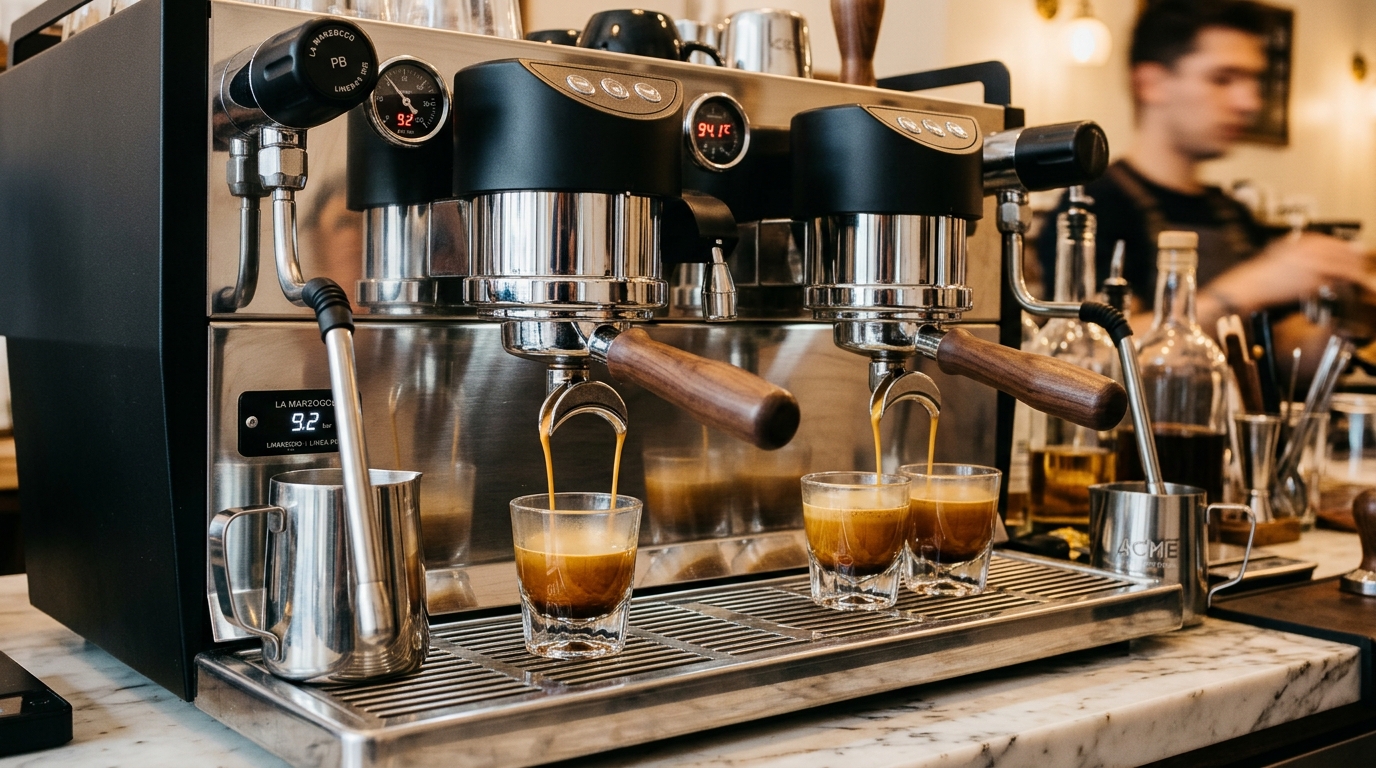
While multi-group espresso machines capture customer attention with polished chrome and theater, the humble commercial batch brewer is the financial engine that keeps high-volume specialty coffee shops profitable.
During the peak morning commute (7:00 AM to 9:30 AM), 60% to 75% of ordering customers in urban and suburban cafes want a fast, high-quality, hot cup of black drip coffee. Hand-crafting individual pour-overs during a 120-customer morning rush creates a fatal operational bottleneck.
A high-performance commercial batch brewer allows a single barista to dispense a 12oz or 16oz cup of perfectly extracted specialty coffee in under six seconds. With a coffee cost of roughly $0.32 per 12oz serving and a retail price of $3.25 to $4.00, batch brew delivers an extraordinary gross margin exceeding 90% with almost zero per-cup labor.
However, selecting the wrong batch brewer can devastate your beverage consistency. Inadequate heating elements cause brew temperature to collapse across consecutive cycles. Poor sprayhead designs drill channels through 150-gram coffee beds, producing under-extracted, sour, or astringent brews. Fragile thermal servers allow heat to escape within 45 minutes, resulting in cold coffee and customer complaints.
This comprehensive technical guide evaluates the three industry-standard commercial batch brewing platforms dominating North American cafes in 2026: Fetco, Bunn, and Wilbur Curtis.
1. Commercial Batch Brewing Architecture: Core Engineering Principles
Every commercial batch brewer functions as an automated immersion-percolation system. Understanding the internal mechanics ensures you select the right plumbing, heating capacity, and digital control parameters.
+--------------------------------------------------------------------------+
|                  COMMERCIAL BATCH BREWER INTERNAL FLOW SCHEMATIC         |
|                                                                          |
|   [COLD WATER INLET]                                                     |
|          | (3/8" Flare, 20-90 PSI, Dedicated Filtration)                 |
|          v                                                               |
|   [INLET SOLENOID VALVE] ---> Controlled by Water Level Probes           |
|          |                                                               |
|          v                                                               |
|   +------------------------------------------------------------------+   |
|   |                   HEAVY-DUTY WATER TANK (6-10 GAL)               |   |
|   |  - Dual Immersion Heating Elements (5.5 kW - 7.5 kW)             |   |
|   |  - PID Temperature Sensor (200°F - 205°F / 93°C - 96°C)          |   |
|   |  - Internal Siphon / Dump Valve System                           |   |
|   +------------------------------------------------------------------+   |
|          |                                            |                  |
|          | (Left Solenoid)                            | (Right Solenoid) |
|          v                                            v                  |
|   [LEFT SPRAYHEAD]                            [RIGHT SPRAYHEAD]          |
|   (Pulse Delivery Pattern)                    (Pulse Delivery Pattern)   |
|          |                                            |                  |
|          v                                            v                  |
|   [BREW BASKET: 120g-250g Bed]                [BREW BASKET: 120g-250g]   |
|          |                                            |                  |
|          v                                            v                  |
|   [THERMAL LUXUS SERVER]                      [THERMAL LUXUS SERVER]     |
|   (1.0 - 1.5 Gal Vacuum Insulated)            (1.0 - 1.5 Gal Insulated)  |
+--------------------------------------------------------------------------+
The Siphon Dump System vs. Flow-Metered Pumping:
Most commercial brewers do not pump water under pressure. Instead, they operate via gravity displacement or direct solenoid dump valves. When a brew cycle initiates:
- The inlet valve admits a pre-metered volume of cold water into the bottom of the hot water reservoir.
- The incoming cold water forces super-heated water from the top of the tank into a siphon tube.
- The hot water flows by gravity over the engineered sprayhead, raining down onto the ground coffee bed.
- Because water delivery relies on hydraulic displacement, consistent incoming water line pressure (minimum 20 PSI, ideally 40 to 50 PSI) is mandatory. Review our complete guide on Commercial Espresso and Coffee Plumbing Requirements to ensure adequate flow rates.
2. Head-to-Head Specification Matrix: Fetco vs. Bunn vs. Wilbur Curtis
The following matrix compares the flagship twin-head commercial batch brewers found in modern specialty coffee shops and high-volume commercial establishments.
| Technical Parameter | Fetco CBS-2142XTS (Twin 1.0 Gal) | Bunn ICB Twin Infusion Series | Wilbur Curtis G4 ThermoPro Twin 1.5 Gal |
|---|---|---|---|
| Manufacturer Origin | Lake Zurich, Illinois, USA | Springfield, Illinois, USA | Montebello, California, USA |
| Brew Capacity | Twin 1.0 Gal (3.8L) Dispensers | Twin 1.0 or 1.5 Gal (5.7L) | Twin 1.0 or 1.5 Gal (5.7L) |
| Max Hourly Output | 15.3 Gallons (~245 cups/hr) | 17.5 Gallons (~280 cups/hr) | 15.0 - 21.0 Gallons (~330 cups/hr) |
| Electrical Voltage | 208V - 240V / 1-Phase | 120V / 208V - 240V / 1-Phase | 220V / 1-Phase (Dual 3-Wire + G) |
| Total Wattage / Amps | 5.3 - 7.0 kW / 22.4 - 29.2 A | 6.0 kW / 25.0 A | 5.1 - 7.6 kW / 23.0 - 34.5 A |
| Tank Capacity | 7.6 Gallons (28.8 Liters) | 11.5 Gallons (43.5 Liters) | 10.0 Gallons (37.9 Liters) |
| Sprayhead Technology | Cascading Spray Dome (CSD) | Peak Extraction Sprayhead | G4 Icon Showerhead + Pulse |
| Pulse Brewing Control | Fully Programmable (1-12 pulses) | Pre-Infusion & Pulse Brew | 12 Independent Pulse Steps |
| Bypass Water Feature | Electronic Bypass Valve | Integrated Automatic Bypass | Programmable Cold/Hot Bypass |
| User Interface | Touchscreen XTS Digital Controller | Intuitive Digital LED Display | G4 4.3” Full-Color Touchscreen |
| Thermal Server Type | Luxus L4D-10 (Vacuum Insulated) | TF Server (Stainless/Poly) | ThermoPro TLC Insulated Servers |
| Typical Equipment Cost | $3,600 - $4,400 (Brewer Only) | $2,800 - $3,600 (Brewer Only) | $3,100 - $3,900 (Brewer Only) |
| Thermal Server Cost (ea) | $380 - $480 per dispenser | $320 - $410 per dispenser | $300 - $390 per dispenser |
3. Deep Dive: Fetco CBS-2142XTS Series (The Specialty Standard)
Fetco (Food Equipment Technologies Company) has long been the gold standard in North American specialty coffee roasting and retail. From Third Wave pioneers to national cafe chains, the XTS series is revered for its thermal stability and extraction programming.
       +------------------------------------------------------+
       |                FETCO CASCADING SPRAY DOME            |
       |                                                      |
       |    Water Inflow                                      |
       |         |                                            |
       |         v                                            |
       |    [ +--------+ ]  <-- Convex Domed Geometry         |
       |    [ |  CSD   | ]      (Eliminates Scale Build-up)   |
       |    [ +--------+ ]                                    |
       |       / | | \                                        |
       |      v  v v  v                                       |
       |    Wide, Gentle Raining Pattern Across 100% of Bed   |
       |                                                      |
       |    ===============================================   |
       |    COFFEE BED: No Pitting - No Center Channeling     |
       +------------------------------------------------------+
Key Engineering Advantages of Fetco:
- Cascading Spray Dome (CSD) vs. Traditional Holes: Traditional commercial sprayheads rely on tiny drilled nozzle holes. In hard water conditions, mineral limescale rapidly clogs these individual orifices, creating high-pressure water jets that bore channels directly through the coffee bed. Fetco’s patented CSD utilizes a domed channel design where water cascades over smooth edges. Limescale cannot easily obstruct the flow, maintaining a wide, uniform rain pattern across thousands of gallons.
- Precision Touchscreen Extraction Profiles (XTS): The digital controller allows cafe operators to program:
- Pre-Wet Percentage: Initial saturation volume (e.g., 10% of total brew volume).
- Bloom Delay: Contact pause (e.g., 45 to 60 seconds) allowing freshly roasted beans to degas carbon dioxide before dynamic flow begins.
- Pulse Count & Duration: Breaking the remaining water delivery into 6 to 10 distinct pulse cycles, maintaining bed temperature and preventing basket overflow.
- Electronic Bypass: Diverting a measured percentage of clean brew water directly into the thermal server without passing through the coffee bed, perfect for creating smooth batch iced coffee or adjusting body on heavy-bodied origins.
- Luxus Thermal Servers (L4D-10 & L4D-15): Fetco’s Luxus dispensers feature genuine double-wall vacuum insulation. Coffee brewed at 200°F remains above 180°F after two hours with zero external electrical heating. The digital freshness timer on the handle displays elapsed time and remaining liquid volume via capacitive level sensors.
The Downside of Fetco:
- Higher Acquisition Cost: A twin Fetco setup with two brew heads, four Luxus servers, and two server counter stands routinely exceeds $5,500, representing a significant capital expense for startups working with tight capital. Review our Coffee Shop Startup Equipment Budget Guide to see how to allocate funds.
- Parts Replacement Pricing: Proprietary circuit boards and touchscreens carry premium replacement costs compared to utilitarian legacy commercial brands.
4. Deep Dive: Bunn ICB Twin Infusion Series (The High-Reliability Workhorse)
Bunn-O-Matic is the undisputed titan of commercial beverage equipment in North America. Virtually every airport, hotel, hospital, and university campus in the United States and Canada operates Bunn commercial infrastructure. The ICB (Infusion Coffee Brewer) is Bunn’s direct answer to the specialty coffee revolution.
Key Engineering Advantages of Bunn:
- Massive Thermal Storage Tanks: The Bunn ICB Twin features an industry-leading 11.5-gallon (43.5-liter) stainless steel water reservoir. While a smaller tank may experience a 6°F to 10°F temperature drop when brewing consecutive twin batches, the immense thermal mass of the Bunn tank guarantees back-to-back brewing at stable 200°F to 204°F temperatures.
- Peak Extraction Sprayhead: Bunn redesigned their traditional 7-hole sprayhead into a multi-directional polymer plate with 17 engineered exit ports. It provides exceptional water coverage, though it requires more frequent manual deliming in hard water environments than Fetco’s CSD.
- Ubiquitous Technician Network & Spare Parts Availability: If a solenoid valve or heating element fails on a Bunn machine at 6:30 AM in Omaha, Denver, or Toronto, virtually every commercial restaurant equipment repair service in the region has replacement components stocked in their service vans. Downtime on Bunn equipment is significantly lower than boutique European imports.
- Energy Saver Mode: The ICB controller includes programmable tank temperature setback during off-hours, reducing overnight standby electrical consumption by up to 35%.
The Downside of Bunn:
- Interface Ergonomics: While the modern ICB display is reliable, navigating submenus to dial in intricate pulse brew ratios is less intuitive than Fetco or Curtis touchscreen systems.
- Aesthetic Styling: Bunn equipment embraces an industrial, utilitarian stainless-box aesthetic that may clash with upscale, minimalist boutique cafe interiors.
5. Deep Dive: Wilbur Curtis G4 ThermoPro Twin (The Digital Customizer)
Based in California, Wilbur Curtis has engineered some of the most technologically advanced brewing electronics in commercial hospitality. The G4 ThermoPro platform combines high-volume industrial reliability with modular, icon-driven digital controls.
Key Engineering Advantages of Wilbur Curtis:
- G4 Touchscreen Architecture: The 4.3-inch color graphic display provides the most granular extraction customization on the market. Baristas can program independent recipes for light roasts, dark roasts, decaf, and cold brew with distinct pre-infusion pulses, bypass percentages, and drip-out delay times with simple graphical sliders.
- Self-Diagnostic Software: The G4 system actively monitors inlet water temperature, heating element current draw, and liquid level probe resistance. If mineral scale accumulates on a sensor or a water line experiences reduced flow, the screen displays a plain-English diagnostic code rather than an obscure flashing LED.
- Energy-Efficient Multi-Wattage Elements: Curtis allows field-configurable heating element wiring, making it easy to adapt the machine from 5.1 kW (on a 20A circuit) to 7.6 kW (on a 30A circuit) depending on your building’s existing electrical panel capacity.
- TLC Thermal Dispensers: Curtis ThermoPro dispensers feature heavy-gauge stainless steel construction with ergonomic carrying handles and sight glasses protected by stainless guards, minimizing broken glass tube incidents in chaotic dishwashing pits.
The Downside of Wilbur Curtis:
- Sprayhead Mineral Sensitivity: The multi-hole Curtis sprayhead requires diligent weekly cleaning. In regions with elevated total dissolved solids (TDS) or carbonate hardness, failure to descale results in uneven shower patterns. Review our Water Filtration for Commercial Coffee Guide to protect your brewer against scale.
6. Batch Brew Extraction Physics: Why Pulse Brewing Dictates Flavor
When brewing a commercial batch of 1.0 or 1.5 gallons, a barista places between 150 grams and 260 grams of ground coffee into a wide stainless steel or polymer brew basket.
                                 [WATER STREAM FROM TANK]
                                            |
                                            v
                                  [PULSE 1: THE BLOOM]
                 Water Volume: 15% | Duration: 20s | Pause Duration: 40s
                                            |
                 Gas Release: CO2 releases; coffee bed swells uniformly
                                            |
                                            v
                                 [PULSE 2 - 8: EXTRACTION]
                 Water Volume: 10% per pulse | Contact Pause: 15s each
                                            |
                 Extraction Dynamics: Soluble compounds wash through paper filter
                                            |
                                            v
                                  [PULSE 9: FINAL FLUSH]
                 Water Volume: 15% | Drain Delay: 60s settling time
                                            |
                                            v
                             [SCA GOLD CUP IDEAL EXTRACTION]
                          TDS: 1.25% - 1.30% | Extraction Yield: 19.5% - 20.5%
Why Continuous Pouring Destroys Large Batches:
If a brewer opens the hot water valve and dumps 1.5 gallons of boiling water continuously onto a 200g bed of coffee:
- Bed Fluidization & Floating: The sheer volume of water floods the basket, causing ground coffee particles to float to the surface rather than remaining in contact with the percolating liquid.
- Channeling: Water seeks the path of least resistance, boring deep micro-channels along the basket edges. Center grounds remain under-extracted (sour, grassy), while grounds along the channel walls become severely over-extracted (dry, bitter, astringent).
- Inadequate Extraction Yield: Total contact time is too brief, resulting in watery coffee with low TDS (0.95% to 1.05%).
The Golden Pulse Profile for Specialty Medium Roasts:
For a 1.0 Gallon (3.78 Liter) batch using 210 grams of coffee (a 1:18 brew ratio):
- Water Temperature: Set boiler PID to 202°F (94.4°C) to achieve a 198°F slurry temperature.
- Bloom / Pre-Wet: 350 mL of water (approx. 1.6x the coffee weight).
- Bloom Delay: 45 seconds pause.
- Pulses: 7 subsequent water pulses of 450 mL each.
- Pulse Pause: 15 seconds between pulses.
- Total Brew Time (including drip-out): 4 minutes 30 seconds to 5 minutes 15 seconds.
- Target Result: 1.25% to 1.32% TDS with an Extraction Yield of 20.0%.
7. Thermal Server Management: Preventing Coffee Staling
A commercial brewer is only half the battle. How you store, transport, and dispense the brewed liquid determines whether your 9:00 AM customers taste sweet jasmine notes or oxidized liquid cardboard.
The Thermal Decay & Flavor Degradation Curve:
| Elapsed Time Post-Brew | Internal Temperature | Sensory Profile & Chemical Status | Operational Action |
|---|---|---|---|
| 0 – 30 Minutes | 192°F – 188°F | Peak aroma, bright origin acidity, transparent body, delicate floral & fruit volatiles intact. | Prime serving window for specialty single-origins. |
| 30 – 60 Minutes | 188°F – 184°F | Excellent balance, round sweetness, slightly diminished aromatic top notes. High customer satisfaction. | Standard commercial serving window. |
| 60 – 90 Minutes | 184°F – 180°F | Acidity begins softening; caramelized sugars dominate. Body feels slightly heavier. | Ideal for blends; acceptable for specialty. |
| 90 – 120 Minutes | 180°F – 175°F | Chlorogenic acids hydrolyze into quinic acids. Bitterness increases noticeably; delicate notes vanish. | Discount for iced base or prepare fresh batch. |
| 120+ Minutes | < 174°F | Oxidized, stale, astringent finish. Off-flavors dominate. | DISCARD. Clean server with hot water rinse. |
The Golden Rule of Thermal Servers:
Never use heated glass pot warmers (hot plates). Hot plates apply direct electrical heat to the bottom of the glass pot, scorching delicate coffee oils, evaporating water, concentrating acids, and turning specialty coffee into acrid sludge within 15 minutes. Always use stainless steel vacuum-insulated thermal dispensers.
8. Facility Requirements: Electrical, Plumbing & Countertop Planning
Installing a commercial twin batch brewer requires planning for high power density and clean water supply:
+--------------------------------------------------------------------------+
|                 COMMERCIAL BATCH BREWER UTILITY ROUGH-IN                 |
|                                                                          |
|   ELECTRICAL ROUGH-IN:                                                   |
|   - Receptacle: NEMA 6-30R (or NEMA L6-30R Twist-Lock)                   |
|   - Voltage: 208V - 240V, Single-Phase, 60Hz                             |
|   - Dedicated Circuit Breaker: 30 Amp double-pole                        |
|                                                                          |
|   PLUMBING ROUGH-IN:                                                     |
|   - Cold Water Supply: 3/8" Male Flare or 3/8" Compression               |
|   - Dynamic Water Pressure: 30 to 50 PSI (Regulated)                     |
|   - Shutoff Ball Valve: Located directly beneath brewer counter          |
|                                                                          |
|   COUNTERTOP PENETRATIONS:                                               |
|   - One 2.5" (64mm) grommeted access hole for water line and power cord  |
|   - Weight Bearing Rating: Minimum 120 lbs (brewer + full water tank)    |
+--------------------------------------------------------------------------+
Review our dedicated architectural guides to coordinate with your general contractor:
- Commercial Espresso Machine & Coffee Electrical and Plumbing Guide
- Coffee Shop Bar Layout and Ergonomic Workflow Design
9. The Verdict: Which Commercial Batch Brewer Should You Buy?
Choose the Fetco CBS-2142XTS if:
- You operate a specialty-focused third-wave cafe or roastery where dialing in origin-specific pulse profiles, bloom delays, and extraction yields is paramount.
- You want the most scale-resistant, reliable sprayhead system (Cascading Spray Dome) on the market.
- Your budget accommodates a $4,000 to $5,500 total system investment with premium Luxus digital dispensers.
Choose the Bunn ICB Twin Infusion Series if:
- You run a high-volume transit cafe, airport kiosk, university coffee bar, or busy drive-thru serving hundreds of gallons per week.
- You prioritize bulletproof commercial reliability, a massive 11.5-gallon water tank for zero temperature recovery lag, and nationwide technician/parts availability.
- You want the highest commercial equipment trade-in value in North America.
Choose the Wilbur Curtis G4 ThermoPro Twin if:
- You want the most intuitive, full-color touchscreen interface with graphic slider recipe adjustments.
- You require granular digital self-diagnostics and field-configurable heating elements to match restrictive building electrical panels.
- You want modern, sleek aesthetics with outstanding value in thermal dispenser pricing.
Frequently Asked Technical Questions
Why is batch brewed drip coffee critical to coffee shop profitability?
Batch brewed filter coffee generates the highest gross profit margin in a commercial coffee shop (typically 88% to 92%). Because an entire 1.5-gallon batch (equaling roughly twelve to sixteen 12oz cups) can be brewed in under 5 minutes with only 90 seconds of active labor, speed-of-service during the morning rush is nearly instantaneous, maximizing hourly sales volume.
What is the difference between single and twin commercial batch brewers?
A single batch brewer features one brew basket and dispenses into a single thermal server (producing 0.5 to 1.5 gallons per cycle, or 20 to 45 cups/hour). A twin commercial brewer features two independent brew heads fed by a large central heating tank (6 to 10 gallons), allowing simultaneous brewing of two different roasts or continuous production up to 15 to 20 gallons per hour during peak morning volume.
What electrical supply is required for a commercial twin batch brewer?
Most commercial twin batch brewers (such as the Fetco CBS-2142XTS or Bunn ICB Twin) require a dedicated 208V to 240V single-phase circuit rated at 30 amps, drawing between 5.5 kW and 7.5 kW. Operating twin brewers on standard 120V household lines is impossible because large commercial hot water tanks require rapid recovery times to prevent brew temperature collapse during consecutive brew cycles.
What is pulse brewing and why does it matter for extraction quality?
Pulse brewing is a digitally controlled cycle that alternates between spraying hot water onto the coffee bed and pausing to allow the water to drain. This intermittent pulsing prevents water channeling, ensures uniform bed saturation, extends contact time for large commercial batches without causing agitation overflow, and elevates total dissolved solids (TDS) into the SCA ideal 1.15% to 1.35% range.
How long can drip coffee remain in a commercial thermal server before quality degrades?
In a high-grade, vacuum-insulated stainless steel thermal dispenser (such as the Fetco Luxus or Bunn TF Server), brewed coffee retains optimal temperature (above 175°F / 80°C) and fresh aromatic flavor for 90 to 120 minutes. After two hours, volatile aromatics dissipate, chlorogenic acids degrade into bitter quinic acids, and the batch should be discarded or diverted to iced coffee base.