Coffee Shop Startup Equipment Budget & ROI Guide (2026)
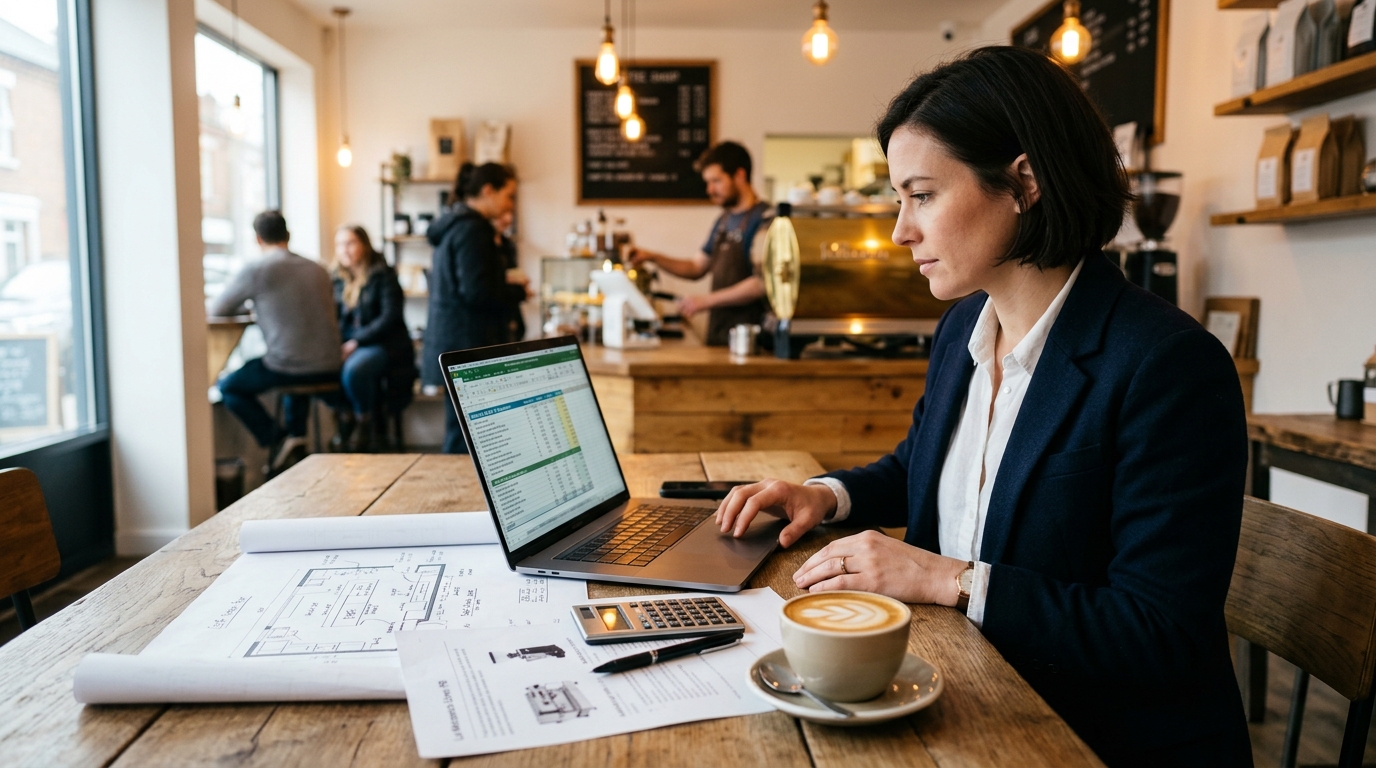
Opening a commercial coffee shop requires balancing culinary passion with strict financial discipline. Among the major line items of a brick-and-mortar cafe buildout—leasehold improvements, architectural permits, branding, initial inventory, and working capital—commercial machinery represents between 25% and 35% of total startup expenditure.
Yet, inexperienced founders frequently make catastrophic financial miscalculations:
- Some burn through their entire liquid cash reserves buying high-end espresso machinery outright, leaving zero working capital to cover payroll and rent during the slow first four months of trade.
- Others under-budget by purchasing residential appliances that burn out within 90 days, triggering expensive emergency replacements and counter downtime.
- Worst of all, many operators forget hidden capital outlays: freight and liftgate delivery, rigging, commercial electrical transformers, water softening trains, and NSF certification permits.
This master financial guide provides a realistic, line-item equipment budget for a standard 1,200 sq ft retail coffee shop in 2026, compares the mathematical trade-offs between cash purchases, commercial leasing, and SBA microloans, breaks down Section 179 tax deductions, and models exact unit economics and ROI per cup.
1. Complete Line-Item Equipment Budget Breakdown
The following budget models an independent specialty coffee shop projecting daily sales of 175 to 350 drinks per day in an urban or suburban retail market:
+-----------------------------------------------------------------------+
|                    CAFE EQUIPMENT CAPITAL ALLOCATION                  |
|                                                                       |
|  Front Espresso Station (32%)                                         |
|  [========================================] $19,500                   |
|                                                                       |
|  BOH Refrigeration & Ice Machine (21%)                                |
|  [==========================>] $12,800                                |
|                                                                       |
|  Batch Brew & Bulk Grinding Station (12%)                             |
|  [===============>] $7,400                                            |
|                                                                       |
|  Warewashing & Stainless Sinks (11%)                                  |
|  [============>] $6,800                                               |
|                                                                       |
|  Water Treatment & Reverse Osmosis (7%)                               |
|  [========>] $4,200                                                   |
|                                                                       |
|  POS Hardware & Network Terminals (5%)                                |
|  [======>] $3,200                                                     |
|                                                                       |
|  Barista Precision Smallwares (4%)                                    |
|  [====>] $2,400                                                       |
|                                                                       |
|  Freight, Rigging & Installation (8%)                                 |
|  [========>] $4,800                                                   |
|                                                                       |
|  TOTAL CAPITAL EXPENDITURE: $61,100                                   |
+-----------------------------------------------------------------------+
Detailed Itemized Cost Matrix:
| Category / Station | Essential Equipment Items | Low-End / Value Tier | Mid-Range Specialty Standard | Premium / High-Volume Flagship |
|---|---|---|---|---|
| Espresso Bar Station | 2-Group Machine, 2 Grinders, Knock Box, Rinser | $13,500 (Rancilio + Eureka) | $19,500 (La Marzocco Linea + Mazzer) | $28,500 (Synesso S200 + Mahlkönig GbW) |
| Batch Drip Coffee | Twin 1.5 Gal Brewer, 3 Urns, Hot Water Tower | $4,500 (Bunn Dual) | $7,400 (Fetco CBS + EK43 Grinder) | $11,000 (Marco Jet System + Mahlkönig) |
| Water Treatment Train | RO System, Membrane, Remineralizer, Tanks | $1,800 (BWT Ion-Exchange) | $4,200 (OptiPure RO + Remineralizer) | $7,500 (Dual Commercial RO System) |
| Cold Storage & Ice | 2 Under-Counter Coolers, BOH Reach-in, Ice Maker | $8,500 (Atosa Commercial) | $12,800 (True Manufacturing + Scotsman) | $19,500 (Hoshizaki + Walk-in Box) |
| Warewashing & Sinks | 3-Bay Sink, 2 Hand Sinks, Mop Basin, Faucets | $4,200 (Advance Tabco) | $6,800 (Custom Stainless + High-Temp Disher) | $12,500 (Conveyor Commercial Dishwasher) |
| POS Hardware & Tech | Cash Drawer, Card Terminals, Kitchen Printers | $1,800 (Square Stand setup) | $3,200 (Toast POS Dual Terminal) | $5,500 (Multi-Station Enterprise POS) |
| Barista Smallwares | Scales, Pitchers, Tampers, Chemicals, Towels | $1,400 | $2,400 (Acaia Scales, Pullman Tampers) | $3,800 (Full Competition Toolset) |
| Freight, Rigging, Labor | Liftgate Shipping, Certified Machine Bench Test | $2,800 | $4,800 | $7,500 |
| TOTAL INITIAL OUTLAY | — | $38,500 | $61,100 | $95,800 |
Review our master Commercial Equipment Checklist for individual model specifications and dimensions.
2. Financing Strategy: Cash Purchase vs. Commercial Equipment Leasing vs. SBA Loan
How you pay for your commercial machinery is just as critical as which machines you select.
+-----------------------------------------------------------------------+
|                    FINANCING VEHICLE COMPARISON                       |
|                                                                       |
|  1. 100% CASH PURCHASE                                                |
|     [Full Capital Outlay Upfront: $61,100]                            |
|     PROS: Zero monthly debt service, no interest charges.             |
|     CONS: Siphons cash reserve; leaves zero cushion for slow months.  |
|                                                                       |
|  2. COMMERCIAL EQUIPMENT LEASING ($1 Buyout Option)                   |
|     [Monthly Lease Payment: ~$1,420/month for 48 months]              |
|     PROS: Conserves liquid cash, 100% tax deductible (Section 179),   |
|           fast 48-hour credit approval.                               |
|     CONS: Overall interest cost (6% to 12% APR equivalent).           |
|                                                                       |
|  3. SBA 7(a) / MICROLOAN                                              |
|     PROS: Lowest interest rates (Prime + 2.75% to 4.5%).              |
|     CONS: Requires 60 to 90 days for bank underwriting; heavy red tape.|
+-----------------------------------------------------------------------+
The Power of Commercial Equipment Leasing ($1 Buyout Structure):
In a commercial equipment lease with a $1 Buyout Option (also known as a capital lease or finance lease), the financing institution purchases the equipment on your behalf and leases it to your business over a 36-month, 48-month, or 60-month term. At the conclusion of the term, you pay a nominal $1 fee, and legal ownership of the equipment transfers entirely to you.
The Lease Rate Factor Formula:
Commercial lease payments are calculated using a Lease Rate Factor (LRF) determined by the loan duration and your business credit tier:
$$\text{Monthly Lease Payment} = \text{Equipment Total} \times \text{Lease Rate Factor (LRF)}$$
For a $60,000 mid-range equipment package:
- 36-Month Term (LRF $\approx 0.0335$): Monthly payment $= $60,000 \times 0.0335 = \mathbf{$2,010/\text{month}}$
- 48-Month Term (LRF $\approx 0.0268$): Monthly payment $= $60,000 \times 0.0268 = \mathbf{$1,608/\text{month}}$
- 60-Month Term (LRF $\approx 0.0225$): Monthly payment $= $60,000 \times 0.0225 = \mathbf{$1,350/\text{month}}$
By allocating $1,608 per month instead of writing a $60,000 check on Day 1, you preserve $58,392 in liquid cash to cover initial barista payroll, specialty coffee green beans, marketing campaigns, and working capital buffers.
3. IRS Section 179: Immediate Tax Depreciation Benefits
One of the most advantageous aspects of commercial equipment financing in the United States is IRS Section 179.
Under standard accounting depreciation schedules (MACRS), commercial kitchen machinery must be depreciated over 5 to 7 tax years, allowing you to deduct only a fraction of its cost each year.
Under Section 179, the Internal Revenue Service permits businesses to deduct 100% of the purchase price of qualifying commercial equipment in the very first year it is placed into service, up to federal limits ($1,220,000+ for qualifying years).
+-----------------------------------------------------------------------+
|                    SECTION 179 TAX ADVANTAGE CALCULATION              |
|                                                                       |
|  Equipment Package Cost:                         $60,000              |
|  Section 179 First-Year Deduction:              -$60,000              |
|                                                                       |
|  Assuming 25% Combined Federal/State Tax Rate:                        |
|  Actual Cash Tax Savings ($60,000 x 25%):        $15,000              |
|                                                                       |
|  EFFECTIVE NET COST OF $60,000 EQUIPMENT:        $45,000              |
+-----------------------------------------------------------------------+
Crucial Financing Secret: Section 179 applies even if you finance the equipment via a lease or loan. You can claim the full $60,000 tax deduction in Year 1 even though you have only made a few thousand dollars in monthly lease payments, creating a massive positive cash-flow dividend for your new business.
4. Unit Economics: Cost of Goods Sold (COGS) & Profit Margin per Cup
To determine how quickly your machinery pays for itself, you must model the true variable cost of producing a single beverage.
+-----------------------------------------------------------------------+
|                  12-OUNCE SPECIALTY WHOLE MILK LATTE COGS             |
|                                                                       |
|  Espresso (18g Dose of Specialty Roasted Coffee @ $16/lb):    $0.64   |
|  Organic Whole Milk (8oz Steamed Milk + Waste @ $4.50/gal):   $0.28   |
|  Paper Cup, Compostable Lid & Sleeve:                         $0.22   |
|  Organic Vanilla / Specialty Flavoring Syrup (1oz):           $0.18   |
|                                                                       |
|  TOTAL VARIABLE BEVERAGE COGS:                                $1.32   |
|  AVERAGE RETAIL MENU PRICE:                                   $5.75   |
|                                                                       |
|  GROSS PROFIT MARGIN PER LATTE:                               $4.43   |
|  GROSS MARGIN PERCENTAGE:                                     77.0%   |
+-----------------------------------------------------------------------+
Drip Coffee Unit Economics:
Drip coffee offers even higher gross margins:
- 16oz Batch Brew Filter Coffee: COGS is approximately $0.45 (coffee bean + paper filter + cup/lid).
- Retail Menu Price: $3.75.
- Gross Profit per Drip Coffee: $3.30 (88% gross margin).
5. Breakeven Analysis: How Many Coffees Pay for the Machinery?
Using our mid-range equipment lease payment of $1,608 per month (for a $60,000 capital package over 48 months), let us calculate the exact number of beverages required to cover equipment financing:
$$\text{Monthly Breakeven Drink Volume} = \frac{\text{Monthly Equipment Lease Payment}}{\text{Blended Gross Profit per Cup}}$$
Assuming an average blended gross profit of $4.10 per cup across lattes, cappuccinos, americanos, and drip coffee:
$$\text{Monthly Breakeven Cups} = \frac{$1,608}{$4.10} \approx \mathbf{392\text{ drinks per month}}$$
$$\text{Daily Breakeven Cups} = \frac{392\text{ drinks}}{30\text{ days}} \approx \mathbf{13.1\text{ drinks per day!}}$$
+-----------------------------------------------------------------------+
|                    DAILY CUP REVENUE ALLOCATION                       |
|                                                                       |
|  Average Cafe Daily Volume: 220 drinks/day                            |
|                                                                       |
|  [|||||||||||||....................................................]  |
|   First 13 Cups / Day:   100% Covers Entire Monthly Equipment Lease   |
|                                                                       |
|  [.............||||||||||||||||||||||||||||||||||||||||||||||||||||]  |
|   Remaining 207 Cups:    Covers Labor, Rent, Utilities & NET PROFIT   |
+-----------------------------------------------------------------------+
The Strategic Lesson:
Selling just 13 to 14 cups of coffee per day pays for your entire state-of-the-art commercial espresso bar, twin batch brewers, multi-stage water treatment system, and commercial refrigeration. Every drink sold beyond that threshold flows directly toward labor, facility lease payments, and owner profit.
6. The 5 Most Costly Equipment Budget Mistakes
Avoid these five expensive pitfalls that routinely derail new cafe operators:
- Forgetting Liftgate & Rigging Fees ($500–$1,200):
Commercial espresso machines and refrigeration units ship via heavy freight trucks. Standard commercial freight carriers do not unload inside your shop unless you pay for specialized “liftgate delivery” and “inside white-glove placement.” A 200 lb espresso machine or 500 lb reach-in cooler cannot be dropped off on the sidewalk by a single driver. - Under-Sizing the Ice Machine ($3,000 mistake):
In specialty coffee, iced drinks account for 60% to 75% of sales during summer months. An undersized 150 lb/day ice machine will run dry by 11:00 AM, forcing managers to make emergency runs to purchase bagged gas station ice at $4.00 per bag. - Ignoring Municipal Water Hardness ($2,000+ repair bills):
Skipping a proper commercial Reverse Osmosis system to save $2,000 upfront will result in destroyed boiler elements and clogged grouphead gicleurs within six months. Review our Water Filtration Guide to avoid voiding your factory warranty. - Incorrect Electrical Element Ordering (25% power loss):
Failing to measure your store’s voltage before placing equipment orders. If you receive 240V heating elements on a commercial 208V building grid, recovery times double. Review our Electrical and Plumbing Guide. - Purchasing Low-Quality Resale Machines from Online Auctions:
Used machines from defunct restaurants often have severe internal lime scaling, worn wiring harnesses, and deformed boiler walls. Unless inspected in person by a certified field technician, buying “as-is” restaurant equipment is a financial gamble.
Conclusion & Capital Action Plan
When architecting your cafe startup budget:
- Target a $50,000 to $70,000 equipment envelope for a standard specialty cafe.
- Apply for a commercial equipment lease ($1 buyout structure) 60 days before opening to preserve liquid working capital.
- Consult with your CPA regarding IRS Section 179 to take an immediate 100% tax write-off in Year 1.
- Implement rigid preventative maintenance protocols from Day 1 to preserve machine resale value. Consult our Preventative Maintenance Protocols to keep equipment running at peak performance.
Frequently Asked Technical Questions
How much should an independent coffee shop budget for equipment in 2026?
A standard 1,000 to 1,500 square foot retail specialty coffee shop should budget between $48,000 and $78,000 for all commercial front-of-house espresso machinery, batch brewers, water filtration, under-counter refrigeration, ice machines, and smallwares.
Is it better to lease or buy coffee shop equipment outright with cash?
For early-stage startups with less than $100,000 in working capital, equipment leasing with a $1 buyout option is typically superior. Leasing preserves liquid cash for initial payroll, marketing, and inventory during the first 6 months, and 100% of lease payments can be expensed under IRS Section 179 tax deductions.
What is IRS Section 179 and how does it apply to coffee machinery?
IRS Section 179 allows US business owners to deduct 100% of the purchase price of qualifying commercial equipment (whether purchased outright or financed via an equipment lease) in the year the equipment is placed in service, rather than depreciating it over 5 to 7 tax years.
How many drinks per day does a cafe need to sell to pay off its equipment lease?
With an average gross profit margin of $4.10 per 12oz specialty latte, a typical monthly equipment lease payment of $1,400 requires selling approximately 342 drinks per month—or just 11 to 12 lattes per day—to break even on machinery financing.