Reverse Osmosis vs. Ion-Exchange for Espresso Boilers (2026)
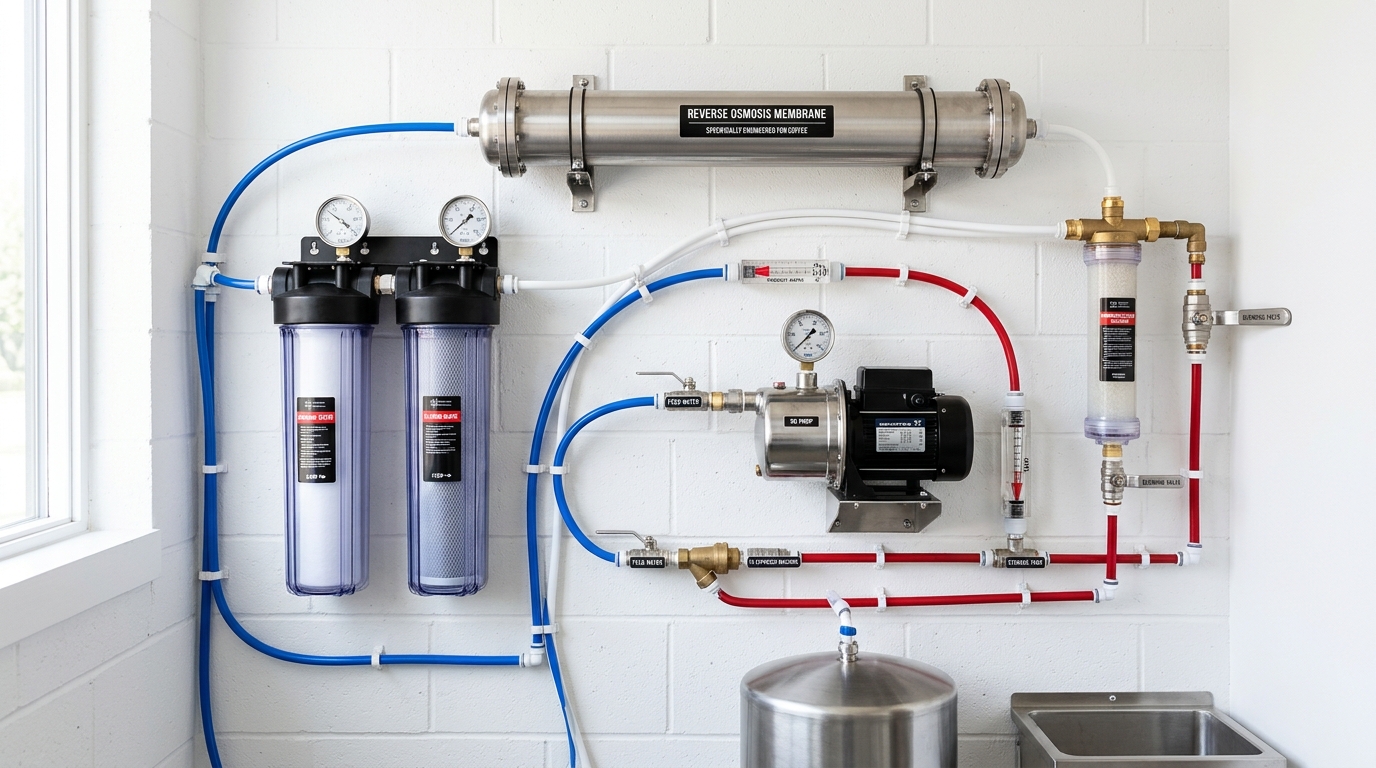
Ask any master commercial espresso technician in North America what causes catastrophic machine breakdowns, and their answer is never faulty computer boards, failed pump heads, or worn portafilter gaskets.
Over 70% of all catastrophic commercial espresso machine failures—including ruptured heating elements, seized flow meters, stuck solenoid valves, and corroded boiler walls—are caused directly by poor water chemistry.
Water makes up 90% of a concentrated shot of espresso and over 98.5% of batch brewed filter coffee. It acts as both the solvent that extracts delicate aromatic sugars from roasted coffee and the thermodynamic transfer fluid circulating through high-pressure copper and stainless steel boilers at 260°F (127°C).
Cafe owners typically face two primary water filtration architectures: Reverse Osmosis (RO) with Precision Remineralization and Weak-Acid Cation (WAC) Ion-Exchange Softening.
Selecting the wrong system can result in one of two devastating financial outcomes: severe calcium carbonate scale that suffocates heating elements in six months, or aggressive, demineralized acidic corrosion that eats through a $15,000 multi-boiler machine from the inside out.
This technical guide delivers an authoritative engineering comparison of Reverse Osmosis and Ion-Exchange softening, examining membrane physics, mineral buffering chemistry, chloride corrosion risks, and total cost of ownership in 2026.
1. The Dual Enemies of Commercial Coffee Boilers: Scale vs. Corrosion
Commercial espresso boilers operate in an extreme thermodynamic environment. Water is heated under pressure up to 260°F (127°C) in the steam boiler and 200°F (93.3°C) in the brew group circuits. At these temperatures, chemical equilibria shift drastically.
+--------------------------------------------------------------------------+
|                  THE THERMODYNAMIC WATER QUALITY SPECTRUM                |
|                                                                          |
|   <--- CORROSION ZONE              SAFE ZONE              SCALE ZONE --->|
|   TDS < 50 PPM                 TDS: 100 - 150 PPM         TDS > 250 PPM  |
|   Alkalinity < 30 PPM          Alkalinity: 40 - 70 PPM    Hardness > 150 |
|   Chlorides > 30 PPM           Chlorides: < 10 PPM        pH > 8.0       |
|   pH < 6.5                     pH: 7.0 - 7.5                             |
|                                                                          |
|   CONSEQUENCES:                IDEAL RESULTS:             CONSEQUENCES:  |
|   - Copper leaching            - Vibrant origin flavor    - Element lime |
|   - Stainless weld pitting     - Round sweetness          - Valve jams   |
|   - Liquid level sensor fail   - Full machine protection  - Restricted   |
|   - VOIDED MANUFACTURER        - Zero scale build-up        water flow   |
|     WARRANTY                   - Zero acid etching        - High power   |
+--------------------------------------------------------------------------+
Enemy #1: Calcium Carbonate Scale Formation ($CaCO_3$):
When water rich in calcium cations ($Ca^{2+}$) and bicarbonate anions ($HCO_3^-$) is heated past 140°F (60°C), bicarbonate decomposes into carbonate ($CO_3^{2-}$), water, and carbon dioxide gas:
$$\text{Ca}^{2+} + 2\text{HCO}_3^- \xrightarrow{\Delta} \text{CaCO}_3\downarrow + \text{H}_2\text{O} + \text{CO}_2\uparrow$$
Calcium carbonate has retrograde solubility—unlike sugar or salt, it becomes less soluble as water gets hotter. Consequently, it precipitates directly onto the hottest surfaces in the machine: the electric immersion heating elements and copper heat exchanger walls.
A mere 1/16-inch (1.6mm) layer of limescale acts as an insulating thermal blanket, forcing the heating element to run significantly hotter to heat the water, increasing electricity consumption by 15% to 20% until the internal resistance coil overheats and burns out. Review our Commercial Espresso Machine Maintenance Protocol for early scale detection signs.
Enemy #2: Acidic Pitting & Chloride Stress Corrosion:
Many cafe owners overcompensate by installing cheap residential reverse osmosis systems or deionizing resin filters that strip 100% of minerals from the water (producing 0 PPM TDS “pure” water).
Pure demineralized water is corrosive poison to an espresso machine.
- Without minerals, water readily dissolves carbon dioxide from ambient air, forming weak carbonic acid that drives pH down to 5.5 - 6.0.
- Demineralized water is chemically unsaturated and aggressively leaches copper, lead-free brass, and nickel plating from boiler components.
- If incoming municipal water contains chlorides ($Cl^-$)—common in coastal cities, agricultural zones, and municipalities utilizing chloramine—water heated above 180°F attacks the protective chromium-oxide passivation layer of 304/316 stainless steel, creating microscopic pitting corrosion. In under 18 months, small pinholes penetrate the boiler wall, destroying the machine.
2. Reverse Osmosis (RO) Architecture with Precision Remineralization
Reverse Osmosis is a physical separation process that forces pressurized municipal water through a semi-permeable Thin-Film Composite (TFC) membrane with microscopic pores measuring roughly 0.0001 microns (0.1 nanometers).
+--------------------------------------------------------------------------+
|                  COMMERCIAL ESPRESSO RO & REMINERALIZATION SYSTEM        |
|                                                                          |
|   MUNICIPAL WATER INLET (40-60 PSI)                                      |
|          |                                                               |
|          v                                                               |
|   [STAGE 1 & 2: SEDIMENT & CATALYTIC CARBON PRE-FILTRATION]              |
|   (Removes 5µm particulates; strips 100% of chlorine & chloramines)      |
|          |                                                               |
|          v                                                               |
|   [HIGH-PRESSURE ROTARY RO BOOSTER PUMP: 80 - 120 PSI]                   |
|          |                                                               |
|          +-------------------------------+                               |
|          |                               | (15-25% Precision Bypass)     |
|          v                               v                               |
|   [TFC RO MEMBRANE]             [PRECISION BLENDING VALVE]               |
|   (Rejects 95-98% TDS)                   |                               |
|   - Rejection Stream -> [DRAIN]          |                               |
|   - Pure Permeate (5-10 PPM)             |                               |
|          |                               |                               |
|          +---------------+---------------+                               |
|                          |                                               |
|                          v                                               |
|          [MINERAL CARTRIDGE / CALCITE POLISHER]                          |
|          (Injects controlled Calcium & Bicarbonate buffer)               |
|                          |                                               |
|                          v                                               |
|          [PRESSURIZED STORAGE BLADDER TANK (10-20 GAL)]                  |
|                          |                                               |
|                          v (Steady 40-50 PSI Delivery at 130-150 PPM)    |
|          [COMMERCIAL ESPRESSO MACHINE & BATCH BREWERS]                   |
+--------------------------------------------------------------------------+
The Three Methods of Remineralizing RO Permeate:
Because pure permeate cannot be fed directly into an espresso boiler, commercial systems utilize one of three remineralization methods:
- Precision Blending Valve (Bypass): The system diverts a dialed percentage of carbon-filtered, de-chlorinated water around the membrane and blends it directly back into the pure RO line.
- Advantage: Highly economical; utilizes the natural mineral balance of the municipal supply.
- Fatal Flaw: If your tap water contains elevated chlorides (>30 PPM), bypass blending reintroduces corrosive chlorides directly into the boiler. Never use bypass blending in coastal or high-chloride municipal areas.
- In-Line Calcite / Magnesium Remineralization Cartridges: The pure RO permeate flows through a sacrificial bed of food-grade calcium carbonate (calcite) and magnesium oxide.
- Advantage: Adds only positive hardness and buffer minerals without reintroducing harmful chlorides or sulfates.
- Limitation: Dissolution rate depends on contact time; during high-volume morning rushes, water passes through the cartridge too quickly, resulting in lower mineral pickup.
- Active Mineral Dosing Injection: Advanced commercial systems (such as high-end BWT or specialized OptiPure models) actively pump measured liquid mineral concentrates (calcium chloride, magnesium sulfate, potassium bicarbonate) into a storage reservoir.
- Advantage: Laboratory-level consistency (+/- 2 PPM) regardless of peak hourly volume.
- Limitation: Substantially higher equipment cost ($6,000 to $10,000+).
3. Ion-Exchange Softening Architecture: Weak-Acid Cation (WAC) Systems
For cafes operating in regions where municipal water has moderate hardness (< 180 PPM) and low chlorides (< 15 PPM), Weak-Acid Cation (WAC) cartridge systems (such as the BWT bestmax PREMIUM or Pentair Everpure Claris Ultra) represent a compact, zero-waste alternative to Reverse Osmosis.
+--------------------------------------------------------------------------+
|                  WEAK-ACID CATION (WAC) ION-EXCHANGE DYNAMICS            |
|                                                                          |
|   INCOMING WATER WITH TEMPORARY HARDNESS:                                |
|   - Dissolved Calcium: Ca²⁺                                              |
|   - Dissolved Bicarbonate Alkalinity: 2(HCO₃⁻)                           |
|                                                                          |
|   WATER PASSES THROUGH HYDROGEN-CYCLE RESIN BED:                         |
|   +------------------------------------------------------------------+   |
|   |  RESIN BEAD MATRIX: Pre-loaded with Hydrogen Ions (H⁺)           |   |
|   |                                                                  |   |
|   |  ION EXCHANGE REACTION:                                          |   |
|   |  Resin-2H⁺ + Ca²⁺  =====>  Resin-Ca²⁺ + 2H⁺                      |   |
|   |                                                                  |   |
|   |  (Calcium binds tightly to polymer resin; Hydrogen is released)  |   |
|   +------------------------------------------------------------------+   |
|                                                                          |
|   DOWNSTREAM BUFFER NEUTRALIZATION:                                      |
|   - Released 2H⁺ reacts instantly with Bicarbonate 2(HCO₃⁻):             |
|                                                                          |
|        2H⁺ + 2HCO₃⁻  =====>  2H₂O + 2CO₂                             |
|                                                                          |
|   RESULT:                                                                |
|   - Total Hardness (Ca²⁺) is reduced                                     |
|   - Carbonate Alkalinity is proportionally lowered                       |
|   - NO SODIUM IS ADDED TO THE WATER                                      |
|   - Zero wastewater generated                                            |
+--------------------------------------------------------------------------+
The Critical Difference Between Salt Softeners & WAC Cartridges:
Many restaurant equipment dealers mistakenly install residential Sodium-Cycle (SAC) water softeners in cafes.
- Sodium Softeners (Salt-Brine Tanks): Swap calcium for sodium. While this prevents limescale, it leaves total bicarbonate alkalinity completely untouched. High alkalinity buffers out all fruit acidity in specialty light-roast coffees, resulting in a flat, chalky, boring cup. Furthermore, elevated sodium can impart a subtle salty or metallic aftertaste.
- Weak-Acid Cation (WAC Cartridges): Swap calcium for hydrogen ions. As shown in the equation above, the released hydrogen actively neutralizes bicarbonate into water and carbon dioxide, simultaneously reducing both scale-forming hardness and excessive buffer alkalinity.
4. Head-to-Head Specification Matrix: RO vs. WAC Ion-Exchange vs. Sodium Softening
The following matrix compares the three dominant water treatment technologies across mechanical, chemical, and economic performance parameters:
| Performance Metric | Commercial Reverse Osmosis (with Remineralization) | Weak-Acid Cation (WAC) Cartridge (BWT / Claris) | Sodium-Cycle Softener (Salt-Brine Tank) |
|---|---|---|---|
| Primary Mechanism | Physical Membrane Separation (0.0001µm) | Chemical Hydrogen ($H^+$) Ion-Exchange | Chemical Sodium ($Na^+$) Ion-Exchange |
| Scale Prevention | 100% Complete (Precision Controlled) | Excellent (Adjustable via bypass head) | Excellent (Replaces $Ca^{2+}$ with $Na^+$) |
| Chloride Removal ($Cl^-$) | YES (Strips 95% - 98% of Chlorides) | NO (0% Chloride Removal) | NO (0% Chloride Removal) |
| Alkalinity Control | Complete Control (Rebuilt to 45-60 PPM) | Proportional Reduction (Buffers to 40-60) | Zero Reduction (Leaves 100% Alkalinity) |
| Flavor Impact on Coffee | Pristine origin clarity, vibrant sweetness | Bright, articulate fruit acidity, clean body | Muted, flat acidity, heavy, salty risk |
| Wastewater Generation | 25% – 50% Drain Reject (1:1 to 2:1 ratio) | 0% Wastewater (100% Efficiency) | Brine backwash (30-50 gal/regeneration) |
| Physical Space Required | Large (Booster, membrane, 15-gal tank) | Ultra-Compact (Single cartridge under bar) | Large (Fiberglass tank + 100-lb salt tank) |
| Electrical Requirement | Dedicated 120V Outlet (Booster Pump) | None (Passive hydraulic line pressure) | 120V Outlet (Timer / Metered Valve) |
| Upfront Equipment Cost | $2,400 – $4,800 installed | $650 – $1,200 installed | $1,100 – $1,800 installed |
| Annual Consumables Cost | $350 – $600 (Pre-filters + Calcite) | $600 – $1,400 (Cartridge swaps 2-3x/yr) | $120 – $200 (Pellet salt bags) |
5. The Chloride Danger: Why Municipalities Dictate Your Filtration Choice
In North America, local geology and municipal water sanitation protocols dictate whether an ion-exchange cartridge is viable or a legal warranty hazard for your espresso machine.
+--------------------------------------------------------------------------+
|                  THE CHLORIDE THRESHOLD DECISION TREE                    |
|                                                                          |
|   TEST RAW MUNICIPAL WATER FOR CHLORIDES (Cl⁻):                          |
|                                                                          |
|   IS CHLORIDE CONCENTRATION GREATER THAN 30 PPM?                         |
|                                                                          |
|          +-----------------------------------------------+               |
|          |                                               |               |
|          v (YES: Chloride > 30 PPM)                      v (NO: < 30 PPM)|
|   +-------------------------------+      +-------------------------------+
|   |   STOP! ION-EXCHANGE FORBIDDEN|      |   EVALUATE TOTAL HARDNESS:    |
|   |   - Ion exchange cannot strip |      |                               |
|   |     chlorides.                |      |   Is Hardness < 180 PPM?      |
|   |   - Hot water + Chlorides =   |      |                               |
|   |     BOILER PITTING CORROSION. |      |   * YES -> WAC Cartridge OK   |
|   |                               |      |   * NO  -> RO System Required |
|   |   MANDATORY: REVERSE OSMOSIS  |      +-------------------------------+
|   |   (With pure remineralization)|                                      |
|   +-------------------------------+                                      |
+--------------------------------------------------------------------------+
The Stainless Steel Pitting Mechanism:
Flagship multi-boiler espresso machines—including the La Marzocco Linea PB and Synesso S200—utilize AISI 304 or 316L stainless steel boilers.
Under normal water conditions, chromium in the steel reacts with oxygen to form an invisible, self-healing chromium-oxide passivation layer.
However, when chloride ions exceed 30 PPM in water heated past 180°F:
- Negatively charged chloride ions penetrate microscopic fissures in the passive chromium layer.
- The chloride reacts with exposed iron, forming highly acidic iron chloride ($FeCl_2$).
- This creates an autocatalytic electrochemical cell: the micro-pit generates concentrated acid at its base, drilling a deep microscopic tunnel through 2mm of solid stainless steel.
- When technicians inspect a failed boiler with chloride pitting, the outside looks pristine, but the inside looks like Swiss cheese.
Manufacturer Warranty Warning: Both La Marzocco and Nuova Simonelli state explicitly in their warranty terms: Boiler failure caused by chloride concentrations exceeding 30 PPM is strictly excluded from factory warranty coverage.
6. Sizing and Utility Planning for Commercial RO Installations
If water testing indicates that Reverse Osmosis is mandatory for your cafe, you must account for footprint, drainage, and hydraulic recovery in your facility plans:
+--------------------------------------------------------------------------+
|                  COMMERCIAL RO UTILITY & PLUMBING ROUGH-IN               |
|                                                                          |
|   1. ELECTRICAL REQUIREMENT:                                             |
|      - One dedicated NEMA 5-15R (120V, 15-Amp) circuit beneath the bar   |
|        to power the high-pressure RO rotary booster pump.                |
|                                                                          |
|   2. WATER INFLOW & REGULATION:                                          |
|      - Cold Water Line: 1/2" or 3/8" dedicated feed with ball valve.     |
|      - Incoming Dynamic Pressure: Minimum 35 PSI.                        |
|                                                                          |
|   3. DRAINAGE REQUIREMENT (MANDATORY AIR GAP):                           |
|      - RO concentrate reject line (1/4" or 3/8" poly tubing) must dump   |
|        into a dedicated floor drain or hub sink with a 1-inch physical   |
|        AIR GAP to satisfy local plumbing and health codes.               |
|                                                                          |
|   4. PRESSURIZED ACCUMULATOR STORAGE:                                    |
|      - An RO membrane produces water slowly (typically 50 to 175 GPD).   |
|      - A pressurized diaphragm storage tank (10 to 20 gallons) is        |
|        mandatory to supply immediate peak morning draw for espresso      |
|        pumps, batch brewers, and ice machines simultaneously.            |
+--------------------------------------------------------------------------+
Review our dedicated facility rough-in guides:
- Commercial Espresso Machine & Coffee Electrical and Plumbing Guide
- How to Open a Coffee Shop: Comprehensive Equipment Checklist
7. The Final Verdict: Which Water Treatment System Should You Choose?
Choose a Commercial Reverse Osmosis System with Remineralization if:
- Your municipal water test reveals chlorides exceeding 30 PPM, sulfates exceeding 50 PPM, or total dissolved solids (TDS) exceeding 300 PPM.
- You operate a high-volume cafe running multiple heavy water consumers (a 3-group espresso machine, twin batch brewer, automated pitcher rinsers, and commercial ice maker).
- You want completely stabilized water chemistry that remains 100% immune to municipal seasonal swings, winter road-salt runoff, and water main disruptions.
- Your budget accommodates a $2,500 to $4,500 capital equipment expenditure. Review our Startup Equipment Budget Guide to structure financing.
Choose a Weak-Acid Cation (WAC) Cartridge System (e.g., BWT Bestmax) if:
- Your municipal water test confirms chlorides are well below 20 PPM, total hardness is between 80 and 180 PPM, and total TDS is below 250 PPM.
- You have zero physical space beneath your counter for a bulky 15-gallon RO expansion tank and booster pump.
- Your municipal lease or environmental philosophy prohibits discarding RO reject wastewater.
- You want an ultra-low initial equipment expenditure under $1,000 and can manage scheduled quarterly cartridge swaps.
Frequently Asked Technical Questions
Why is 100% pure Reverse Osmosis water dangerous to commercial espresso boilers?
Pure Reverse Osmosis (RO) water has virtually all dissolved minerals stripped out (TDS < 10 PPM), leaving it chemically aggressive or 'hungry.' Without calcium and bicarbonate buffering minerals, RO water rapidly absorbs atmospheric carbon dioxide to form carbonic acid (dropping pH below 6.0). This acidic, demineralized water violently leaches copper from boilers, corrodes brass fittings, pits stainless steel welds, and will not register on boiler liquid level probes.
What is the difference between sodium-cycle and hydrogen-cycle ion-exchange softeners?
Traditional sodium-cycle (SAC) water softeners swap calcium and magnesium ions for sodium ions on a 1:1 charge basis; they prevent scale but leave alkalinity and chloride levels untouched while increasing sodium. Hydrogen-cycle weak-acid cation (WAC) cartridges (such as BWT bestmax or Everpure Claris) swap hardness minerals for hydrogen ions (H+), actively neutralizing bicarbonate alkalinity and reducing total TDS without adding salty sodium.
What is a blending valve in a commercial coffee RO system?
A precision blending valve (bypass valve) takes a measured percentage of carbon-filtered, de-chlorinated municipal tap water and blends it back into the pure RO permeate stream before it reaches the espresso machine. This reintroduces necessary calcium, magnesium, and buffer alkalinity to achieve the target 120-150 PPM TDS required for sweet espresso extraction and machine safety.
How much wastewater does a commercial reverse osmosis system produce?
Modern high-efficiency commercial coffee RO systems (such as the OptiPure OP175 or Pentair Everpure MRS-600HE) operate at recovery rates between 50% and 75%, generating 1 to 2 gallons of concentrate (drain wastewater) for every 1 gallon of purified water produced. Older or unassisted residential-style RO systems can waste 4 to 6 gallons of water per gallon produced.
When is Reverse Osmosis mandatory over a standard ion-exchange softening cartridge?
Reverse Osmosis is strictly mandatory whenever incoming municipal water contains elevated chlorides (> 30 PPM), high sulfates, or extreme total dissolved solids (TDS > 350 PPM). Ion-exchange softening cartridges cannot remove corrosive chloride ions; only an RO membrane can physically filter out chlorides to prevent catastrophic pitting corrosion on stainless steel espresso boilers.