Commercial Pitcher Rinsers & Countertop Drainage Guide (2026)
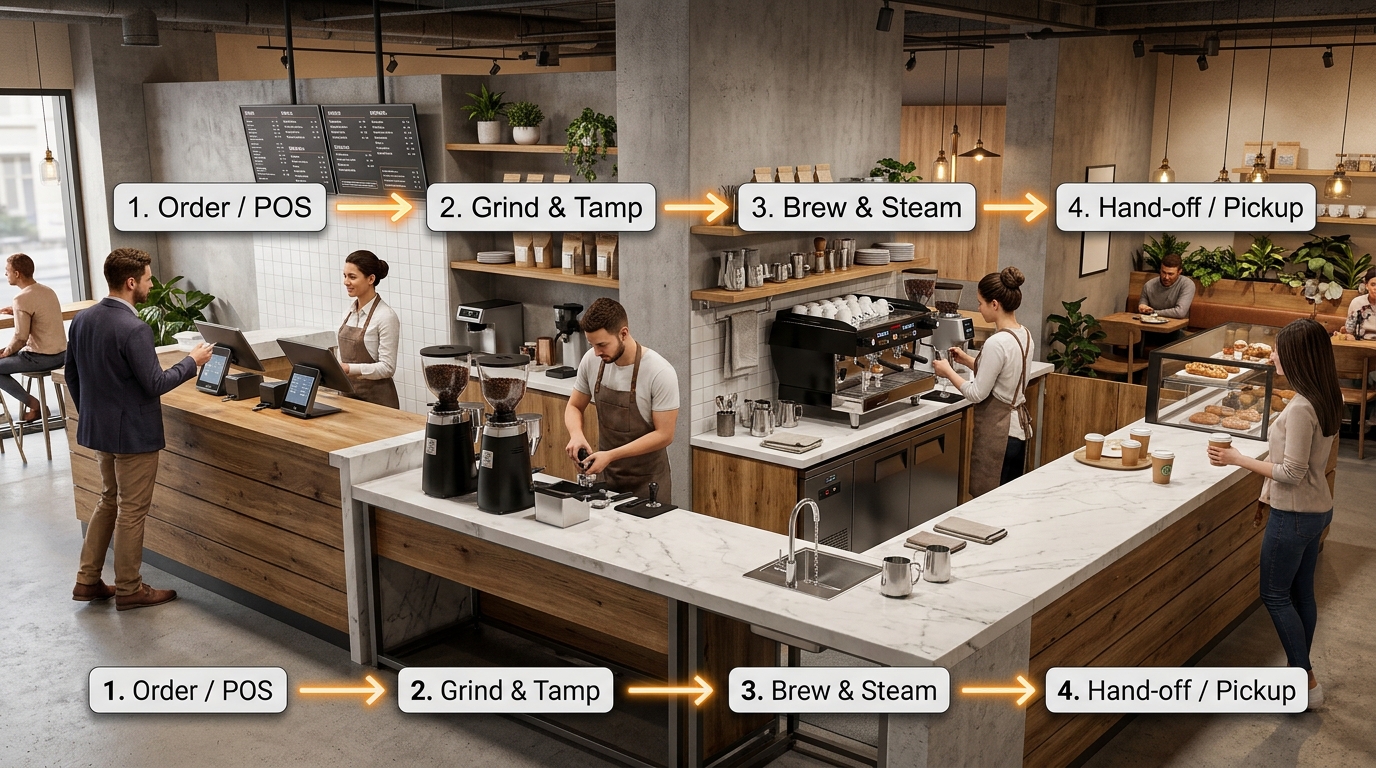
In the fast-paced ecosystem of a commercial specialty coffee shop, the in-counter pitcher rinser is an absolute marvel of speed-of-service engineering.
Before the invention of the countertop rinser, a barista who finished steaming an oat milk latte had to turn around, walk four steps to a three-compartment sink, turn on a faucet, rinse the pitcher, shake it dry, and walk four steps back to the espresso machine.
Doing that across 400 drinks per shift consumed over 80 minutes of wasted barista walking time every single day.
With an in-counter rinser embedded directly beside the espresso machine, the barista simply flips the pitcher upside down, presses down firmly on a pressurized stainless star-wheel for two seconds, and watches a high-velocity 360-degree fan of cold water blast every trace of milk fat out of the pitcher in the blink of an eye.
Yet from a plumbing engineering and municipal health inspection perspective, the pitcher rinser is the single most scrutinized and dangerous component on your entire bar.
Every year, hundreds of coffee shop grand openings across the United States and Canada are delayed by weeks because an unlicensed general contractor plumbed a pitcher rinser directly into a sewer line or failed to install a certified backflow preventer.
A single plumbing code violation can lead to a red-tagged health permit, preventing you from legally opening your doors.
This comprehensive technical guide outlines the plumbing codes, ASSE backflow standards, countertop cutout engineering, and drainage physics required to build a fully compliant commercial pitcher rinser station in 2026.
1. The Cross-Connection Hazard: Why Plumbing Inspectors Target Rinsers
To understand why plumbing inspectors are obsessed with pitcher rinsers, you must understand the fluid mechanics of back-siphonage:
+--------------------------------------------------------------------------+
|                  THE CROSS-CONNECTION BACK-SIPHONAGE HAZARD              |
|                                                                          |
|   NORMAL OPERATION:                                                      |
|   - Municipal Line Pressure (50 PSI) pushes clean filtered water UP.     |
|   - Water sprays out of nozzle to rinse dirty milk pitcher.              |
|                                                                          |
|   THE DISASTER SCENARIO (MUNICIPAL PRESSURE COLLAPSE):                   |
|   - A fire hydrant is opened down the street, or a water main ruptures.  |
|   - Municipal line pressure plunges to negative pressure (A VACUUM).     |
|                                                                          |
|   WITHOUT ASSE 1022 BACKFLOW PREVENTER:                                  |
|   - The negative pressure acts like a giant drinking straw.              |
|   - The rinser nozzle—submerged in room-temperature sour milk and        |
|     bacterial residue—is sucked BACKWARD into the supply line!           |
|   - Contaminated dairy is drawn into the drinking water supply of the    |
|     entire building, triggering widespread foodborne illness.            |
|                                                                          |
|   WITH ASSE 1022 DUAL-CHECK VALVE WITH ATMOSPHERIC VENT:                 |
|   - Check valves snap shut instantly.                                    |
|   - Atmospheric vent opens to break the vacuum.                          |
|   - ZERO CONTAMINATION CAN ENTER THE DRINKING WATER SYSTEM.              |
+--------------------------------------------------------------------------+
The Legal Code Mandate (ASSE 1022 / 1024):
Under the Uniform Plumbing Code (UPC) and International Plumbing Code (IPC):
- Every pitcher rinser connected to a potable drinking water supply must be equipped with an approved Dual-Check Valve with Atmospheric Port conforming to ASSE Standard 1022.
- Simple single-check inline valves are illegal because a single speck of scale can hold the check flap open, completely compromising backflow protection.
- The backflow preventer must be installed on the cold water line downstream of the shutoff valve and immediately upstream of the rinser flexible hose.
2. Inflow Plumbing Engineering: Sizing, Tubing & Water Pressure
A pitcher rinser requires clean hydraulic engineering to deliver an effective cleaning blast without blowing out internal seals:
+--------------------------------------------------------------------------+
|                  PITCHER RINSER INFLOW UTILITY SCHEMATIC                 |
|                                                                          |
|   [COLD FILTERED WATER SUPPLY (3/8" or 1/2" Line)]                       |
|          |                                                               |
|          v                                                               |
|   [DEDICATED 3/8" QUARTER-TURN BALL SHUTOFF VALVE]                       |
|          |                                                               |
|          v                                                               |
|   [BRASS PRESSURE REDUCING VALVE (PRV)] -> DIALED TO 35 – 40 PSI         |
|          |                                                               |
|          v                                                               |
|   [ASSE 1022 CERTIFIED DUAL-CHECK BACKFLOW PREVENTER WITH VENT]          |
|          |                                                               |
|          v (3/8" Flexible Braided Stainless Hose or John Guest Poly)     |
|   [MECHANICAL BRASS STAR-WHEEL POPPET VALVE (Inside Rinser Pan)]         |
|          |                                                               |
|          v (Downstream High-Velocity 360-Degree Fan Jet)                 |
|   [STAINLESS STEEL MILK PITCHER INTERIOR]                                |
+--------------------------------------------------------------------------+
The Water Pressure Sweet Spot (35 to 40 PSI):
- Below 25 PSI: Water trickles weakly out of the spray nozzle. Milk fat and protein films clinging to the corners of the pitcher are not dislodged, forcing baristas to scrub pitchers with rags.
- Between 35 and 40 PSI (Optimal): High-velocity, turbulent fan spray blasts milk residue clean in under two seconds with minimal water consumption (approx. 0.2 gallons per cycle).
- Above 50 PSI: Dangerous. The excessive pressure causes high-velocity aerosolization, spraying fine milk-water mist into the air and onto nearby customer counters. It also places extreme hydraulic shock on the internal poppet valve o-rings, leading to continuous drips. Review our Water Pressure Booster Pumps and Accumulator Tanks Guide to balance bar pressure.
3. Drainage Architecture: The Mandatory Indirect Air Gap Floor Sink
The most frequent reason health inspectors red-tag coffee shop plumbing during pre-opening inspections is improper pitcher rinser drainage:
+--------------------------------------------------------------------------+
|                  MANDATORY INDIRECT DRAINAGE (AIR GAP)                   |
|                                                                          |
|   ILLEGAL DRAINAGE (AUTOMATIC HEALTH CITATION):                          |
|   [Rinser Pan] =====> [Direct Pipe Connection into Sewer P-Trap]         |
|   >>> DANGER: If city sewer backs up, raw sewage flows UP into rinser!   |
|                                                                          |
|   LEGAL DRAINAGE (UPC / IPC COMPLIANT):                                  |
|   [Rinser Pan Drain Fitting (1/2" or 3/4" Barb)]                         |
|          |                                                               |
|          | (Heavy-duty wire-reinforced non-kinking flexible hose)        |
|          | (Minimum 1/4" pitch per foot downward slope)                  |
|          v                                                               |
|   [END OF DRAIN PIPE]                                                    |
|          |                                                               |
|          | <===== 1.0" MINIMUM PHYSICAL AIR GAP (OPEN AIR SPACE) ======> |
|          v                                                               |
|   +------------------------------------------------------------------+   |
|   |         INDIRECT FLOOR SINK / HUB DRAIN (With Domed Strainer)    |   |
|   |  - Connected to building sanitary sewer through dedicated P-trap |   |
|   +------------------------------------------------------------------+   |
+--------------------------------------------------------------------------+
The Three Golden Rules of Rinser Drainage:
- The 1-Inch Air Gap Rule: Under Section 802 of the Uniform Plumbing Code, indirect waste lines from equipment used in food and beverage preparation must terminate at least 1.0 inch (25mm) above the flood-level rim of an indirect waste receptor (floor sink).
- Never Direct-Connect into a Sewer Pipe: Direct-connecting a pitcher rinser drain into a closed PVC drainpipe without an air gap is an immediate health code violation.
- Downward Pitch (1/4” per foot): Pitcher rinser drains operate purely by gravity. The drain hose must have a continuous downward slope of at least 1/4 inch per foot. If the drain hose sags beneath cabinetry, water will pool, causing milk sugars to stagnate, sour, and emit foul, rancid odors.
4. Countertop Integration: Drop-In vs. Flush-Mount Trays
When purchasing a commercial pitcher rinser, cafe owners must specify the physical mounting configuration:
+--------------------------------------------------------------------------+
|                  DROP-IN VS. FLUSH-MOUNT RINSER CUTOUTS                  |
|                                                                          |
|   DROP-IN RINSER PAN (e.g., Espresso Parts 7"x7" or 7"x24"):             |
|   - Profile: Outer perimeter stainless flange rests on TOP of stone.     |
|   - Installation: Simple rectangular cut through quartz or wood slab.    |
|   - Pros: Low contractor labor cost; easy to seal with 100% silicone.    |
|   - Cons: Raised 1/8" metal lip prevents squeegeeing water off counter.  |
|                                                                          |
|   FLUSH-MOUNT REBATED RINSER (e.g., Krome Dispense Flush Series):        |
|   - Profile: Countertop fabricator CNC-mills a 1/8" deep rebate groove.  |
|   - Installation: Rinser sits 100% dead-level with quartz counter surface|
|   - Pros: Beautiful architectural aesthetic. Barista can squeegee coffee |
|     grounds and water drips directly into the drain basin with one swipe.|
|   - Cons: Requires high-precision CNC stone cutting ($300 extra labor).  |
+--------------------------------------------------------------------------+
Rinser Pan Sizing Matrix:
- Compact Square (7” x 7” / 18cm x 18cm): Houses single spray star. Perfect for tight mobile carts or low-volume auxiliary stations.
- Standard Rectangular (7” x 14” / 18cm x 35cm): Houses single spray star plus a perforated drying rack for draining two clean pitchers.
- High-Volume Dual Station (7” x 24” / 18cm x 60cm): Houses two independent spray stars and a wide drying grid, allowing two baristas to rinse dairy and alternative oat milk pitchers simultaneously without waiting. Review our Coffee Shop Bar Layout Guide to position dual rinser stations.
5. Daily Sanitation & Preventative Valve Maintenance
Because pitcher rinsers handle raw milk residue, failure to maintain sanitary protocols turns the basin into a breeding ground for bacteria:
+--------------------------------------------------------------------------+
|                  DAILY & MONTHLY RINSER MAINTENANCE PROTOCOL             |
|                                                                          |
|   EVERY NIGHT (Closing Shift):                                           |
|   1. Lift out the stainless steel wire drip grid.                        |
|   2. Spray basin interior with food-safe sanitizer. Scrub with brush to  |
|      dissolve milk film clinging to corners and drain fitting.           |
|   3. Pour 1.0 liter of near-boiling water (from the tea hot water tower) |
|      slowly down the drain hose to melt residual milk fats and prevent   |
|      line clogging.                                                      |
|                                                                          |
|   EVERY 90 DAYS (Valve Rebuild & Lubrication):                           |
|   1. Turn off under-counter water shutoff ball valve.                    |
|   2. Unscrew top star-wheel actuator; remove mechanical brass plunger.   |
|   3. Inspect internal Viton O-rings for wear or tear.                    |
|   4. Apply a thin coating of NSF food-grade silicone grease (Haynes 500) |
|      to the brass valve stem. Reassemble and leak-check.                 |
+--------------------------------------------------------------------------+
Review our comprehensive sanitation guidelines:
- Commercial Coffee Equipment Maintenance & Water Quality
- How to Open a Coffee Shop: Comprehensive Equipment Checklist
6. The Final Verdict: Checklist Before Calling Your Health Inspector
Before scheduling your final health and plumbing inspection, walk your coffee bar with this compliance sign-off checklist:
- Dual-Check Valve Installed: Certified ASSE 1022 or ASSE 1024 backflow preventer visible on cold water line.
- Dedicated Shutoff Valve: Quarter-turn ball valve located directly beneath the rinser pan for emergency isolation.
- Water Pressure Regulated: Pressure reducing valve dialed between 35 and 40 PSI.
- Indirect Waste Air Gap: Drain hose terminates with a clean, physical 1.0-inch vertical air gap above a floor sink.
- Continuous Downward Pitch: Drain hose has zero sags, bends, or traps that hold stagnant milk water.
- 100% Silicone Perimeter Seal: Countertop cutout perimeter sealed with food-grade clear silicone to prevent under-counter water leaks.
Frequently Asked Technical Questions
Why do municipal health inspectors fail coffee shops over pitcher rinsers?
Health and plumbing inspectors scrutinize pitcher rinsers because they present a severe 'cross-connection' hazard. The spray nozzle sits directly inside a basin of dirty, room-temperature milk residue. If a city water main breaks or line pressure drops suddenly, a vacuum is created that can siphon contaminated, bacteria-laden milk backward through the spray head directly into the municipal drinking water supply. Inspectors require an approved ASSE 1022 backflow preventer on the supply line.
What backflow prevention device is required for a commercial pitcher rinser?
In the United States and Canada, plumbing codes (UPC and IPC) mandate a Dual-Check Valve with Atmospheric Port (complying with ASSE 1022 or ASSE 1024 standards) installed on the water line immediately upstream of the pitcher rinser. Simple single-check valves are strictly illegal and will fail inspection.
What is an 'air gap' and why is it mandatory for pitcher rinser drainage?
An air gap is a physical, unobstructed vertical distance (minimum 1.0 inch / 25mm) between the end of the flexible drain pipe and the flood level rim of the receiving floor sink drain. Under plumbing code, you CANNOT directly plumb a pitcher rinser into a closed sewer pipe with a P-trap. If a city sewer backs up, raw sewage would flow directly up into the rinser basin where drinking pitchers are washed.
What is the optimal water pressure for an in-counter pitcher rinser?
The optimal dynamic operating water pressure for a commercial pitcher rinser is between 30 PSI and 45 PSI (2.0 to 3.1 bar). If water pressure is below 25 PSI, the spray pattern lacks the hydraulic velocity to clean stubborn milk fat from the lower corners of the pitcher. If pressure exceeds 50 PSI, water violently aerosolizes, spraying milk mist all over the barista's counter and blowing out internal valve seals.
What is the difference between drop-in and flush-mount pitcher rinsers?
A drop-in pitcher rinser features a raised stainless steel outer flange that overlaps the top of the countertop cutout by roughly 1/2 inch, making installation straightforward on any surface. A flush-mount (or undermount) rinser is rebated seamlessly flush with the stone countertop, eliminating the raised perimeter lip so baristas can squeegee water and spilled grounds directly into the basin with a single stroke.