Commercial Pour-Over Bar Setup: Marco SP9 vs. Manual Drippers (2026)
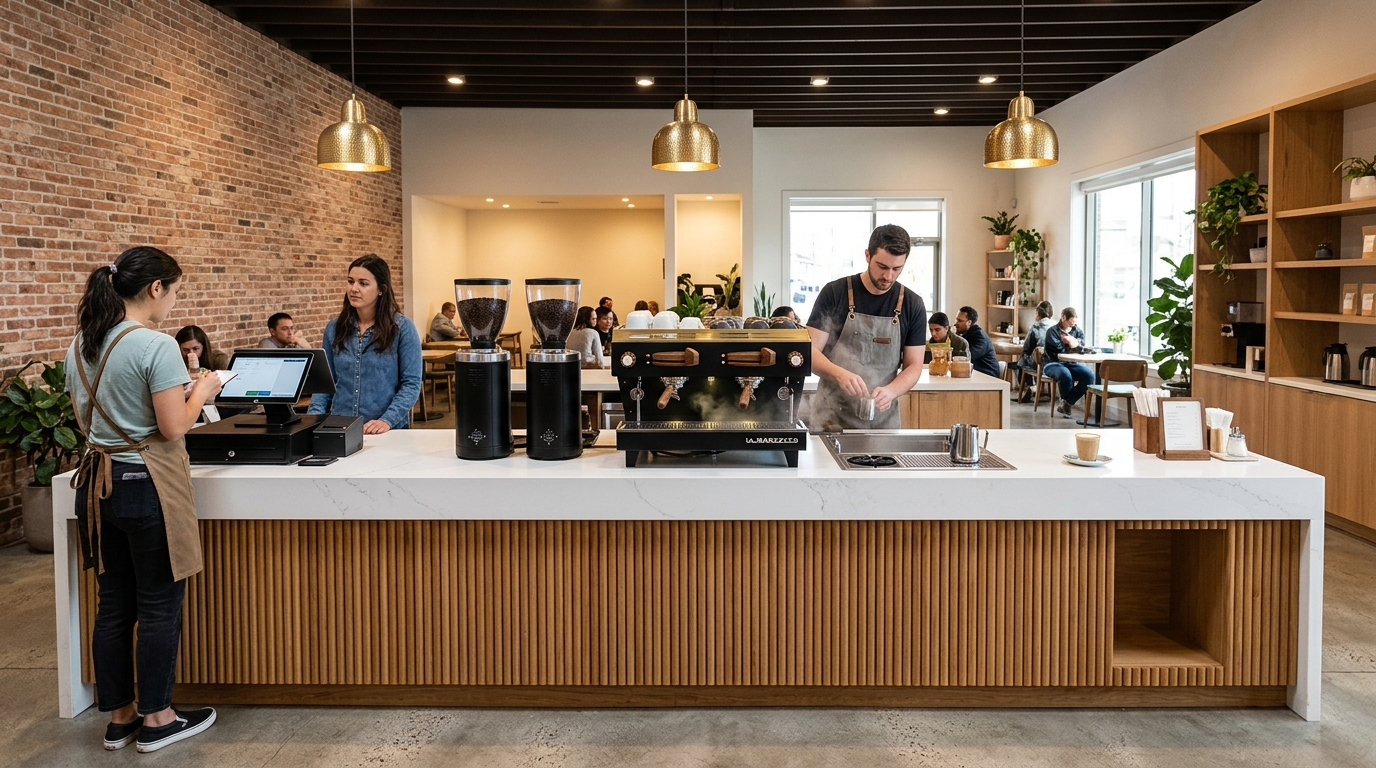
In the third-wave specialty coffee ecosystem, the single-cup pour-over is the ultimate symbol of craft and transparency. Offering rotating single-origin micro-lots from Ethiopia, Kenya, and Colombia allows cafes to charge $6.00 to $9.00 per cup, showcasing exotic florals, delicate fruit notes, and terroir that would be lost in milk-heavy espresso drinks.
Yet from a pure operations and labor economics perspective, manual pour-overs are notoriously dangerous to cafe profitability.
Picture a busy 8:30 AM rush: you have six customers waiting in line for espresso drinks and batch brew. A customer orders a manual pour-over. A barista must now grind an individual dose, rinse a filter, tare a scale, heat a kettle, and stand stationary for four full minutes, meticulously pouring water in concentric circles from a gooseneck kettle.
During those four minutes, the espresso line stalls, morning commuters abandon their orders, and labor costs consume the entire gross margin of that $7.00 cup.
To resolve this tension, commercial cafe architects must choose between cutting-edge automated single-cup brewing systems (such as the Marco SP9 and Poursteady) and ergonomically optimized manual pour-over stations.
This comprehensive technical guide breaks down equipment specifications, under-counter boiler engineering, dripper geometry physics, and labor ROI models for commercial pour-over bars in 2026.
1. The Economics of Pour-Over: Manual Labor vs. Automated Brewing
Before investing in expensive equipment, cafe operators must analyze the direct labor cost and throughput velocity of single-cup service:
+--------------------------------------------------------------------------+
|                  SINGLE-CUP BREWING: LABOR & SPEED COMPARISON            |
|                                                                          |
|   SCENARIO A: MANUAL HAND-POUR (GOOSENECK KETTLE)                        |
|   - Active Barista Labor Time: 4.5 Minutes (Stationary Attention)        |
|   - Maximum Hourly Throughput: 10 to 12 cups/hour per barista            |
|   - Labor Cost per Cup (at $18/hr wage + taxes): $1.65                   |
|   - Consistency: Variable (Depends on barista pouring technique & wrist) |
|                                                                          |
|   SCENARIO B: AUTOMATED PRECISION FONT (MARCO SP9)                       |
|   - Active Barista Labor Time: 35 Seconds (Dose, Grind, Start, Walk)     |
|   - Maximum Hourly Throughput: 40 to 50 cups/hour per barista            |
|   - Labor Cost per Cup (at $18/hr wage + taxes): $0.21                   |
|   - Consistency: 100% Identical (+/- 1°F Temp, Exact Milliliter Delivery)|
+--------------------------------------------------------------------------+
The Annualized Labor Savings Equation:
If your coffee shop sells 40 premium single-cup pour-overs per day:
- Manual Hand-Pouring Labor: 40 cups × 4 minutes active labor = 160 minutes (2.67 hours) of daily labor. At $18/hour, that equals $48.06 per day in dedicated labor—over $17,500 annually.
- Automated SP9 Labor: 40 cups × 35 seconds active labor = 23.3 minutes (0.39 hours) of daily labor, costing $7.02 per day—roughly $2,560 annually.
- Net Annual Labor Savings: $14,940 per year. An automated single-cup brewer costing $4,500 pays for itself in less than four months of commercial service.
2. Under-Counter Precision Systems: The Marco SP9 Deep Dive
Manufactured in Ireland, Marco Beverage Systems pioneered the modern architectural pour-over movement with the SP9 Single & Twin Precision Brewer. By separating the bulky hot water boiler from the countertop, Marco created a minimalist, visually stunning aesthetic that enhances customer engagement.
+--------------------------------------------------------------------------+
|                  MARCO SP9 UNDER-COUNTER PLUMBING & FLOW                 |
|                                                                          |
|                         [SLENDER COUNTERTOP FONT]                        |
|                         - Recirculating Head                             |
|                         - Dispense Chamber with Splash Deflector         |
|                         - Magnetic Filter Basket Holder                  |
|                                     |                                    |
|   ============== COUNTERTOP SLAB CUTOUT (2.5" / 64mm) ================= |
|                                     |                                    |
|                +--------------------+--------------------+               |
|                |                                         |               |
|                v (Insulated Hot Supply Line)             |               |
|   +--------------------------------------------------+   | (Drain Line)  |
|   |         MARCO UC4 / UC10 UNDER-COUNTER BOILER    |   |               |
|   |  - Stainless Steel Vacuum Insulated Pressure Tank|   |               |
|   |  - Continuous Recirculation Pump                 |   |               |
|   |  - High-Precision NTC Temperature Sensor (+/-1°F)|   v               |
|   |  - Electrical: 2.8 kW (UC4) or 5.6 kW (UC10)     | [GRAVITY DRAIN]   |
|   +--------------------------------------------------+                   |
|          ^                                                               |
|          | (3/8" Cold Filtered Water Line, 30-50 PSI)                    |
|   [DEDICATED WATER TREATMENT MANIFOLD]                                   |
+--------------------------------------------------------------------------+
Key Engineering Features of the Marco SP9:
- Continuous Thermal Recirculation Loop: The primary flaw of typical hot water fonts is that water sitting in the countertop neck cools down between orders. If ten minutes elapse between customers, the first 100 mL of water pumped through a cold font will drop from 202°F to 185°F, ruining extraction. The Marco SP9 integrates a continuous closed recirculation loop: hot water is constantly pumped up into the head and back down to the boiler, guaranteeing that the very first drop contacting the coffee bed is at the exact programmed recipe temperature (+/- 0.5°C).
- Dual-Pulse Volumetric Delivery: The SP9 allows independent recipe programming for:
- Pre-Wet / Bloom Volume: Precisely calibrated in milliliters (e.g., 60 mL for a 20g dose).
- Bloom Time Delay: Programmable pause (e.g., 40 seconds) to allow degassing.
- Pulse Frequency: Breaks the main brew into 5 to 9 controlled pulses with mechanical agitation created by the domed disperser head.
- Countertop Footprint: The SP9 font occupies a mere 6.1” x 7.6” (155mm x 193mm) of counter real estate, preserving valuable front-bar workspace for espresso grinders and register operations. Review our Coffee Shop Bar Layout and Ergonomic Design Guide to see where to position pour-over fonts.
3. Automated Competitors: Poursteady vs. Modbar Pour-Over
While the Marco SP9 is the dominant dual-head solution, two other platforms compete in high-volume specialty environments:
| Commercial Feature | Marco SP9 Twin | Poursteady PS1-3C / PS1-5C | Modbar Pour-Over System |
|---|---|---|---|
| Origin | Dublin, Ireland | Brooklyn, New York, USA | Scarperia, Italy (La Marzocco) |
| Number of Heads | 2 Independent Fonts | 3 or 5 Sequential Stations | 1 Font per Sub-Counter Module |
| Boiler Configuration | Single Sub-Counter UC4 or UC10 | Integrated Instantaneous Heater | Dedicated Multi-Boiler Under Counter |
| Electrical Requirement | 208-240V / 2.8kW - 5.6kW (15-25A) | 208-240V / 5.0kW - 7.5kW (30A) | 208-240V / 1.4kW per Module (15A) |
| Pouring Geometry | Center Cascade Pulse Dispense | Motorized X-Axis Robotic Nozzle | Precision Spray Nozzle with Restrictors |
| Recipe Customization | Milliliters, Pulses, Temperatures | Dynamic Spiral & Center Pours via App | Flow-Rate Profiling via Display |
| Equipment Cost | $4,200 – $5,500 (Twin Setup) | $11,000 – $16,000 (3 to 5 Heads) | $5,200 – $6,000 per Single Station |
| Target Operation | Mid-to-high volume specialty cafes | Massive flagship roasteries & events | Boutique luxury cafes & hotel lounges |
The Poursteady Advantage: Robotic Motion
The Poursteady takes automation a step further by utilizing a robotic arm that mimics the exact hand movement of a barista. It moves in concentric circular spirals across the coffee bed, delivering water with dynamic flow rates across three or five drippers simultaneously. However, its significant $12,000+ cost and larger footprint make it an investment suited primarily for high-revenue flagship venues.
4. Manual Pour-Over Station Architecture: Designing for Speed
If your brand philosophy demands the theatrical craftsmanship of a live barista hand-pouring coffee with a gooseneck kettle, you must engineer the manual station to eliminate every millisecond of wasted motion.
+--------------------------------------------------------------------------+
|                 HIGH-EFFICIENCY MANUAL POUR-OVER BAR LAYOUT              |
|                                                                          |
|   [HOT WATER TOWER: 204°F]           [RECESSED SCALE DRAIN TRAY]         |
|   (Marco MIX PB3 / Bunn H3X)         +---------------------------------+ |
|   - Rapid Dispense Pushbutton        | [Acaia Lunar]   [Acaia Lunar]   | |
|   - Fills Kettle in 4 Seconds        |                                 | |
|               |                      | [Dripper 1]     [Dripper 2]     | |
|               v                      | (Kalita 185)    (Kalita 185)    | |
|   [GOOSENECK KETTLE STAGING]         |                                 | |
|   (Fellow Stagg EKG Pro Base)        +---------------------------------+ |
|                                                      |                   |
|                                                      v                   |
|                                            [UNDER-COUNTER DRAIN]         |
|                                                                          |
|   [SINGLE-DOSE RETAIL GRINDER]       [WASTE KNOCK CHUTE & RINSER]        |
|   (Mahlkönig EK43 / Mazzer ZM)       - Flush-mounted rinser bowl         |
+--------------------------------------------------------------------------+
Essential Hardware for a High-Efficiency Manual Station:
- Commercial Precision Hot Water Tower (The Flow Eliminator):
- Never rely on waiting for a 120V kettle to boil cold water. A 120V electric kettle takes 4 to 6 minutes to heat water from room temperature.
- Install a dedicated, direct-plumbed commercial hot water tower like the Marco MIX PB3 or Bunn H3X. These units feature 3-temperature push-button presets and high-recovery heating elements that dispense 204°F water at a blazing 0.8 gallons per minute. A barista can fill an empty gooseneck kettle with boiling water in just four seconds.
- Flush-Mounted Countertop Drip Tray with Glass Rinser:
- Instead of resting pour-over carafes on loose rubber bar mats that collect sticky brown puddles, cut a stainless steel drain trough directly into the counter.
- Embed an integrated cold water pitcher rinser inside the drain trough so the barista can blast-clean carafes and wash away pre-wetting rinse water with a single downward press.
- Built-in Digital Precision Scales:
- Waterproof scales with auto-tare and auto-timer firmware (such as the Acaia Lunar or Acaia Pearl Model S) recessed flush into the stainless drip grid eliminate clumsy balance shifts and messy cords.
5. Dripper Geometry Showdown: Flat-Bottom vs. Conical vs. Immersion
The physical shape of the manual filter dripper dictates the water percolation path, bed permeability, and margin of error for busy baristas:
      CONICAL (Hario V60)             FLAT-BOTTOM (Kalita Wave)         IMMERSION (Hario Switch)
           \       /                             |       |                        |       |
            \     /                              |       |                        |       |
             \   /                               |_______|                        |___o___| (Valve)
              \_/                                 .  .  .
          Single Hole                           Three Holes                      Closed Valve
   Requires Meticulous Pour            Forgiving Horizontal Flow            100% Extraction Parity
1. Conical Geometry (e.g., Hario V60, Chemex):
- Flow Characteristics: Water converges down steep 60° angled walls toward a single large exit orifice. The central column of the coffee bed is twice as deep as the perimeter edges.
- Barista Sensitivity: Extremely High. If a barista pours water too close to the paper wall, water bypasses the bed and exits into the cup without extracting coffee. If they pour aggressively down the center, they bore a deep crater, producing an uneven, astringent cup.
- Verdict for Cafes: Excellent for quiet boutique bars with master baristas; risky for high-volume commercial chains with variable staff experience.
2. Flat-Bottom Wave Geometry (e.g., Kalita Wave 185, Orea V3, Fellow Stagg X):
- Flow Characteristics: The coffee grounds sit in a wide, shallow, uniform cylindrical hockey-puck shape across a flat base with three small exit holes or an open mesh. Corrugated paper flutes keep wet coffee away from the outer walls, eliminating bypass.
- Barista Sensitivity: Very Low (Highly Forgiving). Water naturally pools across the flat bed, creating a uniform hydrostatic head. Minor variations in pouring height or circle speed produce negligible changes in final TDS.
- Verdict for Cafes: The recommended industry standard for commercial cafe service.
3. Hybrid Immersion Drippers (e.g., Hario Switch, Clever Dripper):
- Flow Characteristics: A silicone ball valve or mechanical lever seals the bottom of the cone. Water and coffee grounds undergo a full 2-minute immersion soak (like a French press) before the barista flips the switch, allowing the liquid to drain through a paper filter.
- Barista Sensitivity: Zero. Extraction is governed purely by steep time and grind size, completely independent of pouring agitation or water stream speed.
- Verdict for Cafes: Outstanding operational choice for cafes that refuse to buy an automated Marco SP9 but want 100% consistent single-cup results from junior baristas.
6. Facility Infrastructure: Utilities & Countertop Planning
Installing a dedicated commercial pour-over station—whether automated or manual—requires careful utility planning beneath the counter:
+--------------------------------------------------------------------------+
|                  POUR-OVER BAR UTILITY & CUTOUT CHECKLIST                |
|                                                                          |
|   1. ELECTRICAL SPECIFICATIONS:                                          |
|      - Marco SP9 Single / Water Tower: NEMA 6-15R (208V, 15A, 2.8kW)     |
|      - Marco SP9 Twin: NEMA 6-20R (208-240V, 20A, 5.6kW)                 |
|      - Electric Kettles (x2): Dual NEMA 5-15R (120V, 15A Quad Receptacle)|
|                                                                          |
|   2. PLUMBING SPECIFICATIONS:                                            |
|      - Cold Water Line: 3/8" Male Flare or Compression                   |
|      - Dynamic Pressure: Regulated to 35-45 PSI                          |
|      - Filtration: SCA-compliant remineralized RO or dual carbon block   |
|        (Review: /guides/commercial-coffee-water-filtration-guide)       |
|                                                                          |
|   3. DRAINAGE & CUTOUTS:                                                 |
|      - Font Penetration: 2.5" (64mm) hole core-drilled through stone     |
|      - Recessed Drain Tray: Stainless cut-in with 1/2" flexible drain line|
|      - Minimum Counter Clearance: 32" depth to fit under-counter boiler  |
+--------------------------------------------------------------------------+
Review our dedicated architectural guides:
- Commercial Espresso Machine & Coffee Electrical and Plumbing Guide
- How to Open a Coffee Shop: Comprehensive Equipment Checklist
7. The Verdict: Automation vs. Manual Hand-Pouring
Invest in the Marco SP9 (or Poursteady) Automated System if:
- You project selling more than 25 single-cup pour-overs per day during peak business hours.
- You operate a high-volume cafe where barista labor must remain focused on espresso throughput and customer hospitality.
- You want zero recipe drift across rotating shifts, seasonal staff, and multi-location operations.
- You desire a clean, modern under-counter aesthetic that draws visual focus to coffee brewing without bulky hardware.
Build an Ergonomic Manual Pour-Over Station if:
- Your cafe identity is rooted in slow-coffee ritual, direct barista-to-customer conversation, and artisanal theater.
- Your single-cup volume is modest (fewer than 15 pour-overs daily), making a $5,000 automated system financially unjustifiable.
- You equip the bar with a dedicated high-recovery Marco MIX hot water tower, flush-mounted recessed drain trays, and flat-bottom drippers (Kalita Wave / Orea V3) to protect your team from operational bottlenecks.
Frequently Asked Technical Questions
What is the financial problem with traditional manual hand-pour coffee bars?
The primary operational flaw of manual pour-overs is labor cost and throughput bottleneck. A barista standing with a kettle pouring water over a Hario V60 for 3.5 to 5 minutes produces only 8 to 12 drinks per hour. At $18/hour labor, labor cost alone equals roughly $1.50 to $2.25 per cup, obliterating margins and creating severe service delays during peak morning business.
How does the Marco SP9 automated single-cup brewer work?
The Marco SP9 utilizes an under-counter precision water boiler (Marco UC4 or UC10) connected to a sleek countertop dispensing head. The barista doses and tamps the filter basket, places it beneath the font, and presses a button. The SP9 automatically dispenses a pre-programmed volume of water in precise pulse sequences at an exact temperature (+/- 1°F / 0.5°C), freeing the barista to attend to other orders.
What electrical and plumbing rough-in does an under-counter pour-over font require?
An under-counter system like the Marco SP9 Twin requires a dedicated 208V to 240V, 20-amp single-phase electrical circuit for the sub-counter heating boiler (drawing 2.8 kW to 4.0 kW), a 3/8-inch filtered cold water line with 30-50 PSI regulated pressure, and a gravity drain line for the drip tray cut into the countertop.
Which manual dripper geometry is most forgiving for commercial cafe service?
Flat-bottom drippers with wave paper filters (such as the Kalita Wave 185, Orea V3, or Fellow Stagg X) are far more forgiving and consistent in commercial environments than conical drippers (like the Hario V60). Flat-bottom geometries promote horizontal water flow, reduce channeling along narrow apex points, and produce uniform extraction across varying barista pouring techniques.
How many pour-over stations should a busy specialty coffee shop install?
Most mid-volume specialty cafes (200-400 customers/day) operate best with a dedicated two-station pour-over bar (either a dual automated font like the Marco SP9 Twin or a two-well manual recessed drain rack). High-volume roastery flagships (500+ customers/day) often deploy multi-head automated stations like the Poursteady PS1 (3 to 5 heads) to handle simultaneous peak single-cup demand.