Low-Profile Commercial Espresso Machines: Design Guide (2026)
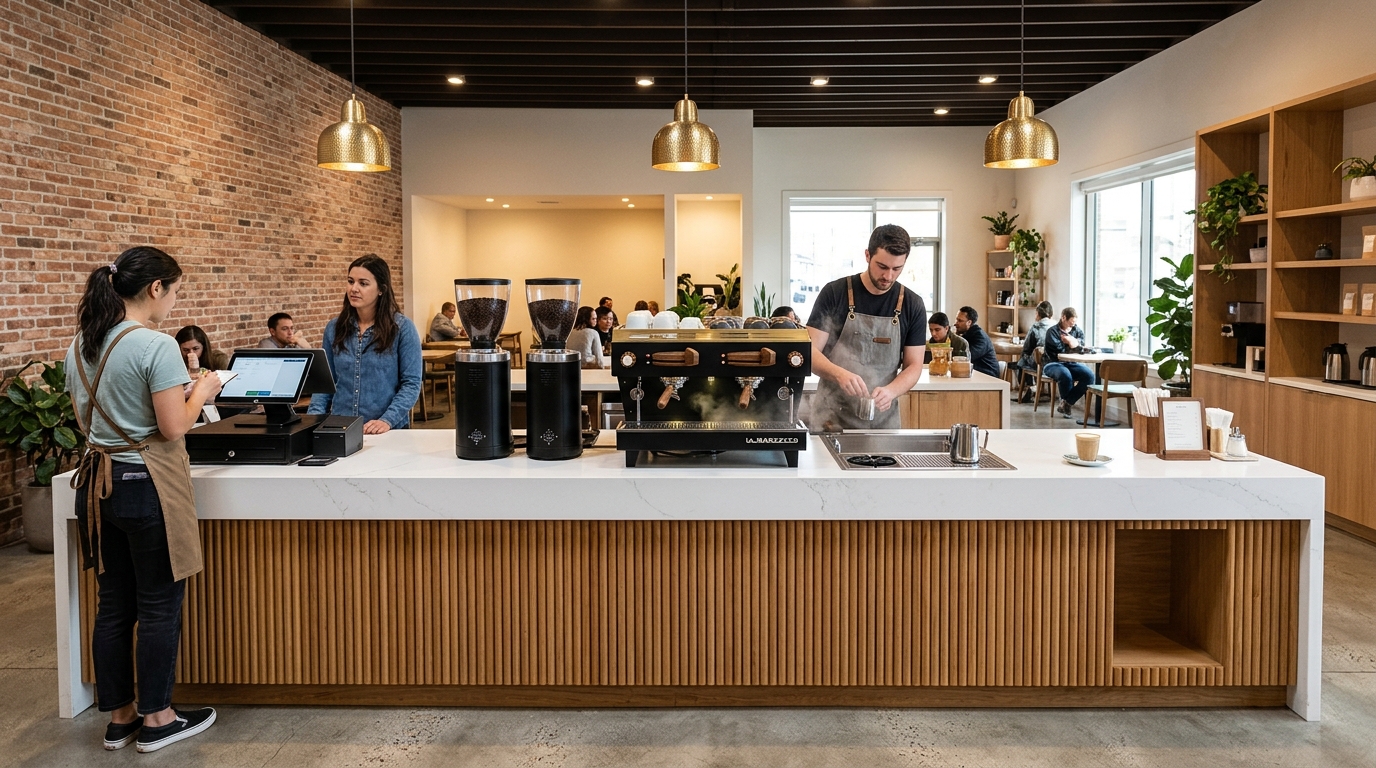
Walk into a traditional coffee shop built in the 1990s or 2000s, and the first thing you encounter at the order counter is an imposing, 30-inch-tall fortress of brushed stainless steel.
Perched on top of the machine are three rows of ceramic cappuccino cups and latte bowls, forming a solid visual barrier.
The customer stands on one side of this “metal wall,” squinting to make eye contact with a hidden barista who is hunched behind the machine, shouting order totals over the hiss of steam.
In modern specialty coffee architecture, this traditional layout is recognized as a profound hospitality failure.
Hospitality research demonstrates that direct eye contact and visual transparency increase customer tipping by 25% to 35%, elevate perceived beverage value, and turn first-time visitors into fiercely loyal regulars. Customers want to see the craftsmanship: the gleaming portafilters, the golden stream of espresso pouring into glass, and the pour-over blooming on precision scales.
To tear down the metal wall, cafe architects in 2026 are deploying Low-Profile and Modular Under-Counter Commercial Espresso Machines.
This comprehensive architectural guide evaluates the engineering, cabinet ventilation, countertop cutouts, and hospitality ergonomics of Modbar, Mavam, Synesso S200, and Victoria Arduino Eagle One.
1. The Three Architectural Tiers of Low-Profile Espresso Engineering
When designing a modern open-concept coffee bar, cafe owners have three distinct hardware avenues to achieve barrier-free customer interaction:
+--------------------------------------------------------------------------+
|                  THE THREE TIERS OF LOW-PROFILE CAFE DESIGN              |
|                                                                          |
|   TIER 1: MODULAR UNDER-COUNTER SYSTEMS (Modbar / Mavam)                 |
|   - Architecture: 100% of boilers and pumps live INSIDE the cabinetry.   |
|   - Countertop: Only slender cast stainless fonts and steam wands rise.  |
|   - Visual Barrier: ZERO (100% Completely Open Sightline).               |
|   - Equipment Cost: $20,000 – $32,000 (Complete 2-3 Group Setup).        |
|                                                                          |
|   TIER 2: INTEGRATED LOW-STANCE COUNTERTOP MACHINES (Synesso S200 / VA)  |
|   - Architecture: Compact all-in-one chassis with low-profile stance.    |
|   - Countertop: Height restricted to 16.5" – 19.0" (42 – 48 cm).         |
|   - Visual Barrier: Minimal (Cups stored in recessed sunken trays).      |
|   - Equipment Cost: $14,000 – $22,000.                                   |
|                                                                          |
|   TIER 3: ARCHITECTURAL SUNKEN COUNTER WELLS                             |
|   - Architecture: A standard machine is dropped into a recessed well.    |
|   - Countertop: Front service counter is stepped down by 6 to 8 inches.  |
|   - Visual Barrier: Reduced, but requires complex carpentry and slab cut.|
|   - Equipment Cost: Standard machine price + $2,500 contractor framing.  |
+--------------------------------------------------------------------------+
2. Modular Under-Counter Systems: Modbar vs. Mavam Deep Dive
The ultimate expression of barrier-free design is the modular under-counter tap system, where the messy mechanical heart of the espresso machine is hidden beneath beautiful quartz, marble, or hardwood slabs.
+--------------------------------------------------------------------------+
|                  MODULAR UNDER-COUNTER HYDRAULIC LAYOUT                  |
|                                                                          |
|   [MINIMALIST CAST STAINLESS TAP]        [INDEPENDENT STEAM LEVER FONT]  |
|   - Volumetric Touchscreen Interface     - Cool-Touch Stainless Wand     |
|   - Real-Time Pressure / Flow Profiling  - Ergonomic Actuator Lever      |
|                  |                                      |                |
|   ===============|======= COUNTERTOP SLAB CUTOUT =======|=============   |
|                  |                                      |                |
|                  v (Heated Umbilical Line)              v (Insulated)    |
|   +----------------------------------+   +---------------------------+   |
|   |   UNDER-COUNTER ESPRESSO MODULE  |   | UNDER-COUNTER STEAM MODULE|   |
|   |  - Dual Boiler / Saturated Neck  |   | - 8-14 Liter Steam Boiler |   |
|   |  - High-Efficiency Gear Pump     |   | - Heavy-Duty Heating Coil |   |
|   |  - 208-240V / 15-20 Amp Circuit  |   | - 208-240V / 30 Amp Circuit|  |
|   +----------------------------------+   +---------------------------+   |
|                  |                                      |                |
|                  +------------------+-------------------+                |
|                                     |                                    |
|                                     v                                    |
|              [ACTIVE CABINET EXHAUST VENTILATION: 75 CFM]                |
+--------------------------------------------------------------------------+
1. Modbar (La Marzocco Engineering):
Acquired by La Marzocco in 2013, Modbar operates on La Marzocco’s core saturated group and dual-boiler patents.
- The Espresso AV Module: Each Modbar font is connected to a dedicated sub-counter module containing a dedicated brew boiler, digital PID, and gear pump.
- Thermal Siphon Umbilical: To prevent cold water in the tube between the cabinet and the counter, Modbar continuously circulates boiling water through the braided stainless umbilical conduit, guaranteeing that the cast stainless font head is thermally stable to within +/- 0.5°F.
- Modularity: A cafe can start with two espresso taps and one steam tap, and later add a third espresso tap or pour-over font without altering the existing chassis. Review our Commercial Pour-Over Bar Guide to see how Marco and Modbar pour-over fonts integrate.
2. Mavam Under Counter:
Engineered in Seattle by Michael Myers, Mavam is renowned for extreme thermal stability and heavy-gauge industrial build quality.
- Triple-Point Temperature PID System: Mavam utilizes three independent heating circuits for every group: (1) a primary sub-counter pre-heat boiler, (2) an individual grouphead boiler, and (3) an active electric heating element embedded directly inside the countertop font collar itself.
- Heated Font Casting: While other systems can lose 1°F during a cold draft breeze across the cafe counter, Mavam’s actively heated font collar maintains an unyielding thermal anchor.
- Low-Voltage Activators: Mavam uses tactile momentary switches on the tap head, giving baristas rapid, satisfying control over pre-infusion and volumetric dosing.
3. The Critical Cabinetry Engineering: Ventilation, Heat & Umbilical Tolerances
Installing under-counter espresso modules without engineered cabinetry will lead to catastrophic electronics failures and spoiled milk:
+--------------------------------------------------------------------------+
|                  UNDER-COUNTER CABINET PLANNING CHECKLIST                |
|                                                                          |
|   1. THERMAL DISSIPATION & EXHAUST (MANDATORY):                          |
|      - A 3-group under-counter system radiates over 7,000 BTUs of heat   |
|        into enclosed cabinetry.                                          |
|      - Without active exhaust, cabinet air temperature can reach 140°F   |
|        (60°C), triggering safety thermal lockouts on computer boards.    |
|      - MANDATORY FIX: Install an active 4-inch 120V cabinet exhaust fan   |
|        (minimum 75 CFM) venting hot air out the rear or kick-plate,      |
|        paired with passive intake louvers near the bottom front.         |
|                                                                          |
|   2. UMBILICAL LINE LENGTH & RADIUS:                                     |
|      - Modbar and Mavam umbilical hoses have a maximum length of 36"     |
|        to 48" (91cm to 122cm).                                           |
|      - Hoses must NOT have sharp 90-degree kinks; minimum bend radius is |
|        4.0 inches (100mm) to prevent internal PTFE water line pinching.  |
|                                                                          |
|   3. COUNTERTOP CORE-DRILLING TOLERANCES:                                |
|      - Font Penetrations: Typically 2.5" (64mm) to 3.0" (76mm) core      |
|        drilled through quartz, granite, or wood.                         |
|      - Drip Tray Drain Cutout: Precision rectangular water-jet cutout   |
|        with flush rebate lip for zero-lip stainless drain grates.        |
+--------------------------------------------------------------------------+
Review our dedicated facility rough-in guides:
- Commercial Espresso Machine & Coffee Electrical and Plumbing Guide
- How to Open a Coffee Shop: Comprehensive Equipment Checklist
4. Integrated Low-Stance Countertop Machines: The Balanced Compromise
If your budget or municipal leasing agreement prohibits cutting multiple complex holes in expensive stone countertops or modifying custom cabinetry, Integrated Low-Stance Countertop Machines provide the ideal middle ground:
+--------------------------------------------------------------------------+
|                  LOW-STANCE COUNTERTOP MACHINES COMPARED                 |
|                                                                          |
|   1. SYNESSO S200 / S300 (Height: 16.9" / 43 cm)                         |
|   - Architecture: Handcrafted multi-boiler in Seattle, Washington.       |
|   - Ergonomics: The lowest standard countertop machine in the industry.  |
|   - Visual Sightline: Baristas look directly across the top casing into  |
|     the eyes of ordering customers. Cups stored in low side trays.       |
|                                                                          |
|   2. VICTORIA ARDUINO EAGLE ONE (Height: 17.2" / 43.7 cm)                |
|   - Architecture: Compact multi-boiler with patented NEO engine.         |
|   - Energy Efficiency: Instantaneous micro-boilers reduce energy by 35%. |
|   - Visual Styling: Ultra-modern automotive curves, customizable panels. |
|                                                                          |
|   3. SANREMO CAFE RACER / F18 (Height: 17.1" / 43.4 cm)                  |
|   - Architecture: Visible naked grouphead architecture, exposed pipes.   |
|   - Visual Styling: Cafe Racer motorcycle aesthetics with open chassis.  |
+--------------------------------------------------------------------------+
Why Low-Stance Countertop Machines Win on Serviceability:
While modular under-counter taps look breathtaking in architectural photography, low-stance countertop machines are infinitely easier to maintain:
- Technician Access: In an unexpected morning breakdown, a technician simply removes two screws on a Synesso S200 to access pumps, heating elements, and solenoids in under sixty seconds.
- Cost: An integrated low-profile machine costs $14,000 to $22,000, compared to $24,000 to $32,000 for a full multi-tap under-counter system with cabinetry carpentry and ventilation ducting.
5. Head-to-Head Specification Matrix: Low-Profile Commercial Platforms
| Design Parameter | Modbar Espresso AV (2-Group) | Mavam Under Counter (2-Group) | Synesso S200 (2-Group Countertop) | Victoria Arduino Eagle One (2-Group) |
|---|---|---|---|---|
| System Format | Modular Under-Counter (2 Fonts) | Modular Under-Counter (2 Fonts) | Integrated Low-Stance Countertop | Integrated Low-Stance Countertop |
| Height Above Counter | 12.5 inches (31.7 cm) | 12.0 inches (30.5 cm) | 16.9 inches (43.0 cm) | 17.2 inches (43.7 cm) |
| Countertop Sightline | 100% Completely Open | 100% Completely Open | Open, Unobstructed Eye Contact | Open, Unobstructed Eye Contact |
| Boiler Location | Sub-Counter Dedicated Modules | Sub-Counter Central Boiler Unit | Internal Dedicated Multi-Boilers | Internal NEO Micro-Boilers |
| Cabinet Ventilation | Mandatory (75 CFM Fan) | Mandatory (75 CFM Fan) | Standard Ambient Dissipation | Standard Ambient Dissipation |
| Temperature Stability | +/- 0.5°F (Saturated Font Neck) | +/- 0.5°F (Heated Font Collar) | +/- 0.5°F (Multi-Boiler PID) | +/- 0.5°F (Instant Pre-Heat) |
| Countertop Cutout Req. | Two 2.5” holes + Tray cut | Two 3.0” holes + Tray cut | One 2.5” utility grommet | One 2.5” utility grommet |
| Typical Equipment Cost | $22,000 – $26,000 | $23,500 – $27,500 | $16,500 – $19,500 | $15,500 – $18,500 |
| Installation Complexity | Very High (Cabinetry + Stone) | Very High (Cabinetry + Stone) | Moderate (Standard Drop-On) | Moderate (Standard Drop-On) |
6. The Verdict: Which Low-Profile System Fits Your Concept?
Choose a Modular Under-Counter System (Modbar or Mavam) if:
- Your cafe concept is built around luxury minimalist aesthetics, open hospitality, and culinary theater where conventional espresso machines look dated or intrusive.
- You have custom, high-end millwork and cabinetry with budget allocated for active ventilation exhaust fans and precision water-jet stone cutouts.
- Your budget accommodates a $24,000 to $32,000 full modular setup. Review our Startup Equipment Budget Guide to evaluate capital allocations.
Choose an Integrated Low-Stance Machine (Synesso S200 or Eagle One) if:
- You want the hospitality advantages of direct customer eye contact and open sightlines without the nightmare of crawling inside cabinetry to service modules.
- You operate a high-volume venue (300+ drinks daily) where bulletproof technician accessibility and rapid 15-minute solenoid replacements are vital to operations.
- You want an ultra-reliable, world-class machine under $20,000 that drops onto any standard commercial counter without custom millwork.
Frequently Asked Technical Questions
What is a modular under-counter espresso machine?
A modular under-counter espresso machine (such as Modbar or Mavam) physically separates the heating boilers, rotary pumps, and electronic circuitry from the countertop. The bulky mechanical modules are mounted inside cabinetry beneath the bar, while only slender, elegant dispensing taps (fonts) and independent steam wands rise through precision holes cut into the stone countertop.
Why do coffee shops choose low-profile espresso equipment?
Traditional commercial espresso machines stand 24 to 30 inches tall with towering ceramic cup stacks, creating an intimidating 'metal wall' that completely severs visual contact between barista and customer. Low-profile machines (under 18 inches tall) or under-counter taps eliminate this barrier, restoring direct eye contact, fostering natural hospitality, and transforming beverage preparation into engaging culinary theater.
What ventilation is required for under-counter espresso boilers?
Because commercial steam and brew boilers operate at 200°F to 260°F, placing them inside enclosed cabinetry generates extreme ambient heat buildup that can overheat electronics and spoil adjacent refrigerated dairy supplies. Under-counter systems mandate active cabinet ventilation, typically requiring mechanical exhaust fans drawing at least 50 to 100 CFM paired with intake louvers providing a minimum of 40 square inches of open passive airflow.
How is water temperature maintained between an under-counter boiler and the countertop font?
To prevent water from cooling down as it travels through the flexible lines between the cabinet module and the countertop tap, manufacturers use continuous heated recirculation loops or actively heated group necks (e.g., Mavam's heated font collar and Modbar's thermal siphon circulation), ensuring that extraction water remains stable within +/- 0.5°F from the very first drop.
Are under-counter espresso systems harder to service and repair than standard machines?
Yes. In an emergency breakdown, technicians working on a standard countertop machine can simply remove two side panels for 360-degree access. With modular under-counter equipment, technicians must crawl inside cramped cabinetry, navigate tangled plumbing and electrical conduit, and frequently pull entire slide-out modules out onto the floor, resulting in higher service labor costs and longer repair times.