Best 3-Group Commercial Espresso Machines for High Volume (2026)
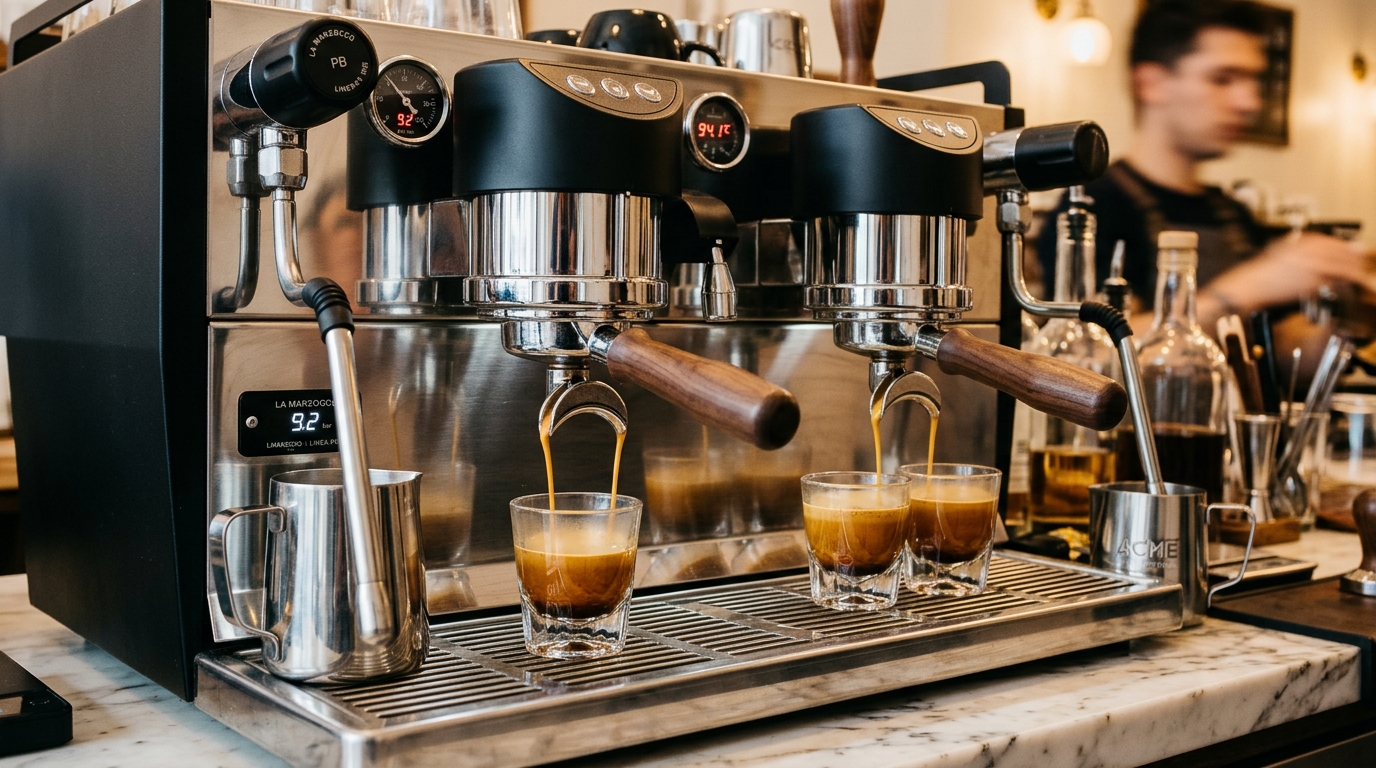
In the high-stakes world of commercial specialty coffee, the choice between a 2-group and a 3-group commercial espresso machine is one of the most critical capital investments a cafe owner will ever make.
A 2-group machine is the standard workhorse for neighborhood cafes serving 150 to 300 drinks per day. But if your venue is located in a high-density urban transit corridor, a bustling financial district, a university campus hub, or a busy hospital concourse, a 2-group machine will buckle under peak morning rush demand.
When 75 customers enter your shop between 7:45 AM and 8:30 AM, two groupheads create an insurmountable physical bottleneck. Two baristas attempting to share a 2-group machine will constantly bump elbows, fight over the single hot water tap, and collide while reaching for steam wands.
A 3-group commercial espresso machine transforms your bar ergonomics. Spanning 38 to 44 inches of counter space, a 3-group chassis provides the physical width necessary for two baristas to work side-by-side simultaneously—one barista pulling shots on Groups 1 and 2 while steaming whole milk on the left wand, while a second barista pulls rotating single-origins or decaf on Group 3 and steams alternative oat milk on the right wand.
In this comprehensive technical guide, we evaluate the four undisputed flagship 3-group commercial espresso machines dominating high-volume specialty coffee in 2026: the La Marzocco Linea PB, the Nuova Simonelli Aurelia Wave T3, the Synesso S300, and the Victoria Arduino VA388 Black Eagle Gravitech.
1. 2-Group vs. 3-Group: The Throughput & Volume Threshold Math
Upgrading to a 3-group machine requires significant capital ($3,500 to $6,000 extra upfront), higher electrical consumption, and larger counter footprints. Cafe owners must analyze whether their projected volume justifies the expenditure:
+--------------------------------------------------------------------------+
|                  HOURLY THROUGHPUT & STAFFING COMPARISON                 |
|                                                                          |
|   METRIC                         2-GROUP MACHINE      3-GROUP MACHINE    |
|   --------------------------------------------------------------------   |
|   Counter Width Footprint        27" – 32" (70-80cm)  38" – 44" (96-112cm|
|   Max Sustained Labor Capacity   1 Barista Dedicated  2 Baristas Shared  |
|   Max Drinks/Hour (1 Barista)    60 – 80 Drinks/Hr    70 – 90 Drinks/Hr  |
|   Max Drinks/Hour (2 Baristas)   90 – 110 Drinks/Hr   140 – 180 Drinks/Hr|
|   Electrical Circuit Breaker     30 Amp (208-240V)    40 – 50 Amp (240V) |
|   Total Steam Boiler Capacity    7 – 11 Liters        11 – 17 Liters     |
|   Operational Weight (Full)      180 – 240 lbs        310 – 350 lbs      |
|   Average Acquisition Cost       $14,000 – $19,000    $18,000 – $26,000  |
+--------------------------------------------------------------------------+
The 3-Group Operational Tipping Point:
Install a 3-group machine if:
- Your morning rush exceeds 100 espresso-based drinks per hour for more than two consecutive hours.
- You operate a dedicated two-barista workflow where one barista acts purely as the “shot-puller” and the second barista acts as the “milk-steamer and expeditor.” Review our Coffee Shop Bar Layout and Workflow Design Guide to see how stations sequence.
- You offer multiple distinct espresso offerings simultaneously (e.g., House Blend on Groups 1 & 2 at 9.0 bars; light-roast washed Ethiopian on Group 3 dialed with a delicate pre-infusion profile).
2. Head-to-Head Specification Matrix: Flagship 3-Group Machines
| Technical Specification | La Marzocco Linea PB 3-Group | Nuova Simonelli Aurelia Wave T3 3-Group | Synesso S300 3-Group | Victoria Arduino VA388 Black Eagle 3-Group |
|---|---|---|---|---|
| Manufacturing Origin | Scarperia (Florence), Italy | Belforte del Chienti, Italy | Seattle, Washington, USA | Belforte del Chienti, Italy |
| Boiler Architecture | Dual Boiler (Saturated Groups) | T3 Multi-Boiler (Group Boilers) | Independent Multi-Boiler | T3 Gravitech Multi-Boiler |
| Steam Boiler Capacity | 11.0 Liters (Stainless Steel) | 14.0 Liters (Nickel Copper) | 12.3 Liters (Stainless Steel) | 14.0 Liters (Nickel Copper) |
| Brew Boiler Capacity | 5.0 Liters (Dedicated Brew) | 0.7L per Group (x3 = 2.1L) | 1.9L per Group (x3 = 5.7L) | 0.7L per Group (x3 = 2.1L) |
| Electrical Voltage / Phase | 208V – 240V / 1-Phase or 3-Phase | 208V – 240V / 1-Phase or 3-Phase | 220V – 240V / 1-Phase | 208V – 240V / 1-Phase or 3-Phase |
| Total Wattage / Amps | 6,100 Watts / 26.5 Amps | 7,300 Watts / 31.7 Amps | 6,700 Watts / 29.1 Amps | 7,300 Watts / 31.7 Amps |
| Recommended Breaker | 40 Amp Double-Pole | 40 or 50 Amp Double-Pole | 40 Amp Double-Pole | 40 or 50 Amp Double-Pole |
| Temperature Control | Dual PID (Brew & Steam) | Independent T3 PID per Group | Individual PID per Group | Independent T3 PID per Group |
| Dosing Technology | Volumetric (Optional ABR Scales) | Volumetric / Easycream Option | Digital Volumetric Timers | Gravimetric (Auto-Tare Scales) |
| Physical Width | 38.0 inches (96.5 cm) | 40.6 inches (103.2 cm) | 37.0 inches (94.0 cm) | 42.3 inches (107.5 cm) |
| Dry / Operating Weight | 202 lbs / 285 lbs (129 kg) | 225 lbs / 315 lbs (143 kg) | 205 lbs / 290 lbs (132 kg) | 242 lbs / 330 lbs (150 kg) |
| Typical Equipment Cost | $21,500 – $24,500 (New) | $19,500 – $22,500 (New) | $22,000 – $25,000 (New) | $26,000 – $31,000 (New) |
3. Deep Dive: La Marzocco Linea PB 3-Group (The Specialty Benchmark)
Named in honor of Piero Bambi (the legendary visionary who designed the original Linea Classic), the Linea PB is the undisputed benchmark of specialty coffee retail in North America.
+--------------------------------------------------------------------------+
|                  LA MARZOCCO SATURATED GROUPHEAD ARCHITECTURE            |
|                                                                          |
|   +------------------------------------------------------------------+   |
|   |         LARGE DEDICATED STAINLESS BREW BOILER (5.0 LITERS)       |   |
|   |  - PID Temperature Regulated (+/- 0.5°F / 0.2°C)                 |   |
|   +------------------------------------------------------------------+   |
|          |                            |                            |     |
|          v (Direct Saturated Weld)    v (Direct Saturated Weld)    v     |
|   [GROUP 1 CASTING]            [GROUP 2 CASTING]            [GROUP 3]    |
|   - Grouphead is a physical hollow chamber welded directly into the      |
|     boiler wall. Water circulates freely inside the neck.                |
|   - Zero temperature drop between boiler interior and dispersion screen. |
|   - Piero Group Caps: Flow meter turbines embedded INSIDE the saturated  |
|     water chamber, eliminating unheated external water lines!            |
+--------------------------------------------------------------------------+
Key Engineering Advantages of the Linea PB 3-Group:
- Fully Saturated Groupheads: Unlike European machines that bolt grouphead brass castings onto a front faceplate—relying on unheated metal thermal conduction—La Marzocco welds the group neck directly to the boiler. The hot brew water is physically inside the group casting. Temperature stability across 15 consecutive double shots is unrivaled.
- Piero Group Cap Architecture: In traditional volumetric machines, the flow meter sits in an unheated plastic box inside the chassis. Water traveling through it cools down before reaching the puck. In the Linea PB, the flow meter turbine is built directly into the saturated group cap itself, completely eliminating temperature drop.
- Auto-Brew Ratio (ABR) Scale Integration: The optional ABR package embeds military-grade load cells directly into the drip tray under all three groups. The barista sets a recipe (e.g., 18.0g dry dose to 36.0g liquid yield). The machine automatically tares the ceramic cup, calculates real-time mass flow, and shuts off the solenoid at exactly 36.0 grams, eliminating barista scale handling.
- Resale Value & Global Technician Familiarity: A well-maintained Linea PB retains 60% to 70% of its capital value after five years of commercial operation, representing the highest liquidity in commercial hospitality.
The Downside of the Linea PB:
- Shared Brew Boiler: All three groups share a single 5.0-liter brew boiler. While thermal mass is immense, you cannot program Group 1 to brew at 200°F for a dark blend while setting Group 3 to 194°F for a delicate washed Geisha. All groups brew at the exact same boiler PID temperature.
4. Deep Dive: Nuova Simonelli Aurelia Wave T3 3-Group (High-Volume High-Steam Titan)
The Nuova Simonelli Aurelia series served as the official machine of the World Barista Championship (WBC) for nearly a decade. The modern Aurelia Wave T3 is an industrial powerhouse engineered specifically for brutal, relentless high-volume operations.
Key Engineering Advantages of the Aurelia Wave T3:
- The Patented T3 Multi-Boiler System:
- Unlike the shared boiler of the Linea PB, the T3 features independent heating circuits for every single group:
- Primary Steam Boiler (14.0 Liters): Massive volume for limitless milk steaming.
- Independent Group Boilers (0.7 Liters each): Every grouphead has its own dedicated stainless boiler with a standalone PID sensor.
- Grouphead Metal Temperature Sensor: A third PID actively heats the grouphead collar itself.
- You can program Group 1 at 198°F, Group 2 at 201°F, and Group 3 at 195°F with independent temperature offsets.
- Unlike the shared boiler of the Linea PB, the T3 features independent heating circuits for every single group:
- Gigantic 14.0-Liter Steam Boiler: The Aurelia Wave boasts the largest steam boiler in its class. In drive-thru or airport settings where four large 16oz or 20oz milk lattes are ordered back-to-back, steam pressure never dips below 1.2 bars.
- Ergonomic Push-Pull Steam Levers: Instead of twisting round knobs hundreds of times per shift—a leading cause of barista carpal tunnel syndrome—the Aurelia features intuitive push-pull toggle levers that instantly lock open or snap closed with a single flick of the wrist.
- Smart Water Technology: The Wave features built-in electrical conductivity sensors that detect incoming water hardness and alert the operator if filtration cartridges are failing before scale can precipitate. Review our Commercial Water Testing & SCA Standards Guide for filtration thresholds.
The Downside of the Aurelia Wave:
- Body Construction: Utilizes more molded composite plastic paneling on the body compared to the heavy all-stainless steel chassis of La Marzocco and Synesso.
- Physical Size: At 40.6 inches wide, it occupies substantial front-counter real estate.
5. Deep Dive: Synesso S300 (The American Artisan Masterpiece)
Hand-built in Seattle, Washington, Synesso machines are revered by specialty roasters for indestructible build quality, ultra-low profiles, and military-grade internal plumbing. The S300 is Synesso’s streamlined, compact volumetric 3-group solution.
+--------------------------------------------------------------------------+
|                  SYNESSO LOW-PROFILE ERGONOMIC SIGHTLINE                 |
|                                                                          |
|   TRADITIONAL HIGH-PROFILE MACHINE (30" Height):                         |
|   [CUSTOMER] ======= [WALL OF STAINLESS STEEL] ======= [BARISTA]         |
|   (Customer stares at metal backplate; barista hidden behind cups)       |
|                                                                          |
|   SYNESSO S300 LOW-PROFILE MACHINE (16.9" / 43cm Height):                |
|   [CUSTOMER] -------- Direct Eye Contact & Conversation -------- [BARISTA]|
|   (Clear view of espresso pouring, milk steaming, and hospitality)       |
+--------------------------------------------------------------------------+
Key Engineering Advantages of the Synesso S300:
- Ultra-Low 16.9-Inch Profile: The S300 stands just 16.9 inches (43 cm) tall above the counter. By removing the visual “metal barrier” between the barista and the customer, it fosters an intimate, engaging cafe environment where customers can watch the extraction theater and converse naturally with staff.
- Individual Group Brew Boilers (1.9 Liters each): Synesso pairs each group with a massive 1.9-liter dedicated brew boiler—nearly three times the volume of competitors’ group boilers—providing exceptional thermal stability during non-stop brewing.
- Cool-Touch Steam Wands Standard: Double-walled stainless wands prevent milk from baking onto the exterior metal, making wipe-downs instantaneous and preventing severe accidental barista skin burns.
- Zero Proprietary Electronics Lock-In: Synesso avoids delicate, failure-prone full-color glass touchscreens that fail in hot commercial kitchens. Instead, they use rugged digital wired handheld controllers and bulletproof mechanical toggles.
The Downside of Synesso:
- Limited Secondary Market Availability: Because Synesso builds machines to order in Seattle in smaller batches, pre-owned parts and third-party technician availability outside major metropolitan areas can be more limited than La Marzocco or Nuova Simonelli.
6. Deep Dive: Victoria Arduino VA388 Black Eagle Gravitech 3-Group
The Victoria Arduino Black Eagle is the ultra-luxury flagship of commercial espresso, serving as the official machine of the World Barista Championship for multiple consecutive competition cycles.
Key Engineering Advantages of the Black Eagle Gravitech:
- Gravimetric Real-Time Precision: The Black Eagle features high-frequency vibration-isolated load cells beneath all three groups. The software algorithm actively compensates for vibrations from grinders, refrigeration compressors, and loud cafe music, delivering liquid yields accurate to within 0.1 grams.
- High-Design Architectural Aesthetic: With stepped aluminum wings, exposed stainless group neck pillars, and a low 19.3-inch stance, the Black Eagle is the ultimate visual status symbol for luxury hotels, high-end design showrooms, and flagship roasteries.
- Granular Water Recipe Management: Baristas can independently profile pre-infusion pressure, infusion timing, and target mass across all three groups with graphical OLED displays positioned directly above each group casting.
The Downside of the Black Eagle:
- Premium Acquisition Cost: At $27,000 to $31,000, the Black Eagle is the most expensive machine in this comparison.
- Complex Calibration: Load cells require regular re-calibration using official stainless calibration weights to maintain accuracy.
7. Electrical & Plumbing Rough-In Requirements for 3-Group Workstations
Installing a 3-group commercial machine requires strict coordination with your electrical and plumbing contractors during early buildout:
+--------------------------------------------------------------------------+
|                  COMMERCIAL 3-GROUP UTILITY ROUGH-IN SPECS               |
|                                                                          |
|   1. ELECTRICAL SPECIFICATIONS:                                          |
|      - Line Voltage: 208V to 240V, Single-Phase (or 3-Phase Commercial)  |
|      - Circuit Breaker: Dedicated 40-Amp or 50-Amp Double-Pole Breaker   |
|      - Receptacle Standard: NEMA 6-50R (or direct-wired industrial whip) |
|      - Continuous Load: 6,000W to 9,100W maximum draw                    |
|                                                                          |
|   2. PLUMBING SPECIFICATIONS:                                            |
|      - Water Supply: 3/8" or 1/2" dedicated line (Regulated 40-50 PSI)   |
|      - Minimum Dynamic Flow Rate: 2.5 Gallons Per Minute (GPM)           |
|      - Upstream Filtration: SCA-compliant RO or WAC softening           |
|        (Review: /guides/reverse-osmosis-remineralization-vs-ion-exchange)|
|                                                                          |
|   3. DRAINAGE & COUNTERTOP PENETRATIONS:                                 |
|      - Counter Core-Drill: Two 3.0" (76mm) grommeted utility cutouts     |
|      - Drain Line: 3/4" flexible heat-resistant wire-reinforced hose     |
|      - Drain Hub: Indirect connection to floor sink with 1" AIR GAP      |
+--------------------------------------------------------------------------+
Review our dedicated facility rough-in guides:
- Commercial Espresso Machine & Coffee Electrical and Plumbing Guide
- Water Pressure Booster Pumps & Accumulator Tanks for Coffee Bars
8. The Final Verdict: Which 3-Group Machine Should You Choose?
Buy the La Marzocco Linea PB 3-Group if:
- You operate a high-volume specialty cafe seeking the most reliable, technician-friendly, and universally understood commercial espresso machine in the world.
- You want the highest commercial resale value and immediate brand credibility with experienced baristas.
- You want the option of factory-integrated Auto-Brew Ratio (ABR) scales built into a bulletproof stainless steel chassis.
Buy the Nuova Simonelli Aurelia Wave T3 if:
- You operate a high-speed transit hub, university campus bar, or drive-thru where uninterrupted milk steaming capacity and 7,300 watts of raw heating power are paramount.
- You want independent temperature control across all three groups with the largest steam boiler in the industry (14 liters).
- You prioritize ergonomic push-pull steam levers to protect your barista team from wrist strain.
Buy the Synesso S300 if:
- You prioritize customer hospitality, eye contact, and bar transparency, demanding an ultra-low 16.9-inch machine height.
- You want heavy-duty, handcrafted American engineering with individual 1.9-liter group boilers and standard cool-touch steam wands.
Buy the Victoria Arduino Black Eagle Gravitech if:
- You run a premier flagship roastery or luxury boutique venue where absolute world-championship gravimetric precision (0.1g accuracy) and dramatic architectural styling take center stage.
- Your budget accommodates a $28,000+ top-tier capital equipment allocation. Review our Coffee Shop Startup Equipment Budget Guide to structure equipment leasing.
Frequently Asked Technical Questions
When does a coffee shop need a 3-group espresso machine instead of a 2-group?
A cafe requires a 3-group commercial espresso machine when sustained peak morning service exceeds 100 to 120 handcrafted espresso beverages per hour, or when two baristas must operate the machine concurrently without elbow collisions. A 3-group layout allows Barista 1 to pull high-volume house blend shots on Groups 1 and 2, while Barista 2 uses Group 3 for single-origin micro-lots, decaf, or mobile order ticket queues.
What electrical circuit is required for a commercial 3-group espresso machine?
Commercial 3-group espresso machines draw massive electrical power, typically requiring a dedicated 208V to 240V single-phase electrical circuit on a 40-amp or 50-amp double-pole breaker (drawing 6.0 kW to 9.1 kW). Standard 30-amp circuits that power 2-group machines will instantly trip under the simultaneous load of multiple large heating elements firing during consecutive rush cycles.
What is the physical counter width and weight of a 3-group commercial machine?
A commercial 3-group espresso machine measures between 38 inches and 44 inches (96cm to 112cm) in counter width and weighs between 220 and 285 pounds (100kg to 130kg) dry. When the large steam and brew boilers are filled to capacity with 15 to 20 liters of water, operational weight exceeds 310 to 340 pounds (140kg to 154kg), requiring heavy-duty reinforced cabinetry.
What is the difference between volumetric and gravimetric (auto-tare) 3-group machines?
Volumetric machines measure liquid volume passing into the boiler using an electronic flow meter turbine, which can drift as coffee density or puck resistance varies. Gravimetric machines (such as the Victoria Arduino Black Eagle Gravitech or La Marzocco Linea PB ABR) embed legal-for-trade load-cell scales directly into the stainless drip tray grates beneath each group, automatically taring cups and stopping extraction precisely when the target beverage weight (e.g., 36.0g) is reached.
How much more does a 3-group machine cost compared to a 2-group model?
Across commercial manufacturers, a 3-group espresso machine typically commands a $3,500 to $6,000 price premium over its 2-group equivalent. For example, a 2-group La Marzocco Linea PB costs roughly $18,500, whereas the 3-group Linea PB costs approximately $22,500. Additionally, ongoing maintenance costs (group gaskets, shower screens, solenoid rebuilds) increase by 33% due to the third hydraulic group.