Commercial Bulk Retail & Cupping Grinders: Mahlkönig EK43 vs. Ditting (2026)
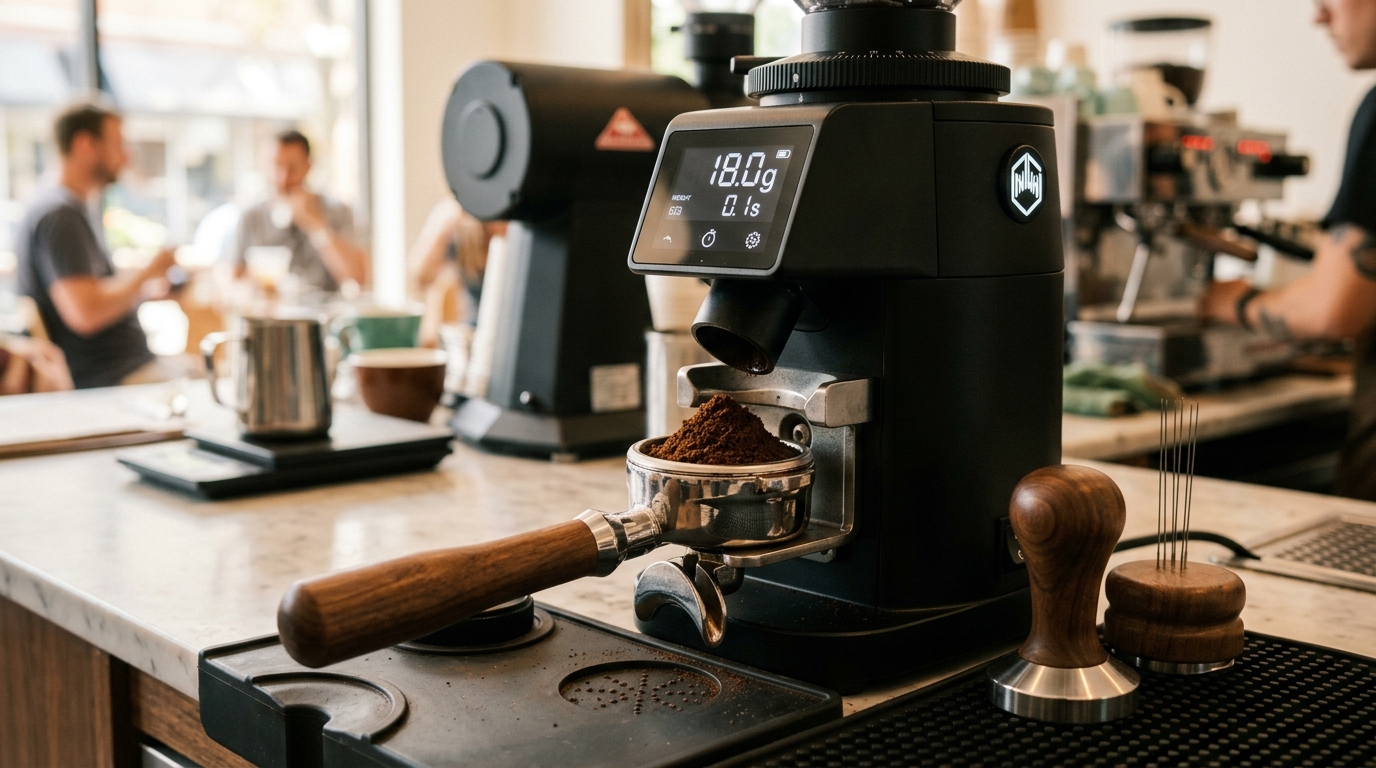
In every commercial coffee shop, the retail shelf is a massive profit center. Selling 12-ounce and 1-pound bags of whole-bean roasted coffee yields 45% to 55% profit margins with zero preparation labor.
However, over 60% of retail consumers do not own a high-end burr grinder at home; they rely on their local cafe to grind their beans for French press, auto-drip, Chemex, or stovetop moka pots at the point of purchase.
Furthermore, commercial batch brewers—such as the Fetco CBS-2142XTS or Bunn ICB Twin—require between 150 grams and 350 grams of ground coffee per cycle. Attempting to grind large batch doses or customer retail bags through an espresso grinder will overheat the motor, generate intolerable static electricity, and ruin the coffee with bitter micro-fines.
This is why the commercial bulk grinder is an indispensable asset on any professional coffee bar. It also serves as the official sensory laboratory tool for green coffee evaluation and cupping table QA.
In this technical guide, we evaluate the industry-standard commercial bulk grinders dominating specialty coffee in 2026: the legendary Mahlkönig EK43 / EK43 S, the Swiss precision Ditting 807 / KR804, and the utilitarian workhorse Bunn G3 HD.
1. Grind Physics: Unimodal vs. Bimodal Particle Distributions
Understanding why bulk grinders cost between $1,500 and $3,500 requires examining the microscopic physics of roasted coffee fracture mechanics:
+--------------------------------------------------------------------------+
|                  PARTICLE SIZE DISTRIBUTION CURVES COMPARED              |
|                                                                          |
|   BIMODAL DISTRIBUTION (Typical Commercial Espresso Grinder)             |
|   - Peak 1: Fines (30-80 microns) -> Fills spaces, restricts 9-bar flow  |
|   - Peak 2: Main Boulders (350-500 microns) -> Primary extraction        |
|   - RESULT: Necessary for rich espresso crema; CATASTROPHIC for filter   |
|                                                                          |
|   UNIMODAL DISTRIBUTION (Mahlkönig EK43 / Ditting 807)                   |
|   - Single Tight Peak: 90%+ of particles cluster at exact target micron  |
|   - Extremely Low Fines Generation (< 5% microscopic dust)               |
|   - RESULT: Flawless extraction parity, zero clogging, radiant sweetness |
+--------------------------------------------------------------------------+
Why Fines Destroy Filter Coffee:
When brewing a batch of drip coffee, microscopic coffee dust particles (“fines”) migrate through the liquid and lodge themselves into the pores of the paper filter, creating an impermeable barrier.
This causes two severe extraction flaws:
- Filter Choking & Bed Pooling: Drain time extends from 4.5 minutes to 7+ minutes. Water pools on top of the bed, resulting in uneven contact and muddy extraction.
- Over-Extraction Astringency: Because fines possess an astronomical surface-area-to-volume ratio, they extract almost instantaneously. While your main coffee particles are extracting pleasant sugars, the fines are violently over-extracting, leaching harsh tannins, ash, and dry bitterness into the beverage. Review our deep dive on Commercial Batch Brew Extraction Physics to see how particle size dictates TDS.
A true unimodal bulk grinder crushes coffee beans between massive, vertically mounted flat burrs, shearing the bean with minimal pulverization and producing a clean, tight particle curve.
2. Head-to-Head Specification Matrix: Mahlkönig vs. Ditting vs. Bunn
| Technical Specification | Mahlkönig EK43 / EK43 S | Ditting 807 (KR804 Successor) | Bunn G3 HD (Bulk Grocery) |
|---|---|---|---|
| Manufacturing Origin | Hamburg, Germany | Bachenbülach, Switzerland | Springfield, Illinois, USA |
| Burr Diameter | 98 mm Flat Burrs | 80 mm Flat Burrs | 80 mm Flat Burrs |
| Burr Material | Cast Steel (Special Heat-Treated) | Wear-Resistant Hardened Steel | Heavy-Duty Tool Steel |
| Burr Orientation | Vertical (Direct Fall-Through) | Vertical (Direct Fall-Through) | Vertical (Angled Chute) |
| Grinding Speed (Avg) | 25 – 30 g/sec (1.8 lbs/min) | 22 – 27 g/sec (1.5 lbs/min) | 18 – 22 g/sec (1.2 lbs/min) |
| Internal Retention | Near-Zero (< 0.5g per dose) | Near-Zero (< 0.5g per dose) | High (2.0g – 5.0g in chute) |
| Motor Wattage / HP | 1,300 Watts / 1.75 HP | 700 Watts / 0.94 HP | 900 Watts / 0.75 HP |
| Electrical Voltage | 100-120V or 200-240V / 1-Phase | 110-127V or 220-240V / 1-Phase | 120V / 1-Phase (11.0 Amps) |
| Bag Clamp Mechanism | Integrated Heavy Spring-Loaded Clamp | Mechanical Bag Clamp + Knocker | Mechanical Bag Clamp Lever |
| Chute De-Clumping | Built-In Vibration & Knocker | Silicone Flapper + Mechanical Knocker | Mechanical Lever Flapper |
| Overall Height | EK43: 30.3” / EK43 S: 26.8” | 807: 21.3” (Compact Countertop) | G3: 27.5” |
| Total Weight | 57.3 lbs (26.0 kg) | 38.5 lbs (17.5 kg) | 59.0 lbs (26.8 kg) |
| Equipment Cost | $2,950 – $3,300 (New) | $2,850 – $3,150 (New) | $1,350 – $1,650 (New) |
3. Deep Dive: Mahlkönig EK43 & EK43 S (The Industry Benchmark)
Originally engineered in Germany as an industrial grain, spice, and poppy-seed mill, the Mahlkönig EK43 was discovered by competitive baristas at the 2012 World Brewers Cup. They recognized that its massive 98mm cast steel vertically oriented flat burrs produced higher extraction yields and origin clarity than any grinder ever created. Today, the EK43 is the undisputed centerpiece of specialty cafes worldwide.
+--------------------------------------------------------------------------+
|                  MAHLKÖNIG EK43 INTERNAL DRIVE ARCHITECTURE             |
|                                                                          |
|        [HOPPER: 1.76 lbs / 800g]                                         |
|                   |                                                      |
|                   v (Direct Gravity Feed into Pre-Breaker Shear)         |
|   +------------------------------------------------------------------+   |
|   |         VERTICAL 98mm CAST STEEL FLAT BURR CHAMBER               |   |
|   |                                                                  |   |
|   |   [Fixed Stationary Burr]  <=====>  [Rotating Drive Burr]        |   |
|   |              |                                 |                 |   |
|   |              v                                 v                 |   |
|   |   Pre-breaking coarse teeth on inner radius                      |   |
|   |   Micro-milling precision shearing channels on outer perimeter   |   |
|   +------------------------------------------------------------------+   |
|                   |                                                      |
|                   v (Direct Fall-Through - Zero Horizontal Drift)        |
|        [BAG CLAMP CHUTE & SPRING-LOADED KNOCKER LEVER]                   |
|                   |                                                      |
|                   v                                                      |
|        [RETAIL BAG OR BATCH BASKET: <0.2g RETENTION]                     |
+--------------------------------------------------------------------------+
Key Engineering Advantages of the EK43:
- Vertical Burr Alignment & True Near-Zero Retention: Unlike traditional commercial grinders where burrs sit horizontally—forcing coffee through a right-angle chute where oils and grounds accumulate—the EK43’s burrs are mounted vertically. Ground coffee exits the burr teeth and falls directly downward by gravity through the chute. Total dose retention is less than 0.2 grams, allowing seamless single-dosing for $15 Geisha pour-overs without cross-contamination.
- Massive 98mm Thermal Sink: The sheer physical mass of the 98mm cast steel burrs acts as an immense thermal heatsink. Grinding 5 pounds of coffee back-to-back causes virtually zero heat buildup in the cutting chamber, preventing the delicate volatile aromatic oils in roasted coffee from burning or degrading.
- The EK43 S Architectural Transformation: The original EK43 towers at 30.3 inches, making it impossible to slide beneath upper cafe cabinetry. The EK43 S retains the identical 1,300-watt motor, burr chamber, and electronics, but shortens the cast body and hopper to 26.8 inches, fitting comfortably on modern commercial back-bars. Review our Coffee Shop Bar Layout Guide for equipment spacing.
The Challenge with the EK43: Factory Alignment Tolerances
Because the EK43 was designed originally as an industrial spice grinder, factory machining tolerances on the burr carrier face can vary by 20 to 40 microns. In specialty coffee, where dialing in requires single-micron precision, burr alignment (truing) is mandatory to achieve maximum unimodal performance.
4. How to Align Mahlkönig EK43 Burrs: The Marker Test Protocol
Achieving world-class extraction yields from an EK43 requires verifying that the rotating burr and stationary burr are perfectly coplanar (parallel to within 5 microns across 360 degrees).
+--------------------------------------------------------------------------+
|                  THE DRY-ERASE MARKER ALIGNMENT PROCEDURE                |
|                                                                          |
|   STEP 1: DISASSEMBLE & DEEP CLEAN                                       |
|   - Disconnect power. Remove dial collar, springs, and front shear plate.|
|   - Thoroughly vacuum and brass-brush every coffee speck from threads.   |
|                                                                          |
|   STEP 2: APPLY DRY-ERASE INK                                            |
|   - Use a red or blue dry-erase marker to color the outer 2mm flat land  |
|     of both burrs completely around the circumference.                   |
|                                                                          |
|   STEP 3: REASSEMBLE & MANUAL KISS TEST                                  |
|   - Reassemble carrier without springs. Screw faceplate finger-tight.    |
|   - Slowly rotate the drive shaft by hand while turning the grind dial   |
|     finer until you hear the very first faint metallic "chirp".          |
|   - Immediately back off; rotate by hand three full turns.              |
|                                                                          |
|   STEP 4: INSPECT INK WIPE PATTERN                                       |
|   - Disassemble and examine the ink on the outer lands:                  |
|     * Case 1: Ink wiped 100% clean around entire ring -> PERFECT ALIGN.  |
|     * Case 2: Ink wiped on one side only (e.g., 25% of ring) -> TILT.    |
|                                                                          |
|   STEP 5: SHIMMING                                                       |
|   - Place thin strips of heavy-duty aluminum foil (approx. 15-20 microns)|
|     directly behind the burr screws opposite the wipe area.              |
|   - Retest until a minimum 90%+ ink wipe is achieved across both burrs.  |
+--------------------------------------------------------------------------+
Performing this alignment reduces micro-fines by over 40%, increases extraction yields by 1.5% to 2.0%, and allows cafes to grind significantly finer for drip batches without basket choking.
5. Deep Dive: Ditting 807 Series (The Swiss Engineering Contender)
Manufactured in Switzerland, Ditting is revered for ultra-hardened tool steel burrs and exceptional retail bag clamping mechanisms. The Ditting 807 is the modern replacement for the legendary KR804.
Key Engineering Advantages of the Ditting 807:
- Precision Swiss Milling: Ditting burrs are individually CNC-milled from proprietary high-wear steel alloys. Out of the box, Ditting machining tolerances are exceptionally tight, requiring far less manual shimming than legacy Mahlkönig units.
- Integrated Dual-Knocker Chute: While the EK43 uses an external spring lever that must be vigorously snapped to dislodge static grounds, the Ditting 807 integrates an internal mechanical shaker that activates automatically when the bag clamp is opened, ensuring 100% of the ground dose enters the customer’s bag with zero counter dust.
- Active Motor Cooling: The 807 features an integrated ventilation fan that draws cool ambient air across the motor coils during high-volume grinding, preventing heat transfer into the hopper during holiday retail rushes.
The Downside of Ditting:
- Smaller Burr Surface Area: With 80mm burrs compared to the EK43’s 98mm plates, the Ditting 807 grinds slightly slower (approx. 22 g/sec vs. 28 g/sec).
- Secondary Market Liquidity: While every specialty barista knows and seeks out the EK43, the Ditting brand carries lower resale recognition on North American secondary markets.
6. Deep Dive: Bunn G3 HD (The Value Workhorse for High-Volume Grocery)
Found in thousands of grocery stores, wholesale bakeries, and high-volume commercial kitchens, the Bunn G3 HD (Heavy Duty) is the budget-friendly alternative to German and Swiss imports.
The Reality of the Bunn G3:
- The Advantages: Costing roughly $1,400 new (less than half the price of an EK43), the Bunn G3 is indestructible. It features a rugged 0.75-horsepower motor, simple mechanical bag switch interlocks (grinder will not run unless a bag is locked in place), and widely available replacement burrs under $180.
- The Severe Limitations for Specialty Cafes:
- Bimodal Grind Distribution: Bunn G3 burrs are stamped tool steel designed for medium drip and French press. They produce significant fines, making the G3 unsuitable for modern high-extraction light-roast batch brew.
- High Retention: The horizontal chute retains between 3 and 6 grams of ground coffee. If a customer grinds a dark French roast, the next customer grinding an Ethiopian light roast will have stale, oily dark roast residue blended into their coffee.
- The Verdict on Bunn G3: Ideal for secondary wholesale prep, cold brew coarse grinding, or grocery retail bags; inadequate for cupping labs or flagship specialty cafe operations.
7. Electrical & Safety Planning for Commercial Bulk Grinders
Bulk commercial grinders utilize heavy industrial motors with massive initial startup torque:
+--------------------------------------------------------------------------+
|                  BULK GRINDER ELECTRICAL INFRASTRUCTURE                  |
|                                                                          |
|   1. MOTOR INRUSH CURRENT:                                               |
|      - Running Current: 11.0 to 12.0 Amps (120V)                         |
|      - Inrush (Start-up Spike): Can exceed 25 Amps for 300 milliseconds  |
|      - Circuit Requirement: Dedicated 120V, 20-Amp NEMA 5-20R circuit    |
|        (Never share an electrical circuit with an ice maker or cooler!)  |
|                                                                          |
|   2. COUNTERTOP STABILITY & CLEARANCE:                                   |
|      - Weight: 58 lbs (26 kg)                                            |
|      - Vibration: Requires rigid quartz, granite, or solid butcher block |
|      - Overhead Clearance: 32 inches for EK43; 28 inches for EK43 S      |
|                                                                          |
|   3. CLEANING UTILITY REQUIREMENT:                                       |
|      - A dedicated handheld micro-vacuum (such as a cordless Milwaukee   |
|        or DeWalt shop-vac) must be stationed beside the bulk grinder to  |
|        daily purge the chute and burr chamber.                           |
+--------------------------------------------------------------------------+
Review our dedicated infrastructure guides:
- Commercial Espresso Machine & Coffee Electrical and Plumbing Guide
- How to Open a Coffee Shop: Comprehensive Equipment Checklist
8. The Final Verdict: Which Bulk Grinder Fits Your Operation?
Buy the Mahlkönig EK43 / EK43 S if:
- You operate a specialty coffee shop, roastery showroom, or cupping lab where particle unimodality, origin transparency, and high extraction yields are fundamental to your brand.
- You require true single-dosing flexibility to switch between pour-over micro-lots, batch brew, and retail customer bags without cross-contamination.
- You want the highest commercial equipment resale value and universal barista familiarity.
Buy the Ditting 807 if:
- You prioritize Swiss build quality, tighter out-of-the-box factory alignment tolerances, and superior bag-shaking chute ergonomics.
- You have limited counter height and want a sleek, modern commercial footprint under 22 inches.
Buy the Bunn G3 HD if:
- You are a high-volume bakery, diner, or budget-conscious startup where the bulk grinder will strictly grind coarse cold brew or grocery bags.
- You have less than $1,500 in capital allocated to your bulk grinding line. Review our Coffee Shop Startup Budget Guide to balance your equipment spending.
Frequently Asked Technical Questions
Why can't a cafe use an espresso grinder to grind retail bags for customers?
Dedicated commercial espresso grinders are engineered for bimodal particle size distributions (producing controlled micro-fines to restrict 9 bars of water pressure in a compact portafilter) and possess narrow exit chutes that retain ground coffee. Grinding a 12oz or 16oz bag of coffee through an espresso grinder will overheat the burrs, cause thermal motor shutdown, create static clumping, and retain stale coffee from previous grinds.
What is unimodal particle size distribution and why is it desirable for filter coffee?
A unimodal grind distribution means that coffee grounds are crushed into a single, tightly clustered particle size curve with minimal 'fines' (microscopic coffee dust) and minimal 'boulders' (large jagged chunks). This uniform particle geometry ensures that every coffee grain extracts at the exact same rate, eliminating bitter astringency and maximizing flavor clarity in drip, pour-over, and cold brew.
What is the difference between the Mahlkönig EK43 and EK43 S?
The Mahlkönig EK43 and EK43 S share the identical internal drive motor, heavy-duty gearing, and 98mm cast steel flat burrs, delivering identical grinding performance and particle geometry. The EK43 S is an ergonomically redesigned 'short' version with a compact 26.8-inch height (compared to the standard EK43's towering 30.3 inches), allowing it to fit beneath standard commercial wall cabinetry.
How long do 98mm cast steel burrs last before requiring replacement?
Genuine Mahlkönig 98mm cast steel burrs have an exceptionally long commercial lifespan of roughly 6,000 kilograms (approximately 13,200 lbs) of roasted coffee under normal operation. For an average specialty cafe grinding 10 to 15 lbs of retail coffee and batch brew daily, a single set of burrs will perform optimally for 2.5 to 3.5 years before noticeable dulling occurs.
What is the 'marker test' for commercial grinder burr alignment?
The marker test is a mechanical calibration procedure where a dry-erase marker is colored along the outer perimeter teeth of both flat burrs. The grinder is reassembled and manually rotated until the burrs lightly kiss. Disassembling reveals where the ink was wiped away: an incomplete wipe indicates the burrs are not parallel, requiring microscopic aluminum foil shims beneath the low spots to achieve 100% coplanar alignment.