Multi-Boiler vs. Heat Exchanger Espresso Machines (2026)
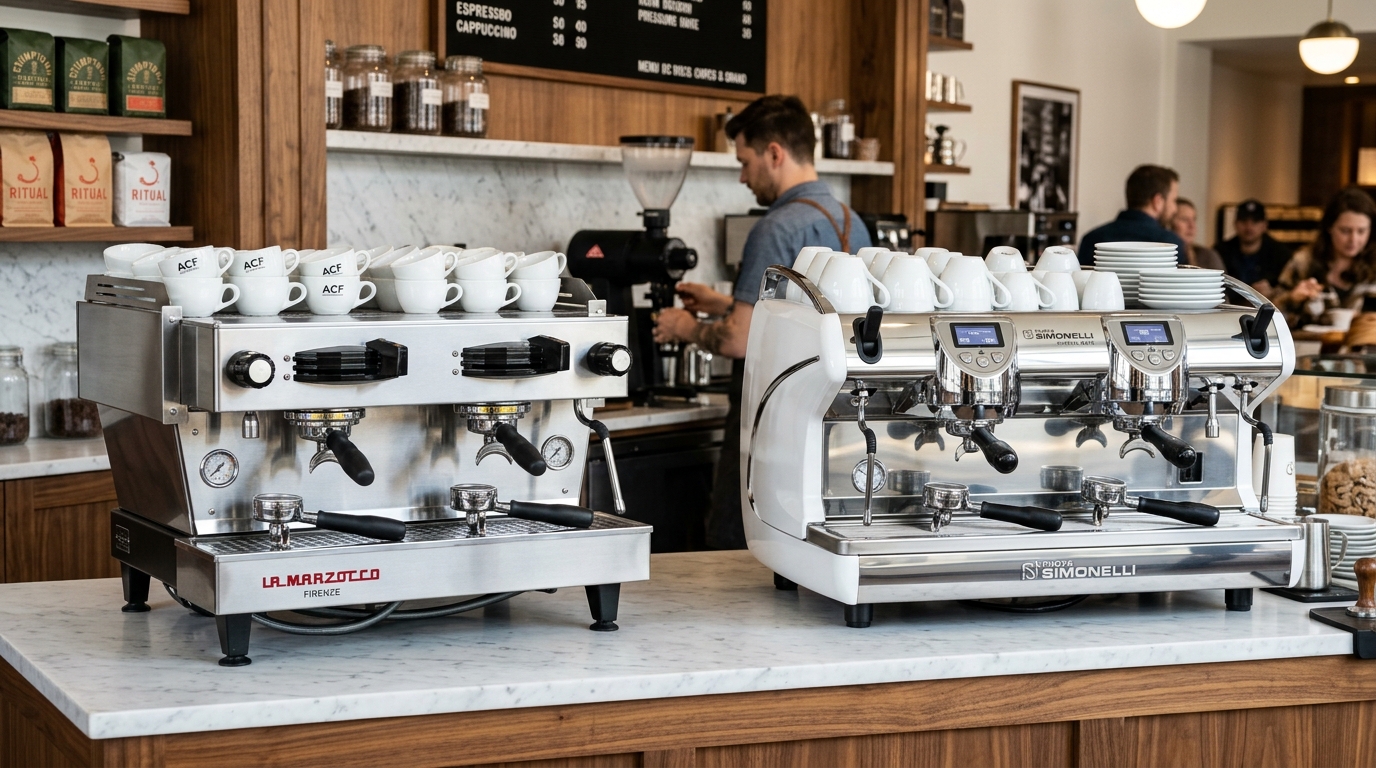
When entrepreneurs begin shopping for their first commercial espresso machine, they encounter a massive price divide.
On one side of the showroom floor sit capable commercial machines priced between $5,500 and $9,000. On the other side sit flagship machines with virtually identical exteriors priced between $16,000 and $26,000.
What justifies a $12,000 price gap between two stainless steel boxes that both pump water at 9 bars of pressure through 58mm portafilters?
The answer lies beneath the metal chassis in the fundamental laws of thermodynamics: Single Boiler Heat Exchanger (HX) Architecture versus Dedicated Dual and Multi-Boiler Engineering.
Selecting the wrong thermal architecture for your cafe’s specific customer volume will result in operational disaster. An undersized HX machine will plunge into thermal collapse during your 8:00 AM commuter rush, while an over-engineered multi-boiler machine can needlessly drain critical working capital from a modest bakery budget.
This technical engineering guide breaks down the physical fluid dynamics, Scace device testing protocols, cooling flush mechanics, and thermal recovery curves of Multi-Boiler vs. Heat Exchanger commercial espresso machines in 2026.
1. Heat Exchanger (HX) Architecture: The Physics of Thermal Siphons
Invented by Ernesto Valente in the iconic 1961 Faema E61, the Heat Exchanger (HX) system was a revolutionary engineering breakthrough that allowed commercial cafes to brew espresso and steam milk simultaneously from a single heating source.
+--------------------------------------------------------------------------+
|                  SINGLE BOILER HEAT EXCHANGER (HX) SCHEMATIC             |
|                                                                          |
|   +------------------------------------------------------------------+   |
|   |         MAIN STEAM & SERVICE BOILER (255°F / 124°C @ 1.3 BAR)    |   |
|   |  - Single large heating element (3,000W - 4,500W)                |   |
|   |  - Generates steam for lattes and hot water for Americanos       |   |
|   |                                                                  |   |
|   |   [==========================================================]   |   |
|   |   |   INTERNAL COPPER HEAT EXCHANGER TUBE (Volume: ~400 mL)  |   |   |
|   |   [==========================================================]   |   |
|   |        ^                                               |         |   |
|   +--------|-----------------------------------------------|---------+   |
|            |                                               |             |
|   [COLD WATER FEED]                                        |             |
|   (From Rotary Pump @ 9 Bar)                               v             |
|                                                     [THERMAL SIPHON LOOP]|
|                                                     (Hot water rises;     |
|                                                      cooler water sinks) |
|                                                            |             |
|                                                            v             |
|                                                     [FAEMA E61 GROUPHEAD]|
+--------------------------------------------------------------------------+
How the HX System Functions:
- The Core Principle: The large boiler does not hold brew water; it holds boiling water and steam at 250°F to 260°F (121°C to 127°C) under 1.2 to 1.4 bars of steam pressure.
- Flash Heating: Passing diagonally through this steam boiler is a sealed copper tube (the heat exchanger) holding roughly 350 to 500 mL of water.
- The Extraction Path: When the barista presses the brew button, the rotary vane pump forces fresh, cold filtered water into the bottom of the copper tube. As it flows through the tube, it absorbs heat from the surrounding steam boiler, exiting the tube at roughly 200°F (93.3°C) on its way to the grouphead.
- The Thermosyphon Circuit: When idle, natural convection circulates hot water upward through an upper pipe into the heavy brass grouphead and returns cooler water through a lower pipe back to the exchanger, keeping the massive brass group casting hot.
2. The Inherent Flaws of HX Machines: The Superheat & Collapse Cycle
While brilliant in concept, the physics of a passive heat exchanger create two severe operational challenges for commercial cafes:
+--------------------------------------------------------------------------+
|                  THE DUAL THERMODYNAMIC TRAPS OF HX MACHINES             |
|                                                                          |
|   TRAP 1: THE IDLE SUPERHEAT TRAP (BURNT, SCORCHED ESPRESSO)             |
|   - Machine sits idle for 3 minutes between customers.                  |
|   - Water trapped inside the 400mL copper tube equalizes with the        |
|     surrounding 255°F steam boiler.                                      |
|   - If pulled without flushing: 235°F boiling water hits coffee puck.   |
|   - SENSORY RESULT: Bitter, astringent, charred rubber, acrid ash.       |
|   - MANDATORY REMEDY: Barista MUST run a 6-10 second "Cooling Flush."    |
|                                                                          |
|   TRAP 2: THE RUSH THERMAL COLLAPSE (SOUR, UNDER-EXTRACTED ESPRESSO)     |
|   - Cafe experiences 10 customers back-to-back in 12 minutes.            |
|   - Cold water is continuously forced through the heat exchanger tube.   |
|   - The tube loses heat faster than the surrounding boiler can replenish.|
|   - Brew temperature collapses: Shot 1 (201°F) -> Shot 8 (186°F!).       |
|   - SENSORY RESULT: Sour, sharp, salty, thin, grass-clipping extraction. |
|   - REMEDY: None. The barista must halt service for 4 minutes to recover.|
+--------------------------------------------------------------------------+
The Labor and Water Cost of the “Cooling Flush”:
Because an idle HX machine superheats its brew water, baristas must flush 4 to 6 ounces of water through the grouphead before every single espresso shot until the hissing steam sound turns into a smooth, silent laminar water stream.
In a commercial cafe serving 300 espresso drinks per day:
- Wasted Time: 300 flushes × 8 seconds = 2,400 seconds (40 minutes of wasted labor daily). Over a year, this equals 243 hours of paid barista labor spent watching water pour down the drain!
- Wasted Filtered Water: 300 flushes × 5 oz = 1,500 oz (11.7 gallons of premium filtered water dumped down the drain every day—over 4,200 gallons per year), accelerating water filter exhaustion. Review our Commercial Water Filtration Guide for cartridge capacities.
3. Dedicated Dual & Multi-Boiler Architecture: The Thermal Anchor
In 1970, Giuseppe Bambi of La Marzocco patented the dual-boiler commercial espresso machine (the GS series), forever severing the hydraulic connection between steam generation and espresso extraction.
+--------------------------------------------------------------------------+
|                  COMMERCIAL DUAL-BOILER HYDRAULIC SCHEMATIC              |
|                                                                          |
|   [DEDICATED STEAM BOILER (8 - 14 LITERS)]                               |
|   - High-Power Heating Element (3,500W - 5,000W)                         |
|   - Regulated at 255°F (124°C) @ 1.3 Bar for Limitless Steam Pressure   |
|   - Feeds Steam Wands and Hot Water Tap ONLY.                            |
|                                                                          |
|   ------------------------- HYDRAULIC SEPARATION ----------------------- |
|                                                                          |
|   [INCOMING WATER PRE-HEATING COIL]                                      |
|   (Cold water passes through a heat exchanger to warm from 55°F to 170°F)|
|          |                                                               |
|          v                                                               |
|   [DEDICATED BREW BOILER (3 - 5 LITERS)]                                 |
|   - Precision Low-Wattage PID Heating Element (1,500W - 2,500W)          |
|   - Regulated at EXACT Extraction Temperature (e.g., 200.5°F / 93.6°C)   |
|   - Digital PID Sensor reads and pulses current every 10 milliseconds.   |
|          |                                                               |
|          v (Direct Saturated Group Neck)                                 |
|   [SATURATED GROUPHEAD: ZERO TEMPERATURE LOSS: +/- 0.5°F]                |
+--------------------------------------------------------------------------+
Why Multi-Boilers Achieve Absolute Temperature Parity:
- Pre-Heating Efficiency: Advanced dual-boiler machines (such as the La Marzocco Linea PB or Strada) pre-heat incoming water through a small heat exchanger inside the steam boiler before it enters the brew boiler. Cold 55°F municipal water never hits the brew boiler; instead, water enters pre-warmed at 170°F, meaning the brew PID only has to adjust temperature by 30°F, eliminating thermal shock.
- PID Feedback Control: Modern Proportional-Integral-Derivative (PID) controllers calculate the rate of temperature change hundreds of times per second. If a shot is pulled, the PID anticipates the heat loss and pulses electrical current into the element within milliseconds.
- Zero Cooling Flush Required: Because the brew water is held at exactly 200°F (never 250°F), the machine can sit idle for three hours, and the first shot pulled will be dead-center at 200°F with zero flushing.
4. Temperature Verification: The Scace 2 Device Testing Standard
How do commercial equipment engineers prove temperature stability? They utilize the Scace 2 Thermofilter Device, developed by espresso engineer Greg Scace.
+--------------------------------------------------------------------------+
|                  SCACE 2 THERMOFILTER TESTING APPARATUS                  |
|                                                                          |
|   [COMMERCIAL PORTAFILTER BODY]                                          |
|   +------------------------------------------------------------------+   |
|   |  - Calibrated Flow Orifice: Simulates 2.0 mL/sec espresso flow   |   |
|   |  - Precision Type-T Micro-Thermocouple: Positioned exactly       |   |
|   |    2mm beneath the shower screen at the puck interface.          |   |
|   |  - High-Accuracy NIST-Traceable Digital Fluke Data Logger        |   |
|   +------------------------------------------------------------------+   |
+--------------------------------------------------------------------------+
The WBC Standard Testing Protocol:
Technicians test machines under the official World Barista Championship thermal protocol:
- Test Sequence: Pull a series of twelve 30-second double shots spaced at varying realistic commercial intervals (10-second pauses, 30-second pauses, 60-second pauses, and 2-minute pauses).
- The HX Result: Traditional commercial HX machines display an intra-shot and inter-shot temperature swing of 4.5°F to 8.2°F (2.5°C to 4.5°C) across the twelve-shot series.
- The Multi-Boiler Result: Flagship multi-boiler machines (Linea PB, Synesso S300, Victoria Arduino Black Eagle) maintain an extraordinary variance of less than +/- 0.7°F (0.4°C) across all twelve shots.
5. Head-to-Head Specification Matrix: Multi-Boiler vs. Heat Exchanger
The following matrix compares commercial machines across mechanical, operational, and financial parameters:
| Engineering Parameter | Commercial Multi-Boiler (e.g., La Marzocco Linea PB / Synesso S200) | Commercial Heat Exchanger (e.g., Nuova Simonelli Appia Life / Rancilio Classe 5) |
|---|---|---|
| Boiler Quantity | Dual Boilers (Steam + Brew) or Multi-Boiler (Group Boilers) | Single Large Combined Boiler |
| Temperature Control | Independent Digital PID per Boiler/Group (+/- 0.5°F) | Mechanical Pressurestat or Single Boiler PID |
| Cooling Flush Required? | NO (100% Zero Flush Required) | YES (Mandatory 6-10s flush after idle) |
| Peak Rush Stability (100+ drinks/hr) | Rock-Solid Stability (Zero Thermal Collapse) | Vulnerable to thermal decay (4°F - 8°F drop) |
| Origin Flavor Articulation | Radiant clarity, sparkling acidity, transparent terroir | Forgiving, round, chocolatey; muted floral notes |
| Electrical Power Draw | Higher (4,500W to 7,500W / 30-50 Amp circuit) | Lower (2,800W to 4,500W / 20-30 Amp circuit) |
| Daily Water Waste | Zero Water Waste | 10 – 15 Gallons daily from cooling flushes |
| Warm-Up Time (Cold Start) | 25 – 40 Minutes | 15 – 25 Minutes |
| Acquisition Cost (2-Group) | $14,000 – $21,000 (New) | $5,500 – $8,500 (New) |
| 5-Year Commercial Resale Value | High (60% – 70% retention) | Moderate (35% – 45% retention) |
6. Energy Consumption & Electrical Infrastructure
Multi-boiler machines require robust commercial electrical panels:
+--------------------------------------------------------------------------+
|                  ELECTRICAL & UTILITY SIZING COMPARISON                  |
|                                                                          |
|   COMMERCIAL HEAT EXCHANGER (2-GROUP):                                   |
|   - Voltage: 208V – 240V, Single-Phase, 60Hz                             |
|   - Total Heating Load: 3,200 Watts                                      |
|   - Current Draw: 14.5 Amps                                              |
|   - Circuit Breaker: Dedicated 20-Amp Double-Pole (NEMA 6-20R)           |
|                                                                          |
|   COMMERCIAL MULTI-BOILER (2-GROUP / 3-GROUP):                           |
|   - Voltage: 208V – 240V, Single-Phase, 60Hz                             |
|   - Total Heating Load: 4,600W (2-Group) to 7,300W (3-Group)             |
|   - Current Draw: 21.0 to 32.0 Amps                                      |
|   - Circuit Breaker: Dedicated 30-Amp to 50-Amp Double-Pole (NEMA 6-50R) |
+--------------------------------------------------------------------------+
Review our dedicated architectural guides:
- Commercial Espresso Machine & Coffee Electrical and Plumbing Guide
- How to Open a Coffee Shop: Comprehensive Equipment Checklist
7. The Final Verdict: Which Boiler System Fits Your Cafe?
Invest in a Multi-Boiler Commercial Machine if:
- You operate a dedicated specialty coffee shop, roastery, or third-wave cafe serving light-to-medium roast single origins. Light roasts require exact brew temperatures (e.g., 201.5°F); a 3°F drop causes immediate sour under-extraction.
- Your morning peak volume exceeds 75 to 100 espresso drinks per hour, where waiting for cooling flushes or thermal recovery will destroy speed-of-service.
- You want the option of gravimetric scales (auto-tare), independent grouphead temperature offsets, and maximum commercial resale value.
- Your budget accommodates a $14,000+ investment. Review our Startup Equipment Budget Guide to structure equipment leasing.
Choose a Commercial Heat Exchanger (HX) Machine if:
- You operate a bakery, restaurant, boutique dessert bar, or hotel lounge where espresso is a secondary beverage complement to food sales (under 60 drinks daily).
- You utilize traditional medium-to-dark Italian roast blends. Dark roasts are significantly more forgiving of minor temperature fluctuations than delicate washed Ethiopian coffees.
- Your commercial building has limited electrical panel amperage (only 20 amps available at 240V).
- You want to minimize initial capital expenditure with a brand-new commercial machine under $8,500.
Frequently Asked Technical Questions
What is a commercial Heat Exchanger (HX) espresso machine?
A Heat Exchanger (HX) espresso machine uses a single large boiler dedicated to generating high-pressure steam and hot water at approximately 250°F to 260°F (121°C to 127°C). To brew espresso, fresh cold water is pumped through a copper tube (heat exchanger) passing directly through the steam boiler, flash-heating the water as it travels toward the grouphead.
Why do Heat Exchanger espresso machines require a 'cooling flush'?
When an HX machine sits idle for more than two minutes between orders, the water trapped inside the copper heat exchanger tube absorbs ambient heat from the surrounding 250°F steam boiler, superheating to 230°F or higher. If a barista pulls an espresso shot with this superheated water, it violently scorches the coffee puck, producing bitter, burnt, acrid flavors. The barista must run water through the grouphead for 6 to 10 seconds (a cooling flush) until the hissing steam subsides and fresh water reaches 200°F.
What happens to brew temperature on an HX machine during a busy morning rush?
During rapid, consecutive drink preparation (e.g., pulling twelve double shots in fifteen minutes), the copper heat exchanger tube loses heat faster than the surrounding steam boiler can replenish it. Consequently, brew water temperature collapses from an optimal 201°F down to 186°F or lower, causing late-rush drinks to taste aggressively sour, thin, and under-extracted.
How does a multi-boiler commercial espresso machine maintain temperature stability?
A multi-boiler machine physically separates the steam and brew circuits into two or more independent boilers. The dedicated brew boiler operates at the exact target extraction temperature (typically 199°F to 202°F) regulated by an electronic PID controller and pre-heated by incoming water loops. Because brew water is drawn from a large reservoir already held at target temperature, grouphead temperature remains rock-solid within +/- 0.5°F across hundreds of consecutive shots.
Are Heat Exchanger machines acceptable for any commercial coffee business?
Yes. Commercial HX machines (such as the Nuova Simonelli Appia Life or Rancilio Classe 5) are excellent, highly reliable, and cost-effective solutions for bakeries, diners, small bistros, and catering operations serving fewer than 50 to 80 espresso drinks per day with steady spacing between orders. However, for specialty coffee shops serving high-density morning rushes and light-roast single origins, multi-boiler machines are virtually mandatory.