The Ultimate Commercial Coffee Equipment Startup Playbook (2026 Edition)
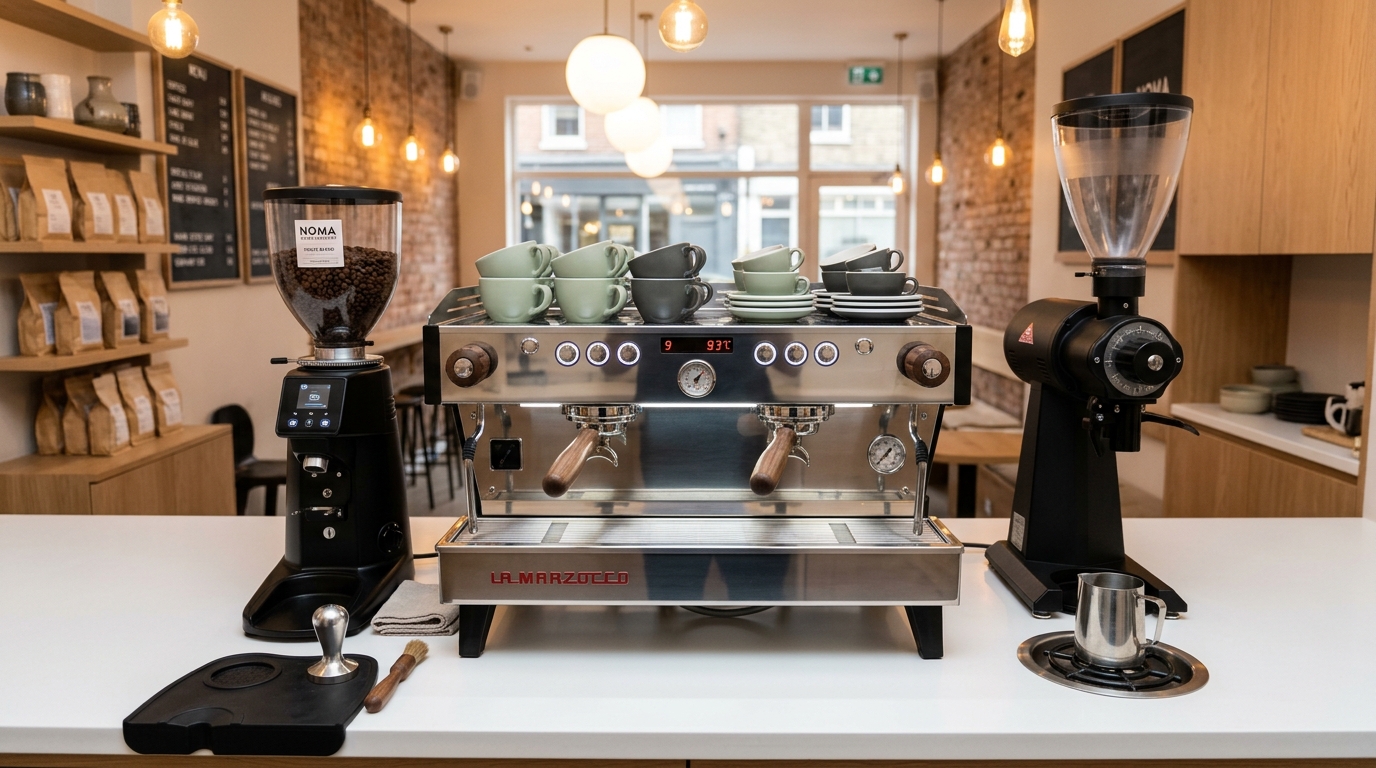
Opening an independent commercial coffee shop is one of the most rewarding entrepreneurial journeys in modern retail hospitality. You are not simply building a storefront; you are creating a vibrant community hub, an artisan sensory destination, and a daily ritual for hundreds of neighborhood regulars.
Yet, behind the aromatic steam, the curated Spotify playlists, and the pristine ceramic cups lies an uncompromising physical and financial reality: a commercial coffee shop is an industrial precision manufacturing facility masquerading as a cozy living room.
Every single business day, your cafe’s equipment infrastructure must:
- Boil and condition hundreds of gallons of municipal water to exact mineral tolerances.
- Pump hot pressurized water at 9 bars (130 PSI) thousands of times with sub-degree thermal stability.
- Shatter hundreds of pounds of brittle roasted coffee beans into microscopic, uniform particle distributions down to single-digit micron tolerances.
- Safely contain 250°F saturated steam and maintain 36°F dairy storage under strict FDA health inspections.
When an entrepreneur approaches equipment selection casually—buying mismatched residential machines on consumer credit cards, ignoring water filtration chemistry, or designing an inefficient bar layout—the business suffers immediate, chronic failures. Operating costs skyrocket, ticket times crawl past four minutes, equipment breaks down during peak weekend rushes, and cash reserves vanish.
Conversely, when an operator approaches equipment through the lens of rigorous systems engineering, the cafe operates as a frictionless, high-margin wealth generator.
This master playbook is the definitive, comprehensive blueprint for commercial coffee shop equipment engineering. Synthesizing hundreds of hours of field diagnostics, technical manufacturer bulletins, plumbing schematics, and financial models, this guide walks you through every stage of the commercial equipment lifecycle from initial lease signing to five-year asset replacement.
1. The Five Core Pillars of Commercial Coffee Engineering
To eliminate chaos and organize your capital expenditures, divide your entire operational footprint into five interdependent engineering systems.
+-------------------------------------------------------------------------+
|             THE FIVE PILLARS OF COMMERCIAL COFFEE ARCHITECTURE          |
+-------------------------------------------------------------------------+
|                                                                         |
|  [PILLAR 1: HYDRAULIC FOUNDATION & WATER ARCHITECTURE]                  |
|  - Reverse Osmosis with precision remineralization blending             |
|  - Water booster pumps, accumulator tanks, and backflow preventers      |
|  - SCA mineral targets: 75-150 ppm TDS, 3-4 grains hardness, 0 chloride |
|                                                                         |
|  [PILLAR 2: ESPRESSO CORE ENGINE & GRINDING MATRIX]                     |
|  - Saturated multi-boiler commercial espresso machines (2 or 3-group)  |
|  - Precision on-demand grinders (Grind-by-Weight / 65mm-83mm burrs)     |
|  - Automated precision tamping systems (Puqpress M-Series)              |
|                                                                         |
|  [PILLAR 3: BULK BATCH EXTRACTION & COLD BEVERAGE SUITE]                |
|  - Twin commercial batch brewers with cascading sprayheads              |
|  - Vacuum-insulated thermal servers (Luxus / ThermoFresh)               |
|  - Commercial nitro cold brew kegerators and draft dispensing towers    |
|                                                                         |
|  [PILLAR 4: REFRIGERATION, ICE & WAREWASHING METABOLISM]                |
|  - Under-counter reach-in refrigerators with front-breathing airflow    |
|  - Commercial nugget/cubelet ice makers with dedicated air gaps         |
|  - NSF 3-compartment sink, hand sinks, and in-counter pitcher rinsers   |
|                                                                         |
|  [PILLAR 5: POINT-OF-SALE, KDS & DIGITAL INFRASTRUCTURE]               |
|  - Ruggedized POS terminals with offline store-and-forward encryption   |
|  - Dual-station Kitchen Display Systems (KDS) with split-ticket routing |
|  - Roaming line-busting mobile handhelds for rush-hour acceleration     |
|                                                                         |
+-------------------------------------------------------------------------+
2. Master Capital Budget: The $65,000 Baseline Equipment Package
Below is the verified, itemized capital budget for a high-performance specialty coffee shop designed to process 400 to 600 transactions daily.
+-------------------------------------------------------------------------------+
|             MASTER COMMERCIAL COFFEE SHOP EQUIPMENT BUDGET (USD)              |
+-------------------------------------------------------------------------------+
| System Category                 | Recommended Commercial Equipment Spec       | Capital Cost (Delivered/Installed)|
|---------------------------------+---------------------------------------------+-----------------------------------|
| **Core Espresso Machine**       | La Marzocco Linea PB ABR (2-Group)          | \$24,500.00                       |
|                                 | *Multi-boiler, integrated scales, dual PID* |                                   |
| **Main Espresso Grinder**       | Mahlkönig E65S GBW (Grind-by-Weight)        | \$3,250.00                        |
| **Decaf / Single-Origin Grinder**| Mahlkönig E65S (Timed Dosing)               | \$2,350.00                        |
| **Automated Precision Tamper**  | Puqpress M3 (Under-grinder integrated)      | \$1,450.00                        |
| **Water Treatment Engine**      | OptiPure BWS350 Reverse Osmosis System      | \$4,200.00                        |
|                                 | *Dual membrane, remineralizer, 50-gal tank* |                                   |
| **Water Booster Pump System**   | Flojet 5000 Series + 2-Gallon Accumulator   | \$650.00                          |
| **Commercial Batch Brewer**     | FETCO CBS-2142XTS Twin 1.5-Gallon Brewer    | \$4,250.00                        |
| **Thermal Holding Servers**     | 4x FETCO Luxus L4D-15 1.5-Gallon Servers    | \$1,600.00                        |
| **Bulk Retail / Batch Grinder** | Mahlkönig EK43 S (98mm Cast Burrs)          | \$3,450.00                        |
| **Commercial Ice Machine**      | Hoshizaki 350-lb Nugget Ice Maker (Air-Cool)| \$3,800.00                        |
| **Under-Counter Refrigeration** | True TUC-48 Solid Door Reach-In             | \$3,400.00                        |
| **Back-Bar Milk Storage Fridge**| True T-23 Single Door Commercial Refrigerator| \$2,800.00                        |
| **In-Counter Pitcher Rinsers**  | 2x Krome Side-Spray Rinsers with Actuators  | \$450.00                          |
| **Nitro Cold Brew Kegerator**   | Kegco Dual-Tap Commercial Draft Kegerator   | \$2,200.00                        |
| **Commercial Blending Station** | Vitamix The Quiet One (Commercial In-Counter)| \$1,450.00                        |
| **Point-of-Sale & KDS Setup**   | Toast Flex Terminal + 22" Commercial KDS    | \$3,200.00                        |
| **Barista Smallwares Package**  | Acaia scales, VST baskets, pitchers, mats   | \$1,850.00                        |
| **Certified Technician Install**| Uncrating, bench-testing, plumbing/electric | \$2,200.00                        |
| **Emergency Spare Parts Kit**   | Gaskets, screens, solenoids, valves, tools  | \$550.00                          |
|---------------------------------+---------------------------------------------+-----------------------------------|
| **TOTAL TURNKEY CAPITAL ASSET** |                                             | **\$67,950.00**                   |
+-------------------------------------------------------------------------------+
3. The 12-Month Pre-Opening Master Equipment Timeline
Procuring and commissioning commercial espresso machinery is not like buying office supplies on Amazon. Equipment lead times, custom manufacturing schedules, municipal utility upgrades, and health inspections require strict scheduling discipline.
+-------------------------------------------------------------------------+
|                  12-MONTH PRE-OPENING EQUIPMENT ROADMAP                 |
+-------------------------------------------------------------------------+
|                                                                         |
|  MONTH 12 - 10: LEASE NEGOTIATION & UTILITY AUDIT                       |
|  - Audit electrical panel: Verify 200A 3-phase service (208V/240V).     |
|  - Audit plumbing infrastructure: Verify 3/4" water main, 45 PSI static |
|    pressure, and dedicated floor sink drain locations.                  |
|  - Send municipal water sample to laboratory for professional SCA assay.|
|                                                                         |
|  MONTH 9 - 7: ARCHITECTURAL CAD LAYOUT & EQUIPMENT SPECS                |
|  - Design counter layout adhering to the 180° Zero-Step Production Cell.|
|  - Lock in equipment specification cut sheets for architects/engineers. |
|  - Issue Request for Proposal (RFP) to local authorized equipment dealers|
|                                                                         |
|  MONTH 6 - 5: EQUIPMENT ORDER PLACEMENT & FINANCING                     |
|  - Execute equipment financing agreement or release capital deposits.   |
|  - Place factory orders for espresso machines (account for 16-week lead)|
|  - Apply for local municipal health department plan review permits.     |
|                                                                         |
|  MONTH 4 - 3: ROUGH-IN MEP (MECHANICAL, ELECTRICAL, PLUMBING)           |
|  - Plumbers install floor drains, backflow preventers, and RO lines.    |
|  - Electricians install NEMA twist-lock receptacles and sub-panels.     |
|  - Order POS terminals and Kitchen Display hardware.                    |
|                                                                         |
|  MONTH 2: BENCH-TESTING & LOCAL RECEIVING                               |
|  - Equipment arrives at local dealer facility for 48-hour bench testing.|
|  - Dealer uncrates, tests for infant mortality, calibrates PIDs.        |
|  - Assemble $400 Emergency Spare Parts Tackle Box and technician toolkit|
|                                                                         |
|  MONTH 1: ON-SITE INSTALLATION & WATER SIGN-OFF                         |
|  - Certified technicians install water RO system, espresso core, brewers|
|  - Chemical water testing performed; warranty validation signed.        |
|  - Barista team initiates 2-week recipe programming and stress testing. |
|                                                                         |
|  DAY 0: GRAND OPENING (FLAWLESS SERVICE LAUNCH!)                        |
|                                                                         |
+-------------------------------------------------------------------------+
4. The 10 Inviolable Rules of Commercial Coffee Engineering
Throughout this technical encyclopedia, we have examined every mechanical subsystem of the commercial coffee bar. Memorize and enforce these ten non-negotiable engineering principles:
+-------------------------------------------------------------------------+
|             THE 10 COMMANDMENTS OF COMMERCIAL COFFEE ENGINEERING        |
+-------------------------------------------------------------------------+
|                                                                         |
|  [RULE 1] WATER IS KING: Never connect an espresso machine to raw       |
|           untreated city water. Install Reverse Osmosis with mineral    |
|           blending, targeting 100 ppm TDS, 3 grains hardness, 0 chloride|
|                                                                         |
|  [RULE 2] ZERO-STEP ERGONOMICS: A barista must never take more than one |
|           step to reach espresso, grinders, milk, ice, and rinsers.     |
|                                                                         |
|  [RULE 3] NEVER BUY ONLINE DROP-SHIP: Purchase core machines through    |
|           authorized local dealers who bundle 1-year labor warranties   |
|           and 48-hour pre-delivery workshop bench-testing.              |
|                                                                         |
|  [RULE 4] RESPECT THE 80% ELECTRICAL LIMIT: Never load an electrical   |
|           circuit or generator past 80% of its rated continuous capacity|
|                                                                         |
|  [RULE 5] BANISH VULCANIZED RUBBER: Replace black NBR grouphead gaskets |
|           with food-grade FDA platinum silicone gaskets on Day One.     |
|                                                                         |
|  [RULE 6] LEVELNESS TRUMPS TAMP PRESSURE: Ditch manual hand tamping.    |
|           Install automated precision tampers (Puqpress) to eliminate   |
|           barista wrist RSI injuries and eliminate channeling gushers.  |
|                                                                         |
|  [RULE 7] INSULATE ALL BOILERS: Wrap bare steam and brew boilers in     |
|           thermal jackets to cut electric bills by 35% and reduce HVAC. |
|                                                                         |
|  [RULE 8] MAINTAIN THE 10% SINKING FUND: Automatically transfer 10% of  |
|           equipment asset value into a segregated capital reserve bank  |
|           account every single month.                                   |
|                                                                         |
|  [RULE 9] STOCK THE $400 EMERGENCY BOX: Keep spare solenoids, vacuum    |
|           breakers, capacitors, and gaskets locked on-site for 10-minute|
|           weekend triage repairs.                                       |
|                                                                         |
|  [RULE 10] BATCH BREW IS YOUR PROFIT ANCHOR: Pair high-recovery twin    |
|            brewers with vacuum thermal servers to fuel a 90% margin     |
|            drip program that subsidizes cafe labor.                     |
|                                                                         |
+-------------------------------------------------------------------------+
5. Comprehensive Cross-Disciplinary Knowledge Hub
Every phase of commercial equipment engineering explored in this master playbook is detailed in our dedicated technical manuals. Explore our specialized guides to master each discipline:
Category: Commercial Espresso Machinery
- Best 2-Group Commercial Espresso Machines (2026 Buyers Guide)
- Best 3-Group Commercial Espresso Machines for High-Volume Bars
- Multi-Boiler vs Heat Exchanger (HX) Commercial Espresso Machines
- Commercial Flow Profiling & Pressure Profiling Espresso Machines
- Low-Profile Commercial Espresso Machines & Undercounter Systems
- Commercial Super-Automatic Espresso Machines: High-Volume Guide
- Buying Used Commercial Espresso Machines: 50-Point Inspection
- La Marzocco vs Nuova Simonelli: Commercial Machine Shootout
- Slayer Espresso vs Synesso S200: American Craft Showdown
- Eversys Enigma vs Franke A1000: Ultra-Premium Super-Automatic Shootout
- Best Compact Commercial Espresso Machines for Mobile Coffee Carts
Category: Grinders & Particle Sizing
- Commercial Espresso Grinders: On-Demand vs Doser Mechanisms
- Commercial Bulk Retail & Cupping Grinders: EK43 vs Competitors
- Commercial Grinder Burr Replacement & Precision Alignment Guide
- Mazzer Major V vs Mahlkönig E65S: High-Volume Grinder Shootout
- Puqpress & Automatic Precision Tampers vs Manual Tamping
Category: Water Chemistry & Maintenance Engineering
- Commercial Coffee Water Filtration: Reverse Osmosis vs Systems
- Reverse Osmosis with Remineralization vs Ion-Exchange Systems
- Commercial Coffee Water Testing & SCA Mineral Standards
- Commercial Espresso Boiler Descaling: Preventive Chemical Protocol
- Water Pressure Booster Pumps & Accumulator Tanks for Espresso
- OptiPure vs Everpure vs 3M: Commercial Water Filtration Comparison
- Commercial Espresso Machine Cleaning: Daily CIP Chemical Guide
- Commercial Espresso Grouphead Rebuild: Gaskets, Screens & Solenoids
- Commercial Steam Wand Rebuild & Vacuum Breaker Maintenance Guide
- Mobile Coffee Cart Electrical & Plumbing: Generators, Inverters & Water
Category: Barista Workflow & Beverage Production
- Coffee Shop Bar Layout & Workflow Design: Ergonomic Speed Guide
- Commercial Batch Brewers: FETCO vs Bunn vs Curtis Comparison
- Commercial Batch Brew Extraction Physics: Yield, TDS & Ratios
- Single-Cup Pour-Over Bar Setup: Modbar vs Marco vs Manual Rails
- Commercial Cold Brew & Nitro Coffee Kegging Systems Guide
- Commercial Under-Counter Refrigeration: Door vs Drawer Guide
- Automated Milk Dispensing Systems: The Juggler vs Under-Counter Taps
- Alternative Milk Steaming Physics: Oat, Almond & Soy Microfoam
- Commercial Pitcher Rinsers & Countertop Drainage Plumbing
- Commercial Ice Machine Sizing & Water Filtration for Coffee Bars
- Drive-Thru Coffee Shop Equipment Engineering & Speed Layout
- Bunn ICB Twin vs FETCO CBS-2141XTS: Batch Brewer Comparison
Category: Financial Planning, Leasing & Risk Management
- How to Open a Coffee Shop Equipment Checklist (2026 Blueprint)
- Commercial Espresso Machine Electrical & Plumbing Guide
- Coffee Shop Startup Equipment Budget: Real Costs (2026)
- Commercial Coffee Equipment Leasing vs Financing Guide
- The $400 Commercial Coffee Shop Emergency Spare Parts Kit
- Coffee Shop Equipment ROI & Cost-Per-Cup Unit Economics Guide
- Commercial Coffee Equipment Depreciation & Maintenance Reserve Funds
- Buying Direct Online vs Local Equipment Dealers: Cost Analysis
- Commercial Coffee Shop Insurance: Boiler Breakdown & Equipment Riders
- Commercial Espresso Machine Energy Consumption & Utility Costs
- Coffee Shop POS Hardware & KDS Architecture: Toast vs Square vs Revel
6. The Commercial Pre-Flight Launch Verification Audit
Before you flip the sign on your front door from “COMING SOON” to “OPEN,” execute this comprehensive, 40-point technical commissioning audit with your lead technician and general manager.
+-------------------------------------------------------------------------+
|             COMMERCIAL COFFEE SHOP PRE-FLIGHT COMMISSIONING AUDIT       |
+-------------------------------------------------------------------------+
|                                                                         |
|  [PHASE 1: ELECTRICAL & UTILITY SAFETY]                                 |
|  [ ] 1. Main voltage measured under load across all 220V legs (208-240V)|
|  [ ] 2. Ground-fault circuit interrupters (GFCI) tested on wet stations |
|  [ ] 3. Type 2 Surge Protective Device (SPD) active in subpanel         |
|  [ ] 4. Dedicated breakers labeled clearly for all major machinery      |
|                                                                         |
|  [PHASE 2: WATER TREATMENT & HYDRAULIC VALIDATION]                      |
|  - [ ] 5. Raw water hardness tested via titration kit (<5 gpg target)   |
|  - [ ] 6. Product water TDS verified with digital meter (75-150 ppm)    |
|  - [ ] 7. Chloride level tested with chemical reagent (must be 0.0 ppm) |
|  - [ ] 8. Dynamic water pressure under full boiler refill (>35 PSI)     |
|  - [ ] 9. Accumulator tank pre-charge confirmed at 25 PSI               |
|  - [ ] 10. Automatic electronic flood-shutoff valve sensor tested       |
|                                                                         |
|  [PHASE 3: ESPRESSO CORE COMMISSIONING]                                 |
|  - [ ] 11. Saturated grouphead temperatures calibrated via Scace device |
|  - [ ] 12. Expansion valve (OPV) set to 9.0 bars against blind basket   |
|  - [ ] 13. Saturated group silicone gaskets holding 100% seal at 9 bars |
|  - [ ] 14. 3-Way solenoid exhaust clean with zero continuous weeping    |
|  - [ ] 15. Vacuum breaker closing cleanly without morning sputtering   |
|  - [ ] 16. Steam boiler pressure stable at 1.4 to 1.6 bars             |
|                                                                         |
|  [PHASE 4: GRINDING & DOSING ACCURACY]                                  |
|  - [ ] 17. Burr carriers checked for parallelism via marker wipe test   |
|  - [ ] 18. Grind-by-weight load cells calibrated with 100g test weight  |
|  - [ ] 19. 10 consecutive doses weighed; standard deviation < 0.2g      |
|  - [ ] 20. Automated tamper (Puqpress) set to 20kg; piston face clean   |
|                                                                         |
|  [PHASE 5: BATCH BREW & DISPENSING]                                     |
|  - [ ] 21. Water sprayheads delivering uniform rainfall across basket   |
|  - [ ] 22. Brew temperature verified at 200°F ($\pm 1^\circ\text{F}$)   |
|  - [ ] 23. Pulse brewing intervals programmed and tested with dry bed   |
|  - [ ] 24. Thermal dispensers holding coffee >175°F at 3-hour mark      |
|                                                                         |
|  [PHASE 6: REFRIGERATION & COLD CHAIN]                                  |
|  - [ ] 25. Milk reach-in holding steady 36°F (verified by data logger)  |
|  - [ ] 26. Front-breathing refrigeration condenser coils vacuumed clean |
|  - [ ] 27. Ice machine producing clear nugget ice; air gap drain secure |
|  - [ ] 28. In-counter pitcher rinsers draining cleanly with zero pooling|
|                                                                         |
|  [PHASE 7: POINT-OF-SALE & KITCHEN ROUTING]                             |
|  - [ ] 29. POS terminals communicating on dedicated PCI-compliant VLAN  |
|  - [ ] 30. Offline payment mode (store-and-forward) tested and verified |
|  - [ ] 31. KDS kitchen displays routing hot drinks to espresso station  |
|  - [ ] 32. Handheld line-busting mobile tablets synced to Wi-Fi mesh   |
|                                                                         |
|  [PHASE 8: RISK MANAGEMENT & OPERATIONAL RESERVES]                      |
|  - [ ] 33. $400 Emergency Spare Parts Tackle Box fully stocked & locked |
|  - [ ] 34. Equipment Breakdown Insurance Rider confirmed active         |
|  - [ ] 35. Local service technician SLA contract executed with 2-hr SLA |
|  - [ ] 36. 10% Maintenance Sinking Fund bank account established        |
|  - [ ] 37. Material Safety Data Sheets (MSDS) on file for cleaning chems|
|  - [ ] 38. Closing barista CIP backflushing SOP laminated on bar wall   |
|  - [ ] 39. Milk steam wand sanitizing chemical protocol trained to staff|
|  - [ ] 40. Shift supervisor emergency triage decision tree memorized    |
|                                                                         |
+-------------------------------------------------------------------------+
Conclusion: The Architecture of Excellence
In the final analysis, great coffee is not an accident of passion; it is the predictable output of sound engineering, disciplined maintenance, and unyielding respect for the physics of extraction.
When you equip your coffee shop with the principles laid out in this master playbook:
- You protect hundreds of thousands of dollars in capital investments.
- You eliminate the stress of chaotic equipment breakdowns during peak rushes.
- You empower your barista team to craft transcendent beverage experiences that build passionate community loyalty.
- You anchor your business on the rock-solid unit economics required to achieve lasting, multi-decade commercial profitability.
Welcome to the craft of commercial coffee engineering. Measure twice, brew with precision, and build something extraordinary.
Frequently Asked Technical Questions
How much does a complete commercial coffee shop equipment package cost in 2026?
For a medium-volume independent specialty coffee shop (1,200 to 1,800 square feet, seating 25 to 40 guests), a complete, professional-grade commercial equipment package costs between $55,000 and $85,000 delivered and installed. This encompasses: a 2-group commercial multi-boiler espresso machine ($18,000-$26,000), dual on-demand grinders ($4,500-$6,500), reverse osmosis water treatment with remineralization ($3,500-$5,500), twin commercial batch brewer and thermal servers ($4,000-$5,500), commercial under-counter ice machine ($3,500-$4,800), commercial refrigeration units ($6,000-$9,000), point-of-sale hardware ($2,500-$4,000), and smallwares and barista tools ($3,000-$4,500).
What is the single most critical infrastructure requirement for a coffee shop build-out?
Water treatment and municipal water filtration is the single most critical infrastructure requirement. Over 70% of all premature commercial espresso machine failures, heating element burnouts, and warranty rejections are caused by improper water quality (calcium carbonate scaling or chloride corrosion). Installing an engineered Reverse Osmosis system with active mineral blending before turning on your machinery is non-negotiable for protecting your capital assets.
How far in advance of opening should commercial coffee equipment be ordered?
Commercial equipment should be formally ordered 16 to 24 weeks (4 to 6 months) prior to your projected grand opening. Premium European and American handcrafted espresso machines (La Marzocco, Slayer, Synesso, Victoria Arduino) carry factory build lead times of 8 to 16 weeks, compounded by oceanic freight transit, custom electrical lead times, and local technician bench-testing.
Should a startup cafe lease or purchase its commercial coffee equipment?
If the business has sufficient equity capital, purchasing outright (or using an equipment financing agreement with Section 179 tax deductions) delivers the lowest total cost of ownership. However, if upfront liquidity is tight, a Fair Market Value (FMV) or $1 Buyout Equipment Lease preserves precious working cash reserves for opening inventory, payroll buffer, and marketing, allowing the machinery to generate revenue while paying for itself in fixed monthly installments.
What electrical service must be confirmed before signing a commercial cafe lease?
Before signing a commercial retail lease, verify that the building has a minimum of 200-Amp, 120/208V or 120/240V 3-phase electrical service panel (400-Amp recommended if incorporating high-speed ovens and extensive refrigeration). Upgrading an undersized 100-Amp residential panel to commercial 3-phase service requires utility transformer upgrades that can cost between $12,000 and $35,000 and delay your opening by 6 to 9 months.